Tech
How to Build AI Software That Detects and Prevents Fraud in Real Time
 9 min read
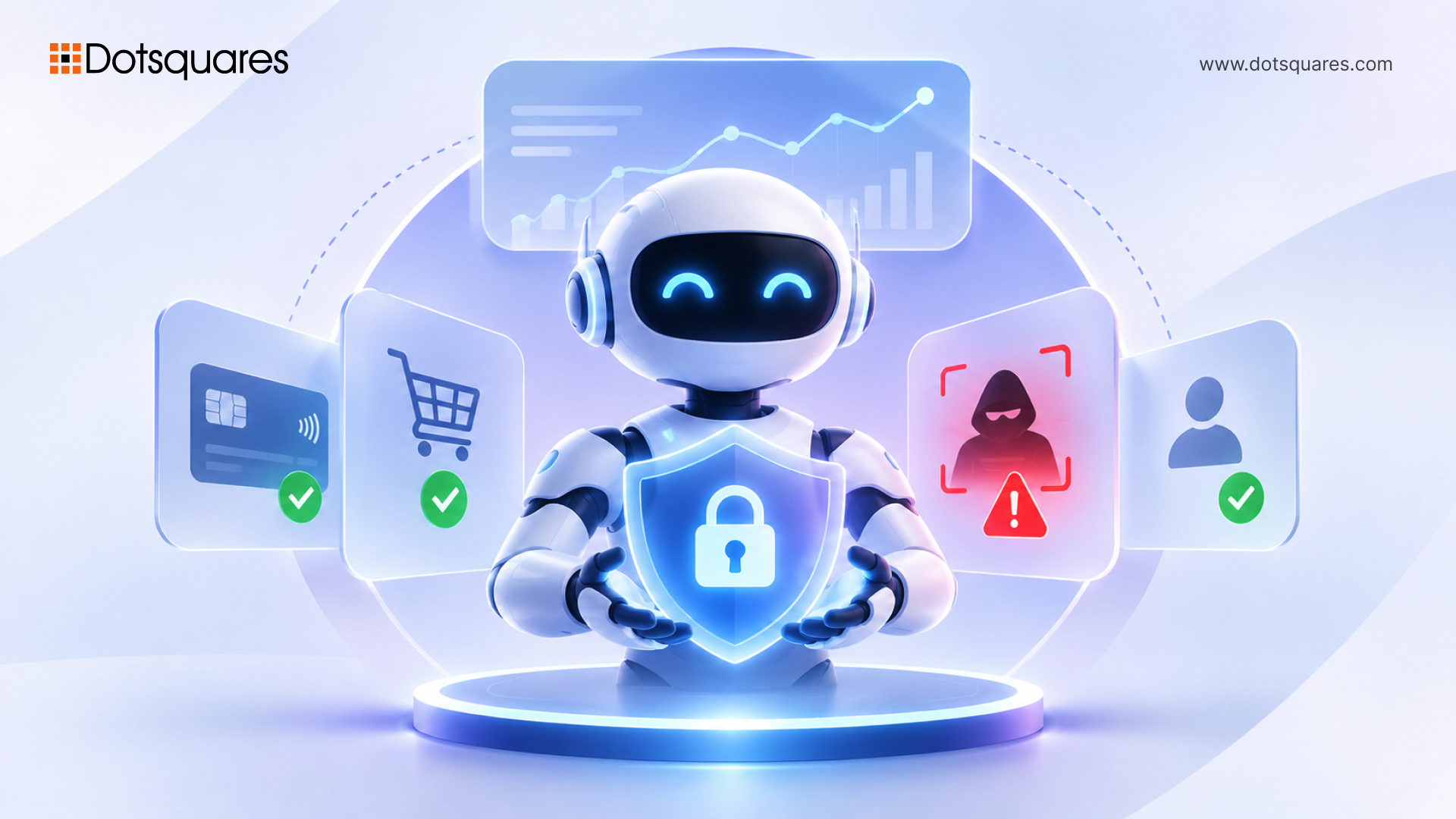
A fraudulent card transaction completes in under two seconds. An account takeover can drain an account before the holder even sees the login notification. So when businesses ask how to build AI software that detects and prevents fraud, the word that matters most in that sentence is "real time." A system that flags fraud eight hours later is an expensive reporting tool, not a protection layer.
ML-based fraud detection software now catches 2–3x more fraud at the same false positive rate as rules-based systems (McKinsey Global Institute). Deloitte's 2025 research found AI-driven systems cut false positives by 50–70%. Organisations with AI in place detect fraud roughly 18 months sooner (ACFE 2025). The question is, how do you actually build one?
What Is Real-Time Fraud Detection and Prevention with AI?
Real-time fraud detection means your system scores every transaction, login, or account event as it happens, in milliseconds, and decides whether to approve, flag, or block it. Leading implementations do this in under 100ms (Gartner 2025).
Real-time fraud prevention goes one step further: it acts on that score automatically, blocking the transaction, triggering step-up authentication, or locking the account, all within the same window. Detection tells you something's wrong. Prevention stops it before it completes.
What makes AI different from traditional rules? Rules are static, "flag transactions over £2,000 from a new device." AI asks whether this specific user, at this time, on this device, in this location, is behaving like themselves. That context is what catches fraud a rule would miss and approves the legitimate transaction a rule would block.
Why Businesses Need AI-Powered Fraud Detection Now
The scale alone makes the case. Global e-commerce fraud losses hit $48 billion in 2025 and are heading for $107 billion by 2029 (Juniper Research). Account takeover losses jumped from $13B in 2024 to $17B in 2025 (Sift). Fintech attack rates rose 122% year over year in Q2 2025.
- $48B global e-commerce fraud losses in 2025 (Juniper Research)
- 50–70% fewer false positives with ML vs rules-based systems (Deloitte 2025)
- 18 months sooner fraud detected at AI-enabled organisations (ACFE 2025)
US merchants pay $4.61 for every $1 lost to fraud once chargebacks, investigation time, and declined legitimate customers are counted (LexisNexis 2025). The AI fraud detection market was valued at $54.61B in 2025 and is projected to reach $67.12B in 2026 (Fortune Business Insights). To see why financial institutions specifically are moving fast here, read more on how AI is reshaping secure digital banking.
How Does AI Detect Fraud in Real Time?
AI creates a model for what “normal” is for each individual or transaction type, and any deviation is marked. These are the methods:
- Supervised learning - based on labeled past data (known cases of fraud and non-fraud). Efficient when you have sufficient number of examples of a particular type of fraud.
- Anomaly / unsupervised detection - identifies transactions outside of the known normal pattern and does not require any labeled examples of fraud. Helps detect new fraudulent approaches that would be unknown to supervised algorithms.
- Behavioral AI - analyzes user behavior on your platform (typing patterns, session duration, device fingerprinting). According to Deloitte 2025, behavioral AI helped to detect account takeover with 91% accuracy and less than 5% false positives.
- Graph analytics - establishes relationships between different entities (accounts, devices, IPs, payment instruments). Helps detect organized fraud schemes that are impossible to identify by single transaction analysis only.
Core Components of an AI Fraud Detection System
A correctly designed fraud detection system must have these layers. Developing effective fraud detection requires AI & ML Solutions that combine machine learning models, real-time data processing, and automated decision-making to identify suspicious activity. :
- Real-time scoring engine – analyzes the event using the trained models and outputs a risk score in less than a second.
- ML model layer – combination of supervised, unsupervised and behavioral models, not an algorithm.
- Rules and decision management – configurable thresholds, velocity controls, whitelists/ blacklists together with the ML layer.
- Data pipeline – consolidates transactional, device, behavioral, and KYC data in real time. The intelligent model with wrong data will generate bad decisions, and this layer is the most challenging one to implement.
- Case management – the place for the human analysts to examine the flagged event, having evidence timeline and entity profile available.
- Model governance and explainability – reason codes, audit trails, drift detection, and retraining process. A model that works well today may not work in six months.
How to Build AI Software That Detects and Prevents Fraud: Step-by-Step
- Fraud scope and risk model definition. Payment fraud, account takeover, identity fraud, AML, chargeback fraud – and the solution requires different input data, different machine learning models training, and different latency requirements.
- Prepare your data for auditing. You need labelled historical fraud data, clean transaction data, and behavioural data if possible. Low data quality leads to a high rate of false positives – exactly the problem you are trying to solve.
- Develop and train the ML models. Python, TensorFlow, PyTorch, Scikit-learn. Train multiple architectures and combine them – using both supervised and unsupervised ML models allows for coverage of known and unknown fraud types. Visa's fraud detection solution analyses over 500 data points for every authorisation.
- Develop real-time inference engine. Apache Kafka for stream processing, Redis for feature lookup, container-based model serving on AWS/GCP/Azure for transaction-level inference (under 100 milliseconds).
- Implement rules, case management, governance. The ML layer produces risk score – the rules define what to do about it. Case management provides everything necessary for an analyst. Governance guarantees transparency of decisions.
- Testing, deployment, monitoring, re-training. Pre-deployment testing on unseen data. Shadow mode before the cutover. Post-deployment: continuous monitoring of false positive rate and drift of ML models.
Best Tech Stack for Real-Time Fraud Detection Software
|
Layer |
Tools / Technologies |
|
ML / AI frameworks |
Python, TensorFlow, PyTorch, Scikit-learn, XGBoost |
|
Real-time event streaming |
Apache Kafka, Apache Flink |
|
Low-latency feature store |
Redis, Feast |
|
Model serving / inference |
TensorFlow Serving, Triton, BentoML |
|
Cloud infrastructure |
AWS SageMaker, Google Vertex AI, Azure ML |
|
API layer |
FastAPI, REST, GraphQL |
|
Database |
PostgreSQL, MongoDB, ClickHouse (analytics) |
|
Orchestration |
Kubernetes, Docker |
How to Reduce False Positives in AI Fraud Detection
False positives are a silent revenue killer. Rules-only systems run 70–80% false positive rates (Journal of Financial Crime, 2025). Well-tuned ML brings that to 12–18%. Here's how:
- Train on balanced data. Use oversampling (SMOTE) to avoid models that over-flag rare events.
- Use behavioural context. A £3,000 transaction at 2am reads very differently for a regular business traveller versus a new user.
- Tune by risk tier. Soft declines and step-up authentication sit between approve and block, use them to catch fraud without refusing legitimate customers.
- Build in feedback loops. When analysts overturn decisions, that's labelled training data. Wire it into case management from day one.
Build vs. Buy: Custom AI Fraud Detection or Off-the-Shelf?
Fraud detection systems off-the-shelf will work fine for low risk applications and standard scenarios, but their models are trained using generic data and they do not explain their scoring decision-making process – a significant drawback in terms of regulatory compliance and communicating with customers.
Custom AI fraud prevention software, built on your data and tuned to your risk profile, outperforms generic solutions at scale. McKinsey puts the ROI at 4.50–6.00 per $1 invested over three years for mature custom programmes. Dotsquares' expert team handles exactly this, from data architecture through deployment, within a broader custom software development capability for seamless platform integration.
Industry Use Cases of AI Fraud Detection
- Financial services: Transaction fraud, AML monitoring, account takeover, synthetic identity detection. JPMorgan scores 40+ real-time attributes per transaction. Visa's AI prevents roughly $40B in fraud annually. More on AI fraud detection in banking.
- Retail and e-commerce: Payment fraud, chargeback fraud (friendly fraud represents 36% of all fraudulent activities worldwide, Merchant Risk Council), loyalty point fraud, promotion abuse.
- Insurance industry: Claim fraud, exaggerated or false claims, uncovered by recognizing patterns in claim history and car repair facilities.
- Healthcare: Billing fraud, prescription fraud, identity fraud. Anomaly detection on billing codes surfaces schemes manual audits miss at scale.
- Marketplaces and Ride Hailing: Driver fraud, refund fraud, seller fraud, behavioral analytics, and graph analytics are better suited when the fraud is based on a sequence of individually credible activities.
Compliance, Security, and Explainable AI
Explainability is not an option in any industry that has regulations. With GDPR, PSD2, and financial services adverse action requirements, it means that your system must justify why a transaction was flagged by giving reasons understandable for the customer or regulator. SHAP values, LIME, and reason codes convert model outputs into understandable reasons ("new device; abnormal location; transaction exceeding limits"). It is much easier to do that from the beginning than retrofitting at a later stage.
Your actual system also needs to be secured. Model inversion attacks, adversarial input attacks, and data poisoning attacks are real threats to your AI fraud detection infrastructure, consider your model to be something you need to secure as well as your data.
Frequently Asked Questions
How long does it take to build AI fraud detection software?
The timeline for a custom build is 4 to 9 months depending on the scope and the cleanliness of the fraud data in your current dataset. Data processing and model training take most of the time not the actual development.
What data does AI fraud detection software need?
At least: transactional historical data with labels, user account data and device/IP data. Behavioral data (user sessions and navigation patterns, device fingerprinting) helps a lot to make the prediction more accurate, especially in account takeovers.
What's the difference between fraud detection and fraud prevention in AI systems?
Fraud detection is when you identify that there is some fraud. Fraud prevention is when you do something about it, preventing the transaction or asking for re-authentication before the fraud happens, in the same millisecond.
Is custom AI fraud detection better than off-the-shelf?
If you have significant transaction volumes or compliance needs, custom always beats generic, since the latter has no access to your users' behavior data and cannot train the model accordingly. McKinsey estimates the ROI at 4.50-6.00 dollars for every dollar spent over 3 years.
How much does it cost to build AI fraud detection software?
The price depends on the scope of the project, types of fraud detection required, integration complexity, inference size, and compliance requirements. A one-vector MVP solution is quite a different project compared to full-stack solution. The best way to start is a scoping discussion.


Related Post
 November 06, 2026
CMDB 360: Bringing Multisource CI Data Together
Learn what ServiceNow CMDB 360 is, how it compares CI data from multiple sources, how IRE and reconciliation rules work, and how to enable and use it.
Keep Reading November 06, 2026How to Build AI Software That Detects and Prevents Fraud in Real Time
Learn how to build AI software that detects and prevents fraud in real time, covering architecture, ML models, tech stack, compliance and costs.
Keep Reading November 05, 2026
From Data to Decisions: An End-to-End Data Engineering Success Story
Explore how Dotsquares built an end-to-end data engineering solution using Microsoft Fabric and Power BI to automate data pipelines and improve booking analytics.
Keep Reading