Tech
Headless Commerce vs Traditional E-commerce: What Businesses Need to Know
 9 min read
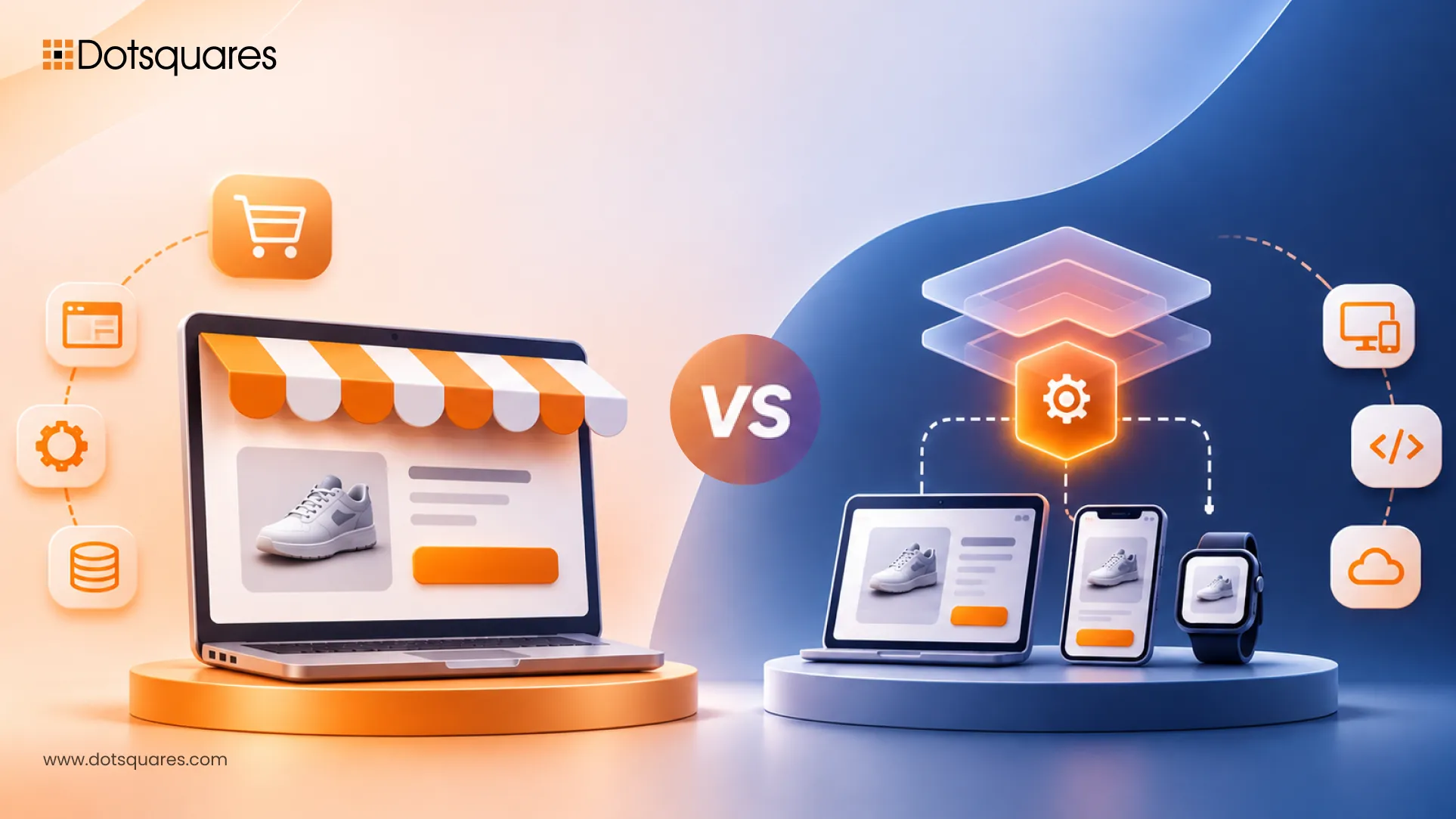
The way online stores are built has changed significantly, and so has the conversation around which architecture a business should choose. For years, the traditional approach, a single, tightly coupled platform handling everything from the storefront to the backend, was the only real option. Now, headless e-commerce development has moved from an enterprise curiosity into a mainstream decision that businesses of all sizes are actively evaluating.
It's not about who sounds more contemporary. The real question is who meets the requirements of business operation. Dotsquares assists companies of various industries in making the right choice in terms of our comprehensive e-commerce development solutions, which include headless e-commerce development for businesses in need of a decoupled architecture solution. Here is how we differentiate the two concepts.
What Is the Difference Between Headless Commerce and Traditional E-commerce?
In a traditional e-commerce architecture, the front end (user interface) and the back end (product inventory, prices, checkout rules, and orders management) are tightly coupled as one integrated solution. The design of the site (theme or template) defines the appearance, and the e-commerce platform defines the functionality of the application. It's all connected, which makes it simple to implement initially but difficult to customize.
In a traditional e-commerce architecture, the front end (user interface) and the back end (product inventory, prices, checkout rules, and orders management) are tightly coupled as one integrated solution. The design of the site (theme or template) defines the appearance, and the e-commerce platform defines the functionality of the application. It's all connected, which makes it simple to implement initially but difficult to customize.
Headless and Traditional E-commerce Compared for Businesses
|
Factor |
Traditional E-commerce |
Headless Commerce |
|
Architecture |
Front end and back end tightly coupled |
Front end and back end decoupled via API |
|
Customisation |
Limited by platform constraints |
Full control over front-end experience |
|
Speed to launch |
Faster initial setup |
Longer build time, more investment upfront |
|
Multichannel delivery |
Primarily web-focused |
Web, mobile app, IoT, voice, any channel |
|
Developer dependency |
Lower, platform handles most updates |
Higher, front-end changes need dev resource |
|
Cost |
Lower upfront and ongoing |
Higher implementation cost ($2.6M avg for enterprise) |
|
Scalability |
Can hit platform limits at scale |
Scales independently on each layer |
What Are the Business Benefits and Challenges of Headless Commerce?
Let's check what headless commerce actually delivers, and where it creates real complexity.
The improvements are quantifiable. Organizations who have made the transition to headless systems find they are able to make changes to their storefronts much more quickly: 77% claim they can do so much quicker since the move, compared to just 34% of those who could manage it on a non-headless platform. New campaigns, promotions and landing pages come out much quicker. That is quite an advantage in itself.
The metrics confirm the same thing. Headless websites tend to experience improvements of between 20% to 50% in terms of page load speeds, with mobile Largest Contentful Paint taking just 1.5 seconds compared to 2.4 on a traditional platform, a 38% reduction. Each extra second of load time reduces conversion rate by about 2%.
Adoption is accelerating. The global headless commerce market is projected to reach $2.1 billion by the end of 2026 and $7.24 billion by 2033, growing at a 22.6% CAGR. Around 73% of businesses have already implemented some form of headless architecture.
These are very real problems, and deserve some serious discussion. The typical cost for headless implementations is $2.6 million. They need constant developer involvement for front end maintenance. Data migrations in this domain run over budget or deadline in 80% of cases without adequate planning. And data migrations without server-side rendering could result in an instant 30% drop in organic traffic. But they are not reasons to evade headless technologies – quite the contrary.
Is Headless Commerce Better for Website Performance, SEO and Customer Experience?
For performance and customer experience, yes, when done right. Faster load times, smoother interactions, and the ability to deliver consistent experiences across web, app and other channels all improve with headless architecture. Choosing the right e-commerce platform is part of getting that right, because not every headless platform is equal in how it handles performance out of the box.
Regarding SEO, things get a little more complicated. Headless allows the developer total freedom over the layout, meta data, Core Web Vitals and URL structure – factors that are all important in terms of search. However, this freedom is a double-edged sword: one of the most frequent reasons behind major loss of organic traffic when using a headless setup is improper server-side rendering. Provided that there’s an appropriate technical solution applied, headless commerce will have better SEO than traditional platforms and vice versa.
What Is the Difference Between Headless Commerce and a Headless CMS?
This is one of the most commonly confused comparisons in the space, and it matters for businesses making architecture decisions. So we've now read how headless commerce works; let's check how a headless CMS fits into the picture differently.
A headless CMS manages content, blog posts, landing pages, marketing copy, media, and delivers it via API to front end consumers. It has no commerce functionality built in. It doesn't handle products, pricing, cart logic or payment processing. It's purely a content management and delivery layer.
Headless commerce versus headless CMS is not an exclusive choice because they perform different roles and often are combined. A company may have its headless commerce architecture (handling products and payments) and a separate headless CMS (handling editorial and campaign pages), both feeding their contents through an API to the same front end. Such combination allows total freedom to tailor both buying and editorial experiences with no restrictions from either system imposed on the other.
When Should a Business Choose Headless or Traditional E-commerce?
Traditional vs headless ecommerce isn't a question with one universal answer. It's a question about what a specific business actually needs to accomplish. The 2026 picture shows headless architecture moving firmly into the mainstream, but mainstream adoption doesn't mean it's right for every business at every stage.
E-commerce of the traditional kind makes perfect sense in situations where time-to-market is of utmost importance, the product catalog and customer journey are uncomplicated, there is no available front-end development resource within the team, and budget constraints apply to implementation. Shopify, WooCommerce, and BigCommerce in their out-of-the-box versions are reliable, have good support and are truly able to do the job in most online retail scenarios. When trying to grasp the power of a platform such as BigCommerce, it might be worthwhile having a closer look at BigCommerce features.
Headless commerce is a solution that works well if the business needs to provide a seamless experience through various channels, such as web, mobile application, in-store kiosk, or voice from one back-end system. Headless commerce is also a viable solution if existing platform limitations are currently holding the team back, there are additional complexities associated with international or B2B commerce that require custom commerce logic, or conversion rate improvements make it worth the cost.
What Should Businesses Consider Before Investing in Headless E-commerce Development?
Before committing to headless e-commerce development, there are a few practical questions worth answering honestly.
- Do you have the developer resource to maintain a custom front end? Headless front ends need ongoing development attention. If your team can't support that, the operational cost quickly erodes the performance benefit.
- What's driving the decision? If it's genuinely a need for multichannel flexibility or performance at scale, headless is the right answer. If it's because headless sounds more modern, it isn't.
- Have you scoped the migration risk? SEO impact, data migration complexity and integration quality are where headless projects most commonly go wrong. Proper technical scoping upfront is not optional.
- What does the total cost of ownership look like over three years? Implementation cost is one line. Developer resource, platform fees, infrastructure and ongoing maintenance together are the real number. Model it out before committing.
- Which platforms and frameworks fit your stack? Next.js captures 31% of new project starts and is growing at 38% annually. React underpins 45% of major web projects. Knowing what your team works best in shapes what a sustainable headless build looks like.
Conclusion
The choice of whether to go headless vs traditional e-commerce is a question of suitability, not style. The traditional e-commerce frameworks continue to be the appropriate option for most businesses: well-supported, quick to deploy, and perfectly suitable for regular online retailing. Headless architecture is the way to go when scalability and flexibility are essential considerations and when there is the necessary resource and planning to deploy it effectively.
The choice of whether to go headless vs traditional e-commerce is a question of suitability, not style. The traditional e-commerce frameworks continue to be the appropriate option for most businesses: well-supported, quick to deploy, and perfectly suitable for regular online retailing. Headless architecture is the way to go when scalability and flexibility are essential considerations and when there is the necessary resource and planning to deploy it effectively.
FAQs
What is headless commerce in simple terms?
Headless commerce disconnects the storefront from the commerce engine. Both work together through API, whereby the storefront is free to be anything the business desires: a web store, app, kiosk, or even any other channel, and the commerce engine will take care of the rest, which include product management, pricing, payment processing, and fulfillment.
Is headless commerce better than traditional e-commerce?
No. While headless comes with many benefits including performance and flexibility at scale and across different channels, it is expensive and time-consuming to implement and maintain. Traditional platforms, on the other hand, are cheaper and easier to implement. Which one a business uses really depends on its requirements.
What is the difference between a headless CMS and headless commerce?
While the headless CMS handles content management of articles, blogs, landing pages, marketing content, headless commerce handles the transactional layer that involves product management, pricing, cart, checkout, and fulfilment. Both services complement one another and not replace each other. In many cases, businesses use both services simultaneously through an API that powers the same front end.
How much does headless e-commerce development typically cost?
The cost to deploy a headless WordPress site ranges at about $2.6 million, per WP Engine research. Depending on the platform you are using and the complexity of your front end, you may incur a cost lower than the average cost. The development team needed for front-end maintenance is yet another cost to consider.
Can headless commerce hurt SEO?
If done the wrong way, yes, migrations without server-side rendering have led to the reduction of organic traffic by up to 30%. If done right, headless allows developers total control of the page structure and metadata that results in better SEO performance compared to traditional platforms. Planning is key.


Related Post
 November 18, 2026
Headless Commerce vs Traditional E-commerce: What Businesses Need to Know
Compare headless commerce and traditional e-commerce to understand their benefits, challenges, SEO impact and suitability for your business.
Keep Reading November 17, 2026
Drupal 10 Reaches End of Life: What It Means and What to Do Next
Drupal 10 reaches end of life on 9 December 2026. Learn about security risks, Drupal 11 benefits, and the steps to upgrade.
Keep Reading November 17, 2026
Best AI Model Optimisation Techniques to Improve Speed, Accuracy and Efficiency
Explore the best AI model optimisation techniques to improve speed, accuracy and efficiency, reduce inference costs, and prepare models for reliable business deployment.
Keep Reading