
Is Your Business AI-Ready?

Tech
 5 min read
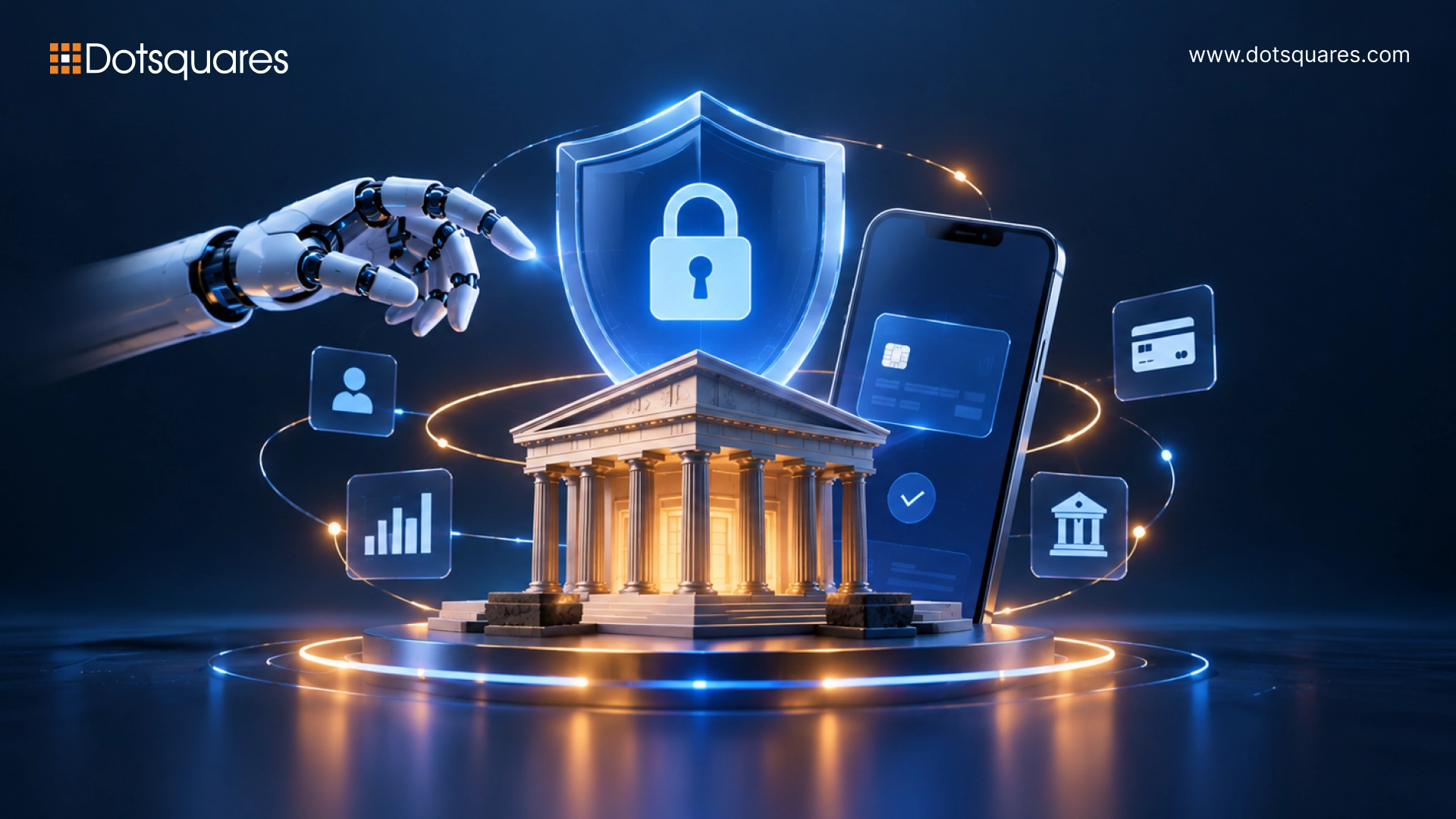
Picture this. You're at a café, your phone buzzes, and your bank wants to know if you just spent $900 on electronics in a city you've never visited. You didn't. One tap on "No" and the card is frozen. That whole exchange takes seconds, and it's a good way to see how AI improves security in digital banking. Something noticed the purchase didn't match you, and it spoke up before the money was gone.
AI in banking isn't only about chatbots anymore. It's in logins, payments, loan checks, even the paperwork compliance teams deal with. So what's it actually doing?
Most of us bank on our phones. Opening an account, paying a friend, applying for a loan, it's all a few taps. Fraudsters have noticed, obviously.
Here's the awkward part: they use AI too. Feedzai's 2025 AI Trends report found that more than half of fraud attempts now involve it. Think cloned voices, deepfake video, and fake identities built from leaked data. A simple rule like "flag anything over $5,000 from a new country" just doesn't cut it against that.
So banks fight back with their own AI. That same Feedzai research says about 90% of financial institutions use AI against fraud. And the money is big. McKinsey figures generative AI could add somewhere between $200 and $340 billion a year to global banking. You don't see numbers like that for something that isn't working.
Every regular at a small shop gets recognised. The owner knows what you usually buy, and if a stranger walked in with your wallet, they'd probably notice. AI fraud detection does that for millions of accounts at the same time.
It learns what's normal for you. Where you shop. When you log in. Which phone you use. How much you tend to spend. When something doesn't fit, it assigns a risk score straight away, and the bank decides whether to approve, ask you to confirm, or block.
Old rule-based systems only catch what somebody already thought to write down. A model can notice patterns no one has described yet. Small stuff counts too, like typing speed, or two "unrelated" accounts that keep using the same device.
And the false alarms? Everyone hates a declined card at the checkout when the purchase was fine. Vendors say AI cuts those false positives a lot compared with rule-based tools. The exact figures vary from bank to bank, so take any single number with a pinch of salt. The trend, though, is clear.
Passwords are a headache. People reuse them, forget them, and type them into fake pages.
That's why banks lean on things that are harder to copy. Fingerprint and face matching come first. Then liveness checks, which tell a real face from a photo held up to the camera. Some apps also watch how you hold the phone and tap the screen, and flag it if someone else seems to be using your account. Voice login is growing as well, although it needs deepfake detection beside it now.
Most of this happens in the background. You tap once and you're in. Safer and easier rarely come together, but this is one of the few places they do.
Ask anyone in a banking compliance department what their week is like. Identity checks, no anti-money-laundering alerts, no more documents to read, more names to compare with a watchlist. Most alarms are false and even so someone has to deal with them.
AI is doing a huge proportion of that work. It glances at ID documents in an instant. It prioritises alerts so analysts dive into the high-risk ones first. And it saves the explanation of each decision useful, as regulators now require banks to justify their models.
Models will have mistakes. They can take on biases from training data, and adversaries can attempt to trick models. With generative AI, there are additional concerns like leaking sensitive information, or generating convincing but fraudulent answers.
So rules come first. If you and your team are exploring this, our guide on generative AI risk management in financial services explains what to set up before launch. The essentials: regular testing and monitoring, subjecting any major decisions to a human in the loop, and post-deployment model validation as performance changes occur over time.
The mistake we see most often in banking app development is leaving security until the last sprint. By then, changing anything is slow and costly.
Plan for it early instead. Connect fraud scoring to the payment flow from day one. Design biometric login and device binding in, rather than bolting them on. Have data handling, consent and audit logs ready before the first compliance review. And build the app so you can swap in a better model later without starting over.
Ready-made tools cover the basics fine. But every bank has its own customers, data and risks, and that's where custom AI development tends to win. A model trained on your own transactions will know your customers better than a generic one.
We develop safe, scalable digital solutions for banks, lenders, and fintech startups. Our fintech software development team takes care of all applications (from mobile banking to tools for fraud and risk management), designing their security and compliance from the very beginning.
Whether you're upgrading a platform you already have or starting fresh, we can help you work out where AI helps most, and then build it properly.
As digital banking expands, so too do the number of attacks on it. AI offers a real opportunity for banks to get the jump on it by detecting malicious activity earlier, reducing the risk from login-side attacks and reducing the burden on compliance teams. Those that do it correctly will adopt AI as part of their bedrock, with proper guardrails on top.
Thinking of a secure banking product? Get in touch with the Dotsquares team and we will guide you to the next step.


 October 07, 2026
Learn the difference between business intelligence and business analytics, including their uses, tools, benefits, & how they support better business decisions.
Keep Reading October 07, 2026Discover how AI in banking powers fraud detection, biometric authentication, and compliance to build secure digital banking. Explore Dotsquares' insights.
Keep Reading October 07, 2026
Learn how AI fraud detection helps banks prevent fraud in real time using machine learning, behavioural profiling, anomaly detection and AI-powered KYC.
Keep Reading