Tech
ServiceNow + MCP: Connecting Enterprise AI to Governed ServiceNow Data
 11 min read
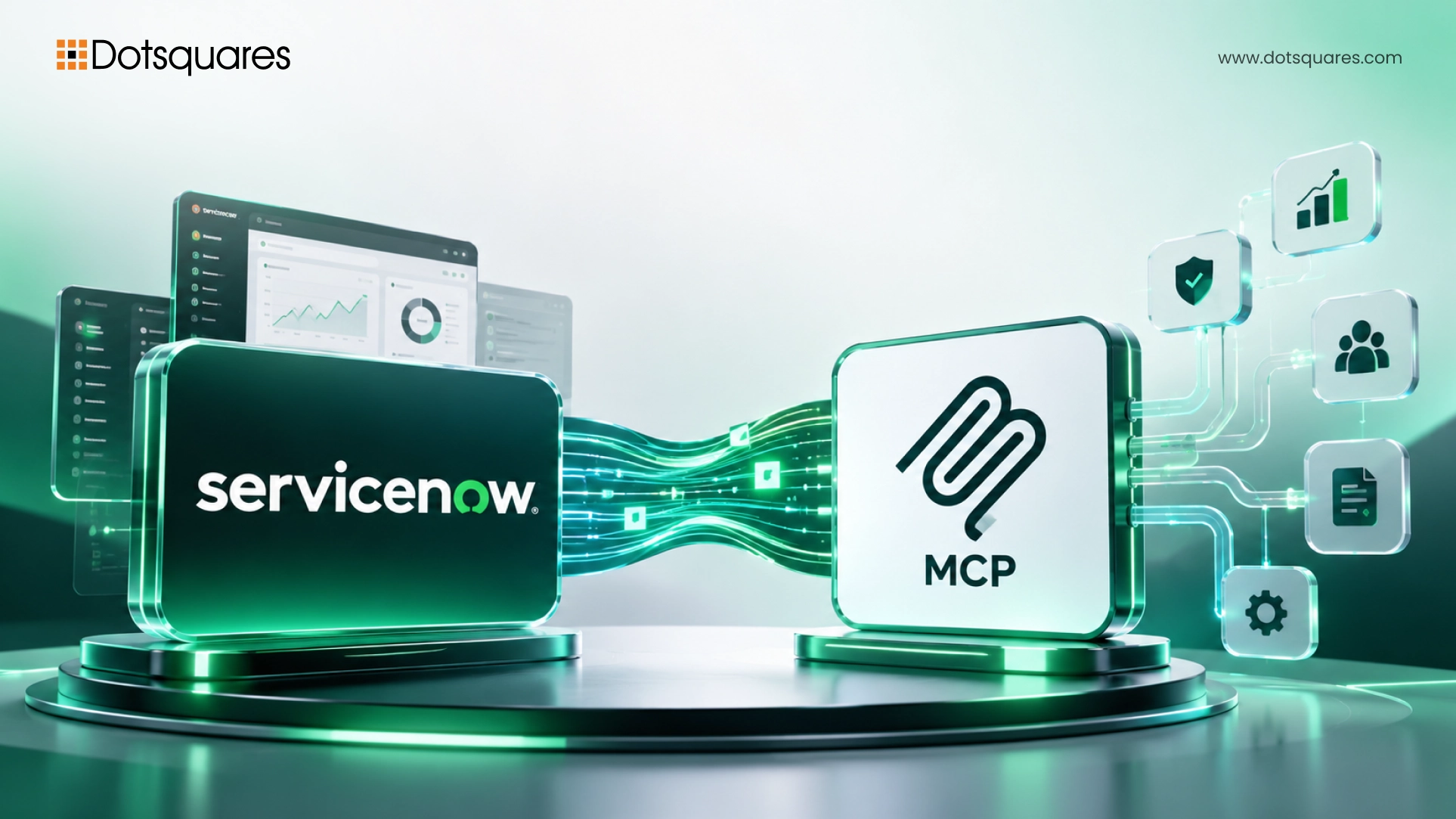
Here's something most enterprise AI rollouts get wrong from the start: the AI is smart, the platform is capable, but the two are barely talking to each other. An AI agent that can't read live incident data, can't check an open change request, or doesn't know what's in a user's active service catalogue, that agent is doing a very poor impression of being useful.
This is the problem the ServiceNow MCP integration is built to fix. And once you understand how it works, it changes the way you think about connecting AI to enterprise data entirely.
So What Is MCP, and Why Should ServiceNow Teams Care?
Model Context Protocol (MCP) is an open-source standard providing AI models a standardized and consistent interface to plug into the systems and data that will allow them to be put into practice. The protocol was developed by Anthropic but was quickly adopted across the board as a de-facto standard of how to wire AI agents into the enterprise infrastructure.
Imagine a universal adapter. Without an MCP, for your AI agent to read the data from ServiceNow, perform queries to your CRM, retrieve information from your data warehouse and respond in the ticketing system – you would need custom integrations for each individual integration, which is costly and hard to maintain. With an MCP, all those systems get a standardized way of interacting with your AI models, as well as the reverse.
This is particularly important for companies already using ServiceNow. After all, ServiceNow contains some of the most vital information for any organization: incident records, change requests, configuration items, entries of your services catalog, CMDB data, SLAs, etc. The minute your AI agents start reading and acting upon this data – things become quite interesting.
Industry analysts project the MCP market will reach $10 billion by 2026. Separately, research consistently shows that 70–95% of enterprise AI initiatives run into problems because of integration bottlenecks, not because the AI itself isn't good enough. MCP is the infrastructure layer that addresses exactly that gap, and agentic AI for enterprise workflow automation becomes meaningfully practical the moment that data access problem is solved.
How the ServiceNow MCP Server Actually Works
ServiceNow has built native MCP server capability directly into the platform. You create and manage ServiceNow MCP servers from the MCP Server console inside your instance. Each server is essentially a controlled gateway; you decide which tools it exposes, who can connect to it, and when it's active.
Here's the architecture in plain terms:
- The MCP server sits inside your ServiceNow instance and exposes a specific set of tools to external AI clients. Each server has its own endpoint in the format https://<your-instance>.service-now.com/sncapps/mcp-server/mcp/<server-name>.
- MCP clients, AI assistants, agent frameworks, and custom LLM applications connect to that server using inbound OAuth authentication. Your existing identity and access management policies govern who can connect and what they can do.
- Tools are the things the server makes available: actions that the AI can invoke, querying incident records, reading CMDB data, triggering a Now Assist skill, submitting a service request, and so on. You configure which tools each server exposes.
One of the more practical design decisions here is that you're not limited to a single server. You can create separate ServiceNow MCP servers for different use cases, one for IT operations, one for HR service delivery, one for security workflows, each with its own tool set and access scope. An AI agent working on IT incidents gets access only to IT incident tools; it doesn't automatically have access to HR records because they're on a different server with a different access profile.
This is exactly the kind of ServiceNow data governance and Workflow Data Fabric thinking that mature implementations are built on: the idea that controlled data access isn't a barrier to AI capability; it's a prerequisite for trusting the AI you deploy.
What Can You Actually Do with ServiceNow MCP Tools?
Let us bring this home. The MCP tools framework from ServiceNow allows the AI agents to function throughout your ServiceNow processes in such a way that was possible only through custom API creation or manual operation by a human in the past.
IT Service Management
The AI agent connected to your ServiceNow ITSM data via the MCP can scan your live incident queues, evaluate assignment group loads, search for CMDB configuration items, find known errors using the knowledge base, and offer resolutions to the problems all in real time and all within your designated access limits. That is a very different picture from an AI assistant that operates using the documentation from six months ago and has no way of seeing what is happening in your environment right now.
Change and Release Management
MCP tools can give an AI agent visibility into the active change schedule, pending approvals, CAB meeting timelines, and conflict checking against scheduled maintenance windows. An agent that can read this data can help coordinators spot risks, draft change records, and flag overlapping requests without someone having to manually export and cross-reference reports.
Service Catalogue and Request Fulfilment
The connection between AI agents and ServiceNow's service catalogue is one of the higher-value use cases for servicenow mcp. An AI assistant that knows what's in the catalogue, what each item requires for fulfilment, and what the current queue looks like can handle a significant portion of routine request intake, answering questions, pre-populating forms, routing requests to the right fulfilment group, without escalating to a human agent for every interaction.
Asset and Configuration Data
Querying the CMDB through MCP will make it possible for the AI agent to comprehend the asset relationships, CI status and dependencies to give recommendations accordingly. The ServiceNow interaction between an organization's assets and enterprise systems can extend across hardware, cloud and external service providers, which makes this type of contextual information the key distinguishing factor between useful AI workflows and plausibly wrong suggestions.
Governance Isn't the Obstacle, It's the Architecture
The hesitation most enterprise teams have around connecting AI to live operational data is understandable. ServiceNow holds sensitive configuration data, employee records, security incidents, and audit trails. The idea of an AI agent roaming freely through all of that is, reasonably, not something most CISOs or platform owners are keen on.
MCP's architecture is specifically designed for this concern. A few things worth understanding:
- OAuth 2.1 enforcement. Every MCP client connecting to your ServiceNow instance authenticates through OAuth. Your existing identity provider governs who gets access. No custom authentication to maintain, no separate credential management layer.
- Role-aware access. The tools an AI agent can invoke are tied to the roles and permissions of the connecting account. An agent working in an HR context accesses HR tools; it doesn't automatically have access to security incident data. The data boundaries are the same ones your platform already enforces.
- Granular server control. You can activate or deactivate a server at any time. If a specific AI integration is causing problems or you need to temporarily restrict access, you switch the server off; the AI clients lose access immediately.
- Audit trails. Interactions through MCP generate audit records in your ServiceNow instance, which means the AI's actions are as visible and reviewable as any other integration.
This is meaningfully different from connecting AI to ServiceNow through a generic API key and hoping for the best. The governance layer isn't bolted on afterwards; it's built into how servicenow mcp works at the protocol level.
Where Does This Fit in a Broader Enterprise AI Strategy?
MCP will not replace the ServiceNow integration mechanisms that you have set up to this point. What it provides is an extension of the capabilities of AI agents within the integration ecosystem that you have created. The analogy to keep in mind when implementing this is that the integration layer takes care of moving data back and forth; MCP makes it possible for AI agents to function in the layer while being fully aware of what is going on at all times.
For those companies that find themselves at an earlier stage of their journey, it is important to mention that MCP integrations can be done in a matter of hours as opposed to the several weeks necessary to create an API-based custom integration. This is a very important consideration since it allows the company to create a servicenow mcp server, observe how the AI agent utilizes the integration and then decide how much to scale.
The broader picture here is one where ServiceNow becomes an active participant in your AI infrastructure rather than a system that AI has to work around. When your AI agents can see live ITSM data, query your CMDB, and act on service catalogue information in real time, the ServiceNow ITSM solutions you've already invested in get significantly more return.
The key shift MCP enables: AI agents go from working with what they were trained on to working with what's happening in your environment right now. For ServiceNow specifically, where the operational value is in the live data, not the documentation, that distinction matters enormously.
Getting This Right in Practice
Implementation considerations worth thinking through before you start:
- Start with a scoped server. Don't expose everything at once. Pick a high-value, well-understood workflow, say, Level 1 ITSM triage, and build the server specifically for that use case with only the tools that use case requires.
- Map your access model before you build. Decide which service accounts or integration users the MCP clients will authenticate as, and make sure those accounts have exactly the access the use case needs, nothing more.
- Instrument from day one. Build in logging and monitoring for AI agent interactions through your servicenow mcp servers, so you have visibility into what the agents are actually doing with the access they're given.
- Plan for the Now Assist integration. ServiceNow allows you to create MCP tools directly from Now Assist skills. If you're already running Now Assist in your environment, this is the fastest path to a working MCP integration; your AI skills become directly callable tools for external AI agents.
For teams working through a broader ServiceNow development and integration programme, MCP is a natural next layer, not a replacement for what's already in place, but an extension that makes the investment work harder. And for teams looking at where custom AI development fits within a ServiceNow-heavy environment, MCP is the architectural answer to the question of how you connect those two things without compromising the governance you've spent years building.
Frequently Asked Questions
What is the ServiceNow MCP server?
The ServiceNow MCP server is a native capability within the ServiceNow platform that lets you create controlled gateways for AI agents to connect to your ServiceNow data and workflows. You configure each server with a specific set of tools and actions the AI can invoke, and manage access through OAuth authentication and role-based controls. Each server has its own endpoint and can be activated or deactivated independently.
How is ServiceNow MCP different from a standard API integration?
A standard API integration is point-to-point; you build it for a specific purpose and maintain it as requirements change. MCP provides a standardised protocol layer that AI agents can use to connect to ServiceNow (and other enterprise systems) without a custom integration for each connection. It also handles authentication, access scoping, and audit trails at the protocol level, which reduces the governance overhead that typically comes with API integrations.
Is ServiceNow MCP secure enough for enterprise use?
Yes, the ServiceNow MCP implementation uses OAuth 2.1 for authentication, enforces role-based access controls from your existing ServiceNow configuration, and generates audit trails for agent interactions. You can also scope each MCP server to a specific set of tools, so AI agents only have access to what the defined use case requires. Governance is built into the architecture, not added on afterwards.
What kinds of workflows can ServiceNow MCP tools support?
The main use cases are ITSM (incident management, change management, problem management), service catalogue and request fulfilment, CMDB queries, HR service delivery, and any Now Assist skill you've already built in your instance. You can also create multiple MCP servers for different departments or functions, each with its own tool set and access profile.
Do we need to rebuild our existing ServiceNow integrations to use MCP?
No. MCP sits alongside your existing integrations; it doesn't replace them. Your current data flows between ServiceNow and other enterprise systems stay in place; MCP is the layer that gives AI agents governed, real-time access to what's in ServiceNow. If you're already running Now Assist, you can create MCP tools directly from existing Now Assist skills, which is typically the fastest starting point.


Related Post
 November 02, 2026
ServiceNow + MCP: Connecting Enterprise AI to Governed ServiceNow Data
Learn how ServiceNow MCP connects AI agents with live enterprise data, including ITSM, CMDB and service catalogues, while maintaining access controls and governance.
Keep Reading November 02, 2026
ServiceNow Autonomous Workforce: What's New in 2026?
Explore the ServiceNow Autonomous Workforce updates, including AI specialists, EmployeeWorks, AI Control Tower, key partnerships and changes to ITSM operations.
Keep Reading October 30, 2026
How Much Does CRM Software Cost for Local Government in Australia?
How much does CRM software cost for Australian councils? Explore 2026-27 pricing models, per-user fees, hidden costs and tips to budget smartly.
Keep Reading