Tech
Agentic AI Software Development Solutions for Inefficient Workflows
 8 min read
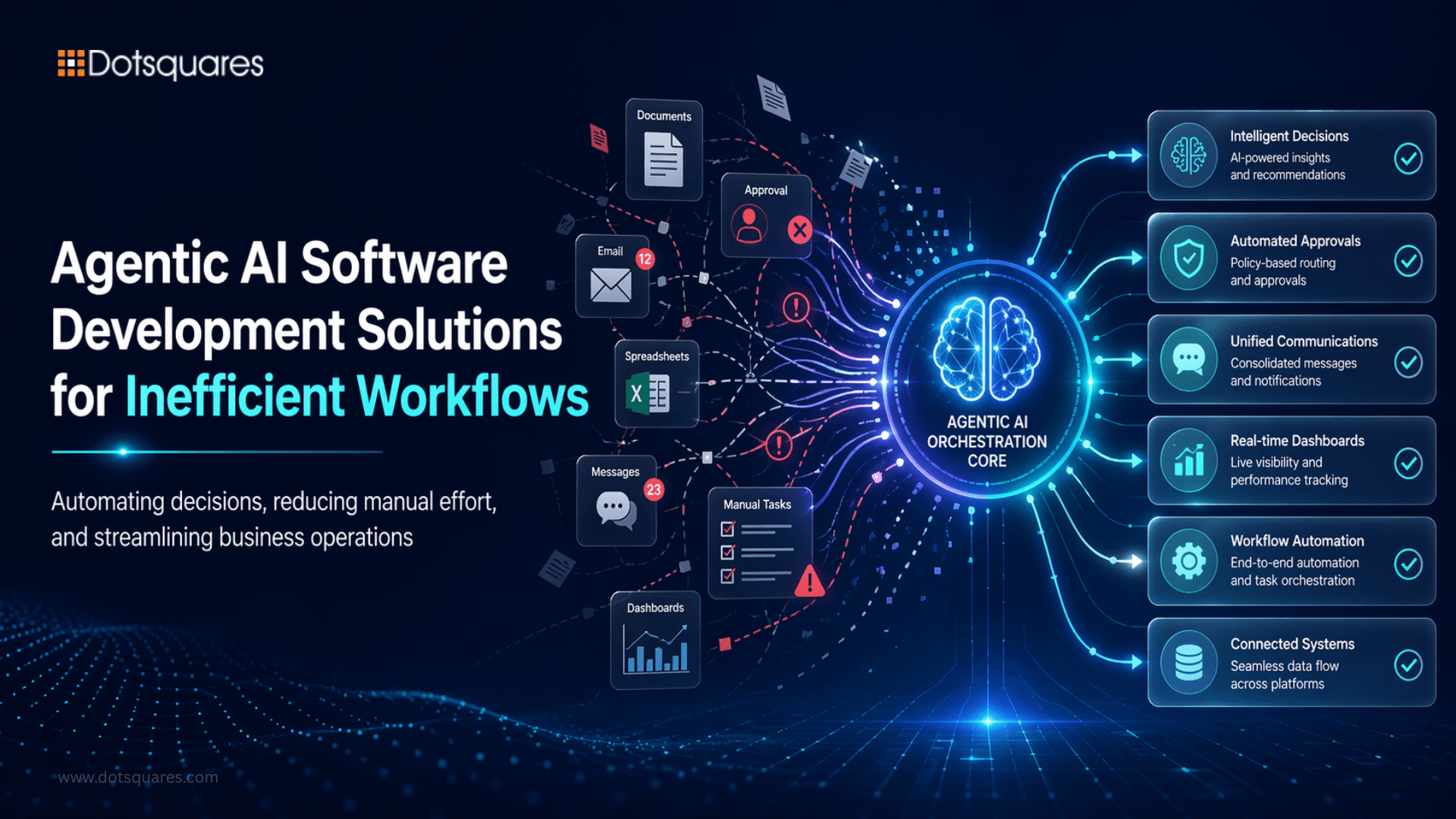
Most businesses don't have a productivity problem. They have a workflow problem.
The work is proceeding at a slow pace because it requires excessive manual work to connect multiple different systems. Someone is transferring information between different platforms. A process halts its progress because it needs a human judgment which should have been made through automation. The team dedicates half of their workweek to complete tasks which exist because their surrounding systems fail to establish proper communication.
The hidden expense which affects business operations remains unrecorded on balance sheets but appears throughout business activities. According to McKinsey, employees use 60% of their working hours to handle various work-related activities which include coordination and communication and process management instead of doing their actual job responsibilities.
Agentic AI Development is changing that equation. Not incrementally, fundamentally.
What Causes Inefficient Workflows in Modern Businesses?
Before getting into the solution, it's worth being honest about what's actually creating the problem. Because inefficient workflows rarely have a single cause.
Manual processes and repetitive tasks are the most visible culprit. Data entry, report generation, status updates, approval routing, these tasks consume significant time and introduce error at every step. They persist not because businesses want them, but because replacing them has historically required either expensive custom development or tools that don't quite fit.
Lack of system integration is often the deeper issue. Most organisations run on a collection of platforms that were never designed to work together. CRM, ERP, project management, finance, customer support, each works within its own logic, and the humans in between spend their days bridging the gaps manually.
Limited automation capabilities: The outdated systems of the organisation restrict their ability to solve problems because they only have access to basic automated functions. The system provides only minor assistance through its scheduled tasks and simple rule triggers and basic API connections because it fails to resolve the system's core challenges.
Why Traditional Automation Isn't Enough
This is where a lot of businesses find themselves stuck. They've implemented automation. They're using RPA tools, workflow software, integration platforms. And they're still hitting walls.
The first explanation states that traditional automation systems operate through established rules which govern their entire functioning. The system operates perfectly when users follow prewritten instructions under consistent conditions but it fails when actual situations do not match the established rules.
Rule-based limitations: The system can only operate within its predefined programming limits because all situations that fall outside these parameters require human operators to take control. When situations do not match expected patterns, all exceptional cases together with their special conditions go back to needing human involvement.
Lack of adaptability: The system requires continual manual updates to adapt to changing business operations because it cannot adjust itself to new requirements. The fast-paced nature of organisations causes their maintenance workloads to reach critical levels.
Human dependency remains high because someone still needs to monitor, manage, and intervene in automated processes regularly. The automation handles volume but doesn't reduce oversight requirements as much as organisations hoped.
This is exactly why businesses exploring AI Consulting Services are increasingly moving the conversation beyond traditional automation toward something more capable.
What Is Agentic AI Software Development?
Agentic AI is a different category of technology, and understanding what makes it different is worth taking a moment to do properly.
Traditional AI systems, including most of what businesses currently use, are reactive. They respond to inputs according to patterns they've learned. They're powerful within defined parameters, but they don't pursue goals, they don't plan sequences of actions, and they don't adapt their approach when circumstances change.
Agentic AI systems do. An AI agent is a system that can perceive its environment, set sub-goals, take sequences of actions, evaluate outcomes, and adjust its approach, all in pursuit of a broader objective, without requiring human instruction at each step.
The difference isn't just technical. It's the difference between a tool that executes tasks and a system that solves problems. AI/ML Development Services that incorporate agentic architectures are enabling businesses to automate not just individual tasks but entire decision-making workflows, the kind that previously required human judgment at every turn.
How Agentic AI Solves Workflow Inefficiencies
- The fundamental ability to make independent decisions brings about complete transformation. An agentic system evaluates the existing information with its contextual understanding to make decisions while only turning to human operators for authentic emergencies. This solution brings major benefits to enterprises that experience delays because of their need to obtain approval for every business operation.
- The collaboration between multiple agents enables more advanced cooperation between different systems. The automated system cannot execute a complete process because it needs to handle decision-making tasks that occur across various departments and system networks. Agentic architectures enable multiple specialised agents to work simultaneously by managing different workflow segments while they work together to share information throughout their operational phases.
- The system performs continuous assessment of its operational methods to identify which ones deliver optimal performance during its real-time optimisation process. The implementation of custom AI development solutions that utilise agentic frameworks enables organisations to cut down their operational times by up to 70 percent according to some implementations in environments that depend on manual processes.
Key Features of Agentic AI Systems
What distinguishes a well-built agentic AI system from conventional automation comes down to three core characteristics.
Goal-driven execution means the system works backward from an objective rather than forward through a fixed sequence of steps. If the usual path to the goal is blocked, it finds another way, rather than failing and waiting for human intervention.
Context awareness allows the system to factor in information beyond the immediate task, historical patterns, current system states, user preferences, and broader business conditions, in the same way a skilled human operator would.
Continuous learning means performance improves over time. The system learns from its operational history by detecting patterns in results which enables it to improve its decision-making process and create institutional knowledge that remains intact after employee departures.
Implementation Approach: How to Get Started
The path to agentic AI implementation is more structured than many businesses expect, and starting in the right place makes a significant difference to outcomes.
Identifying workflow gaps is the essential first step. This means mapping current processes honestly, where do things slow down, where does human intervention happen most frequently, where does error occur, and where is there genuine complexity that conventional automation has failed to address? These pain points are where agentic AI delivers the clearest and fastest return.
Choosing the right AI architecture requires understanding both your technical environment and your specific workflow requirements. Not every problem needs a multi-agent system. Some workflows benefit from a single capable agent. Others require orchestrated collaboration between specialised agents. Getting this architecture decision right upfront avoids significant rework later.
The software development process for agentic AI projects requires different methods than traditional software development because it needs to test systems through real operational scenarios and needs to integrate with current system architecture and needs to implement system testing through controlled operational stages before complete deployment.
Challenges and How to Overcome Them
Data quality issues are the most common barrier to successful agentic AI implementation. Agents make decisions based on data, and if that data is incomplete, inconsistent, or poorly structured, decision quality suffers accordingly. A data audit and remediation plan before development begins is almost always time well spent.
Integration complexity is real, particularly in organisations running legacy systems with limited API capability. The good news is that modern agentic frameworks are increasingly designed with integration flexibility in mind, but this needs to be scoped honestly rather than assumed away.
Change management is the challenge that technical teams most often underestimate. Agentic AI changes how people work, sometimes significantly. Employees who understand what the system is doing and why, who have been involved in identifying the problems it solves, and who trust its outputs are far more likely to adopt it effectively than those who feel it's been imposed on them.
Why Choose Dotsquares for Agentic AI Software Development
Building agentic AI systems that actually work in production, not just in demos, requires a combination of technical depth, domain understanding, and delivery experience that's genuinely uncommon.
At Dotsquares, our end-to-end AI expertise spans the full development lifecycle, from workflow analysis and architecture design through to deployment, integration, and ongoing optimisation. We don't hand over a system and disappear. We build with production performance as the primary measure of success.
Our solutions are built to scale, starting with the highest-impact workflow problems and expanding capability as confidence and performance are validated. And our Hire AI Developers model gives businesses the flexibility to access specialist agentic AI expertise without the overhead of building a permanent internal team from scratch.
We've delivered AI solutions across industries including finance, healthcare, retail, logistics, and professional services, and the workflow problems, while they look different on the surface, tend to share the same underlying patterns that agentic AI is built to address.
The Bottom Line
The expenses generated by inefficient workflows exceed all other costs. The operational costs and competitive advantages of businesses start to decline because of these efficiency problems which develop into major issues after extended periods.
The existing rules-based automation technology has reached its maximum capability for businesses because it operates according to predetermined guidelines. The remaining complexities require agentic AI to handle decision-making tasks, which involve multiple systems and exceptional cases that require human assistance to function.
Gartner predicts that by the year 2028, agentic AI will independently handle 15% of routine work disputes which currently require human assistance. This percentage will grow as organisations start to adopt the technology and it becomes more advanced.
Companies that address current workflow challenges will establish an operational framework which will enhance their productivity and operational abilities throughout time.
Dotsquares offers the expertise needed to help you identify which areas of your workflows will benefit most from agentic AI implementation.


Related Post

 October 16, 2026
E-commerce Security: Protect Your Store From Cyber Threats
Learn how E-commerce security protects your online store from fraud, data breaches, and bots. Explore threats, PCI DSS, and best practices.
Keep Reading October 15, 2026
Low-Code Integration: What It Is, How It Works and When Businesses Should Use It
Learn how low-code integration connects business apps and APIs, its key benefits, common use cases, limitations, and when to choose custom integration.
Keep Reading October 15, 2026
SAP BW to Cloud Migration: Benefits, Challenges and Planning Steps
Learn about SAP BW to cloud migration, including benefits, challenges, AWS options, cost factors and planning steps for a successful migration.
Keep Reading