Cascading tasks from global headquarters to every local company
A global medical technology group needed to push tasks from head office down to individual companies in every country — and see, at a glance, what had been done. We built the hierarchy, the visibility and the reporting that made it possible.

The Client
Getinge is a global medical technology group supplying hospitals, clinics and life science institutions with the equipment and systems used in surgery, intensive care, sterilisation and cardiovascular treatment. Founded in Sweden and now operating internationally, the group's products support clinicians in critical settings where reliability is not negotiable — operating theatres, intensive care units and sterile processing departments. The business spans manufacturing, research and development, regulatory affairs, sales and service across numerous countries, with local operating companies serving their own markets while working within a group-wide framework of policy, quality and compliance obligations. Medical technology is among the most heavily regulated industries in the world, and Getinge's local companies must each demonstrate adherence to standards that vary by jurisdiction while remaining consistent with group requirements. Coordinating that across a large international structure is a significant organisational undertaking in its own right.
Impressive Numbers
- Task assignment across multiple levels — from global to country to individual company
- Unified global view of task status for head office, with local views scoped per company
- Real-time reporting replacing manual status collection (estimated)
The Challenge
In a group of many local operating companies across many countries, head office faces a persistent problem: how do you ask every company to do something, and then find out whether they have?
Getinge needed to assign tasks at different levels — to a whole country, a region, or an individual company — and then track completion. Doing this by email and spreadsheet was possible but unreliable. Recipients were unclear whether a request applied to them. Status had to be collected manually and was out of date by the time it was compiled. Nobody at group level had a dependable answer to 'where are we with this?'
Related to this, the group struggled to be confident that employees were aware of and trained on current policies. Policies could be published, but publication is not adoption, and there was no straightforward way to see who had engaged.
There was also a structural gap: policy and task information was not connected to employee records, making it difficult to align obligations with individual roles. A task belonging to a quality manager in one country needed to reach that person, not everyone in the building.
Access control was a further concern. With tasks spanning countries and companies, the group needed confidence that people saw and modified only what was theirs. Unauthorised viewing or editing of another company's work had to be closed off first.
Getinge needed task management that understood their hierarchy, respected their permission boundaries, and gave head office a reliable global picture.

The Solution
We implemented a task management system within Getinge's SharePoint intranet, built around the group's organisational hierarchy rather than as a flat list of assignments.
The hierarchy was the central design problem. The system lets a super administrator at group level assign tasks at whichever level is appropriate: to every company in a country, to a group of companies, or to a single one. Recipients see the tasks that apply to them and nothing else. That sounds simple, but it is the difference between a system people trust and one they ignore — if a user's task list contains items that are not theirs, they stop reading it.
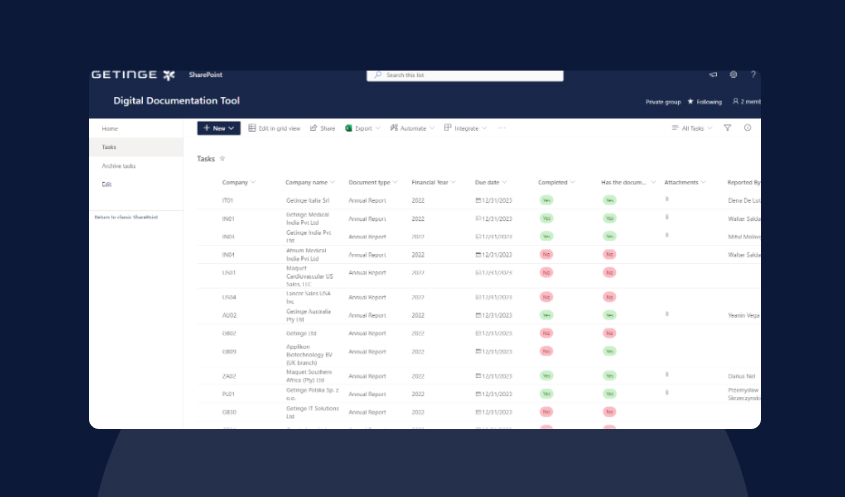
Task visibility is therefore scoped per company. Each local operating company sees its own assignments and can update their status, while head office retains a unified view across the whole structure. From one screen, the group can see which countries and companies have completed a task, which are in progress and which have not started — without asking anybody.
We built distinct user groups mapped to areas of the organisation and associated tasks with those groups rather than with named individuals wherever possible. This means delegation works properly: when someone changes role or leaves, the task belongs to the group and remains visible to whoever holds that responsibility now. It also makes assignment faster, since head office allocates to a defined group rather than assembling a recipient list each time.
Access control was strengthened throughout. Permissions determine who can view and who can modify tasks at every level, so a user in one company cannot see or alter another's. Sensitive information is restricted based on role, and the boundaries are enforced by the platform rather than by convention. For a group handling material subject to regulatory scrutiny, that assurance was a prerequisite rather than a feature.
On top of the task engine we built dynamic reporting. Rather than compiling status manually, the group generates real-time reports on task progress across countries and companies, filtered as required. Head office gets the evidence for decision-making without a collection exercise, and local companies can see their own position at any time.
Notifications keep the system moving. Users are alerted when tasks are assigned, when deadlines approach and when statuses change, so progress does not depend on people remembering to check. That single addition changed the character of the system from a record to a working tool.
We also invested in the interface. The landing page was designed to be genuinely pleasant to use and to present the information a user needs immediately — their outstanding tasks, recent changes and the routes to everything else. Getinge's users are clinicians' suppliers, engineers and regulatory specialists, not intranet enthusiasts, and a system they find awkward is a system that quietly fails. The navigation is clean, the key functions are visible without hunting, and the whole experience is straightforward enough to need no training.
Underneath all of this sits the document management the group already needed: controlled access to files and folders, secure and tailored to user roles, so that the policies and guidance associated with tasks are available to exactly the right people.
Client's Quote / Review
DRAFT FOR CLIENT APPROVAL — please confirm wording and attribution before publication.
"Coordinating activity across companies in many different countries used to mean sending requests out and waiting to find out what had happened. We can now assign work at whatever level makes sense, and see the global picture whenever we want it. That visibility has changed how we run group-wide initiatives."— [Name], [Job title], Getinge Group
The Results
The most significant change is that head office can see what is happening. A group-wide task now has a live status across every country and company, visible from one screen, without anyone compiling it. Initiatives that previously involved a request followed by weeks of chasing now have a progress view that updates itself. For a group of this scale and geographic spread, that shift from periodic reporting to continuous visibility has changed how group-level work is run.
At local company level, the improvement is clarity. Each company sees the tasks that apply to it and nothing else, which means the task list is trusted and used rather than skimmed. The ambiguity of the old approach — where recipients had to work out whether a request applied to them — has gone, and with it a common reason for things not being done.
Assignment itself is faster and more robust. Because tasks are associated with defined user groups rather than named individuals, head office allocates work to a responsibility rather than a person. Staff changes no longer orphan tasks, and the group is not maintaining recipient lists. Delegation within a local company works the same way.
The reporting capability replaced a manual collection exercise with something immediate. Real-time reports on progress across countries and companies give the group evidence for decisions rather than an estimate, and local management can check their own position at any time rather than waiting to be told. Both effects reduce the volume of status-chasing email that surrounded the previous process.
Access control gave the group the confidence it needed to use the system for material that matters. Viewing and editing rights are enforced by role and organisational position, so one company cannot see or alter another's tasks, and sensitive information stays with those entitled to it. In a heavily regulated industry, that was the precondition for the system being adopted at all.
Notifications turned a passive record into an active tool. Users are told when work is assigned and when deadlines approach, so progress no longer depends on people remembering to log in. Completion rates improved simply because the system prompts rather than waits.
The interface has done its quiet job. Because the landing page presents outstanding work and key functions immediately, users find what they need without training, and adoption across a technically diverse international workforce happened without the resistance such rollouts often meet.
Taken together, Getinge gained something they did not previously have: a dependable mechanism for making something happen across the whole group, and for knowing that it has.

