
Is Your Business AI-Ready?

Tech
 6 min read
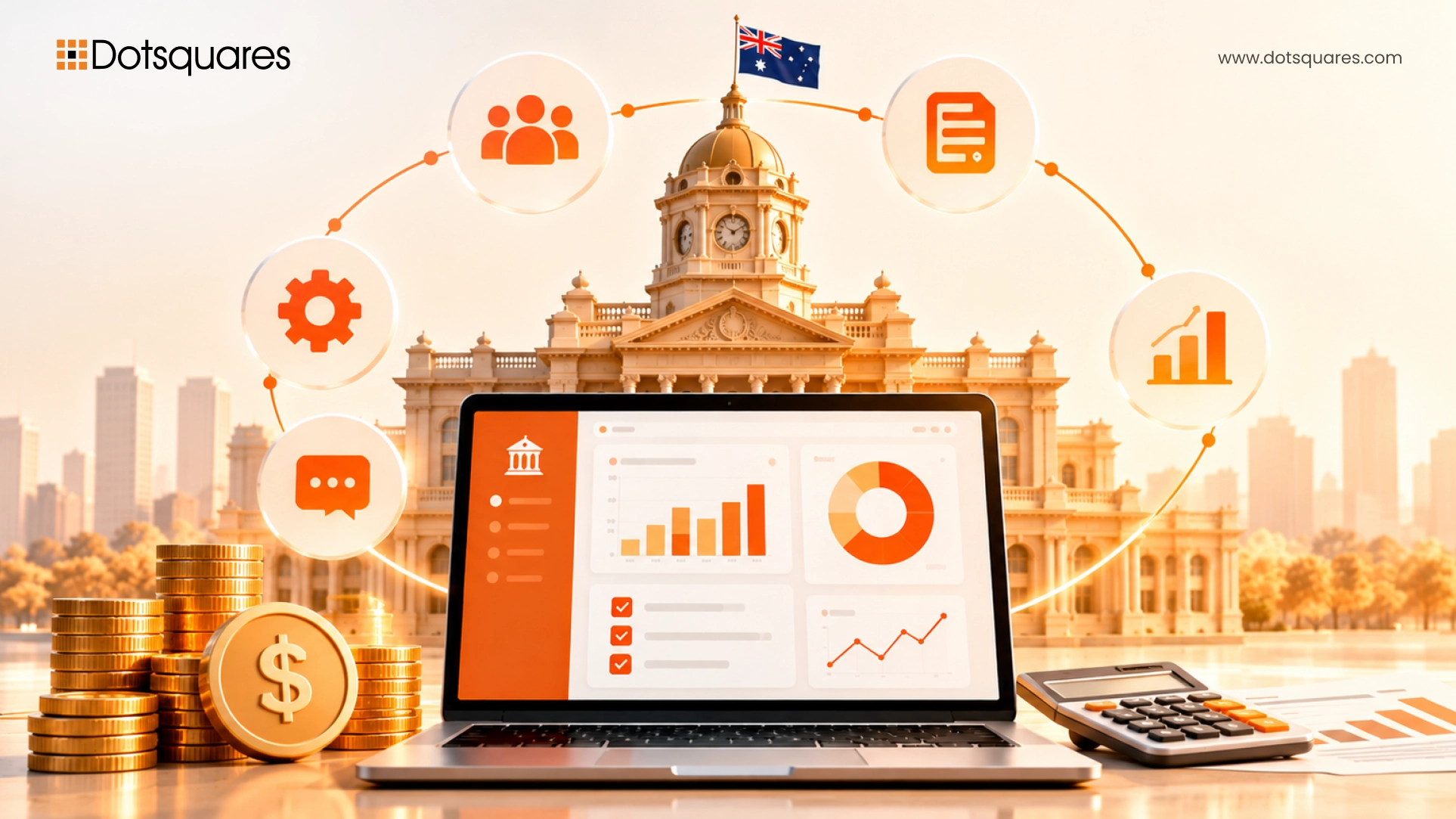
A resident rings the council about a blocked drain. Two days later they email about the same drain. A week on, they ring again, and whoever picks up has no idea the first two contacts ever happened. That's three records, three people, and one very annoyed ratepayer. It's also the exact problem a CRM is meant to fix, and it's why more and more of Australia's 500-plus local councils are asking the same question: what does CRM software cost for local government Australia actually come to?
The honest answer is that it depends, but not in a vague way. The cost comes down to a handful of specific things, and once you know what they are, you can budget properly and spot a quote that's missing something. Here's how it breaks down in 2026.
A typical business CRM tracks sales leads. CRM for local government does something different. It captures every single incoming request received through phone, counter, email, or portal, assigns a responsible party to handle the request along with deadlines, and maintains a complete history associated with the resident and the property. Now, add to this equation the rates team, planning, waste, parks, and compliance team also using the same system, and you will see how big the task can become.
This increased scope is what adds to the cost. Any off-the-shelf government CRM solution that is available in the market is priced more on the basis of its sales functionality; however, the local councils end up paying for the additional integration and configuration costs too.
Most council CRM budgets are made up of the same five lines.
Prices move around, so treat these as ballpark figures and get a current quote before you plan anything. In Australian dollars, these are the rough ranges for the main platforms councils look at.
|
Platform |
Licence cost (per user, per month) |
Typical implementation |
|
Zoho CRM |
Roughly A20toA60 on paid tiers |
A5,000toA10,000 for a small setup |
|
Microsoft Dynamics 365 |
Roughly A$150 and up |
A15,000toA50,000 for a small team |
|
Salesforce |
Roughly A40toA270+ depending on edition |
A35,000toA75,000 per cloud |
|
Custom-built CRM |
No per-seat licence |
Higher upfront, priced by scope |
One thing catches people out. Real-world spend on the bigger platforms often lands at one and a half to two times the headline seat price once add-ons, extra storage and integrations are counted. A quote that only shows licences isn't a full quote.
Councils hold sensitive resident information, and Australian government bodies generally expect that data to stay in Australia. Many council tenders say so outright. Microsoft's Dynamics 365, for example, is IRAP certified and keeps customer data at rest in Australia, and other vendors offer Sydney-region hosting.
This matters for cost because Australian hosting, security certification and audit logging can add to the bill, or push you toward a specific vendor. It's far cheaper to settle this before you sign than to discover it halfway through procurement. Check your own council's data policy first.
Off-the-shelf is also cheaper at the outset since all you need to do is pay the licence fee, get it configured and you'll be off and running within weeks, or even months. The problem is that councils have their own workflow, such as multi-level approval processes or connecting the request with the property, and configuring the software to work properly is costly anyway.
A custom build costs more at the start, but there's no per-seat fee, and it's built around how your council actually works. For larger councils or ones with unusual requirements, it can work out cheaper over five years. Our guide to custom CRM software development walks through when that trade-off makes sense. If you're still comparing platforms, this rundown of the best CRM options in Australia is a good place to start.
A few things rarely show up in the first quote.
Working through a CRM implementation checklist before you go to market helps you catch most of these early.
Start by listing every team that will touch the system, and every system it needs to connect to. Ask each vendor for a quote that covers licences, setup, integrations, migration, training and the first year of support, all in one document. Then compare on total cost over three to five years, not the monthly seat price.
It's also worth thinking about where CRM is heading. Tools that sort requests automatically and suggest replies are getting cheaper and more common, and our piece on how AI is changing CRM is useful if you want to future-proof the purchase.
It varies a lot by platform and scope. Licences are usually the smaller part, and setup, integrations and data migration often cost more than the first year of licences combined, so ask for an itemised quote.
Many tender documents require it, and government bodies are generally expected to keep resident data onshore. Check your council's own policy and the vendor's hosting options before you commit.
It can be over five years, since there's no per-user fee, but the upfront cost is higher. It tends to suit larger councils or ones with workflows that off-the-shelf tools handle badly.
Getting a straight answer on CRM pricing in Australia shouldn't take months. Dotsquares works with Australian organisations to scope, price and build CRM systems, from a configured off-the-shelf platform to a full custom build. Get in touch with the team and we'll help you work out what a CRM for your council should actually cost.


 October 30, 2026
How much does CRM software cost for Australian councils? Explore 2026-27 pricing models, per-user fees, hidden costs and tips to budget smartly.
Keep Reading October 30, 2026
Learn how ServiceNow Service Graph CMDB improves data accuracy, strengthens governance and supports faster incident resolution and better IT operations.
Keep Reading October 30, 2026
Compare Salesforce Apex vs Java to understand their key differences, features, use cases and limitations, and choose the right language for your business
Keep Reading