Tech
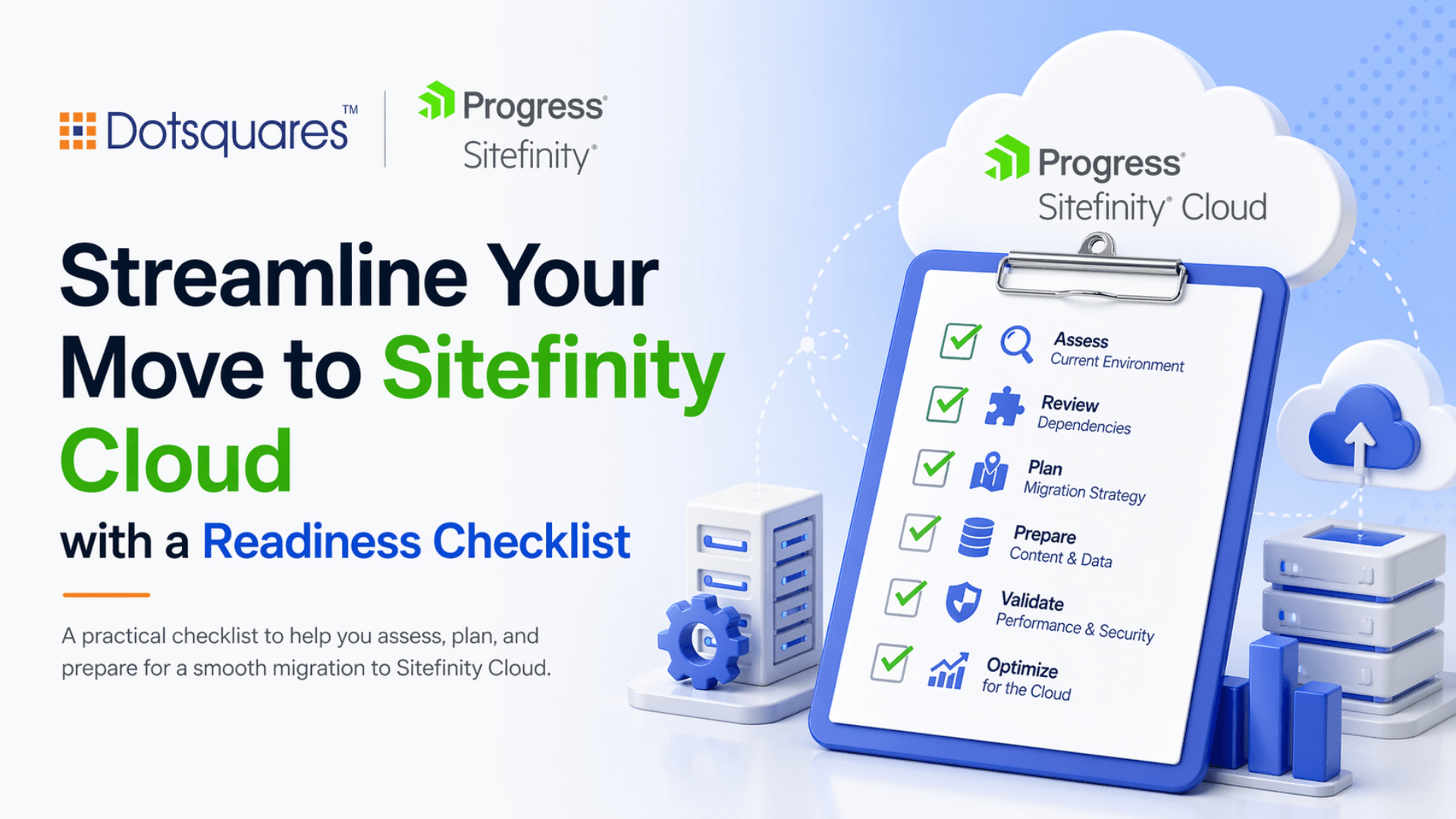
Streamline Your Move to Sitefinity Cloud with a Readiness Checklist
 7 min read
Cloud migration sounds straightforward until you're in the middle of it.
What initially looks like a simple technical shift often reveals deeper complexities, such as undocumented legacy integrations, incompatible content formats, and overlooked security requirements. Despite these discoveries, project deadlines rarely move, putting immense pressure on the development team to deliver a seamless transition without disrupting the business.
According to Gartner, through 2025, 99% of cloud security failures will be the customer's fault, not the platform's. That's not a damning statistic about cloud technology. It's a damning statistic about preparation. Most cloud migrations that go wrong don't fail because the destination platform couldn't handle the workload. They fail because the organisation wasn't actually ready to move.
For businesses migrating to Sitefinity Cloud, the difference between a migration that lands cleanly and one that drags on for months usually comes down to a single factor: how thoroughly the groundwork was laid before the first file moved.
That's exactly what a Sitefinity Cloud Readiness Checklist is designed to address.
What Is a Sitefinity Cloud Readiness Checklist, And Why Does It Matter?
A readiness checklist isn't a tick-box exercise. Done properly, it's a structured diagnostic that tells you, honestly, before you've committed time and budget to the migration process, whether your current environment, your team, and your content are actually in a position to move successfully.
Think of it as the equivalent of a survey before buying a property. You might be confident everything is fine. But until someone has systematically looked at every relevant area and documented what they found, you're making decisions based on assumptions rather than evidence.
A Sitefinity readiness checklist helps teams compare legacy systems against cloud requirements. This identifies necessary updates and potential delays before the migration even begins.
McKinsey research found that organisations that invest in thorough pre-migration planning complete cloud migrations 40% faster than those that begin without it. The upfront time investment doesn't delay the migration, it accelerates it by removing the unplanned stops.
What the Checklist Actually Covers
A comprehensive Sitefinity Cloud readiness assessment works across several distinct areas, each of which has the potential to create problems if left unexamined.
Technical Infrastructure Assessment:
Current server configurations, database versions, hosting environment specifications, and network architecture all need to be mapped against Sitefinity Cloud requirements. Incompatibilities identified here are straightforward to resolve before migration, expensive to discover after.
Content and Data Audit:
Content volume, structure, media assets, and metadata all affect how cleanly content migrates to the cloud environment. Unstructured or inconsistently tagged content creates manual work at the worst possible time, mid-migration. Businesses can reduce this complexity by simplifying CMS management with Sitefinity before starting the migration process. A pre-migration content audit surfaces these issues when there's still time to address them systematically.
Custom Modules and Integrations:
Most Sitefinity implementations have custom modules, third-party integrations, and bespoke functionality that were built for an on-premise environment. Not all of these translate directly to cloud architecture without modification. The checklist identifies which integrations need to be rebuilt, reconfigured, or replaced, and scopes that work before it becomes a blocker.
Security and Compliance Requirements:
The cloud environment requires mapping data residency, GDPR, and industry standards directly to your existing access control policies. Working with an experienced Cloud Consultant helps identify compliance gaps early and reduce risk. IBM's Cost of a Data Breach Report found that the average cost of a cloud-related breach was $4.45 million in 2023, and compliance gaps identified before migration cost a fraction of what they cost after one.
Performance Benchmarking:
The current performance metrics which include page load times and server response times and traffic volumes establish a baseline which will be used to measure performance after the migration. The migration performance improvements cannot be proven without this baseline because it serves as the standard for demonstrating migration success.
Team Readiness and Governance:
Who owns each stage of the migration? Who has sign-off authority? What procedures will be followed when unexpected issues arise? Governance gaps are as dangerous as technical ones, and they're more common. The checklist for readiness requires all necessary discussions to take place before these conversations become essential during times of stress.
How the Checklist Simplifies the Migration Process
The practical value of working through a readiness checklist before migration begins shows up in several specific ways.
It replaces assumptions with evidence. Most migration problems begin with someone assuming a particular system, integration, or content type will "probably be fine." The checklist requires all assumptions to undergo testing and documentation which transforms the confidence-based assessment into a fact-based evaluation.
The system establishes a common reference point which all team members can use. Development teams, content teams, IT, compliance, and business stakeholders all have different pieces of the migration picture. The completed checklist provides a shared document which shows all project details, thus preventing misunderstandings and showing lost links that cause migration delays.
It sequences work correctly. Not everything in a migration can happen simultaneously. Some tasks are blockers for others. A checklist with clear dependencies helps teams understand what needs to happen in what order, preventing the situation where work gets done in the wrong sequence and has to be redone.
It reduces manual errors. Gartner estimates that 70% of cloud migration failures are caused by human error, not technical limitations. Systematic checklists reduce the surface area for human error by ensuring nothing falls through the gaps between team members or project phases.
It gives stakeholders confidence. For organisations where senior leadership or board approval is required for significant infrastructure changes, a completed readiness assessment provides documented evidence that the migration has been properly planned and risk-assessed, which makes approval conversations significantly easier.
The Business Impact of Being Cloud Ready
The difference between a prepared migration and an unprepared one isn't just a smoother technical process, it has measurable business consequences.
Faster migration timelines. Organisations that complete thorough readiness assessments don't spend weeks mid-migration discovering problems that should have been identified in planning. IDC research found that businesses with comprehensive migration plans completed their moves 35% faster than those without structured preparation. That time saving translates directly into reduced cost and earlier access to the performance and scalability benefits of the cloud environment.
Lower risk of migration failure. Failed or stalled cloud migrations are more common than the industry typically acknowledges. The majority are attributable to insufficient pre-migration planning, unresolved dependencies, undocumented customisations, and governance gaps that only become visible when they become problems. Readiness assessment is the most reliable mitigation available.
Improved post-migration performance. A migration that's been properly planned doesn't just land without incident; it lands in a better position. The team starts with content that meets all requirements while they complete their testing work before they start operating the new system on its first day.
Scalability from the start. Businesses choose Sitefinity Cloud because it offers automatic scaling and removes the burden of managing on-site systems. The system becomes immediately accessible after clean execution of the migration process which enables users to access its full capabilities.
These outcomes clearly highlight the key benefits of Sitefinity, especially for businesses looking to scale efficiently in a cloud environment. From improved performance and faster deployment to built-in scalability and reduced operational overhead Sitefinity enables organisations to manage digital experiences more effectively.”.
Getting Migration-Ready With the Right Partner
The effectiveness of a readiness checklist depends on the expertise behind it. Reviewing your requirements with a Sitefinity architect ensures every technical detail is covered—an advantage that a standard, non-expert evaluation simply cannot provide.
The goal of this activity involves moving beyond document creation. You must assess your current state and map out the target environment and potential risks before starting the migration.
Dotsquares has delivered Sitefinity CMS development and migration projects across complex enterprise environments, working with organisations to assess readiness, resolve pre-migration gaps, and execute migrations that land cleanly and perform from day one.
A structured readiness assessment provides the necessary foundation for your Sitefinity Cloud migration because it enables you to evaluate your current position before establishing migration timelines. Our Sitefinity team is ready to start discussing your needs.


Related Post

 October 15, 2026
Low-Code Integration: What It Is, How It Works and When Businesses Should Use It
Learn how low-code integration connects business apps and APIs, its key benefits, common use cases, limitations, and when to choose custom integration.
Keep Reading October 15, 2026
SAP BW to Cloud Migration: Benefits, Challenges and Planning Steps
Learn about SAP BW to cloud migration, including benefits, challenges, AWS options, cost factors and planning steps for a successful migration.
Keep Reading October 12, 2026
Mobile App Development with React Native and What You Need to Know
Learn how React Native works, where it saves time and cost, which industries use it, and whether it's still a good choice in 2026.
Keep Reading