
Is Your Business AI-Ready?

Tech
 5 min read
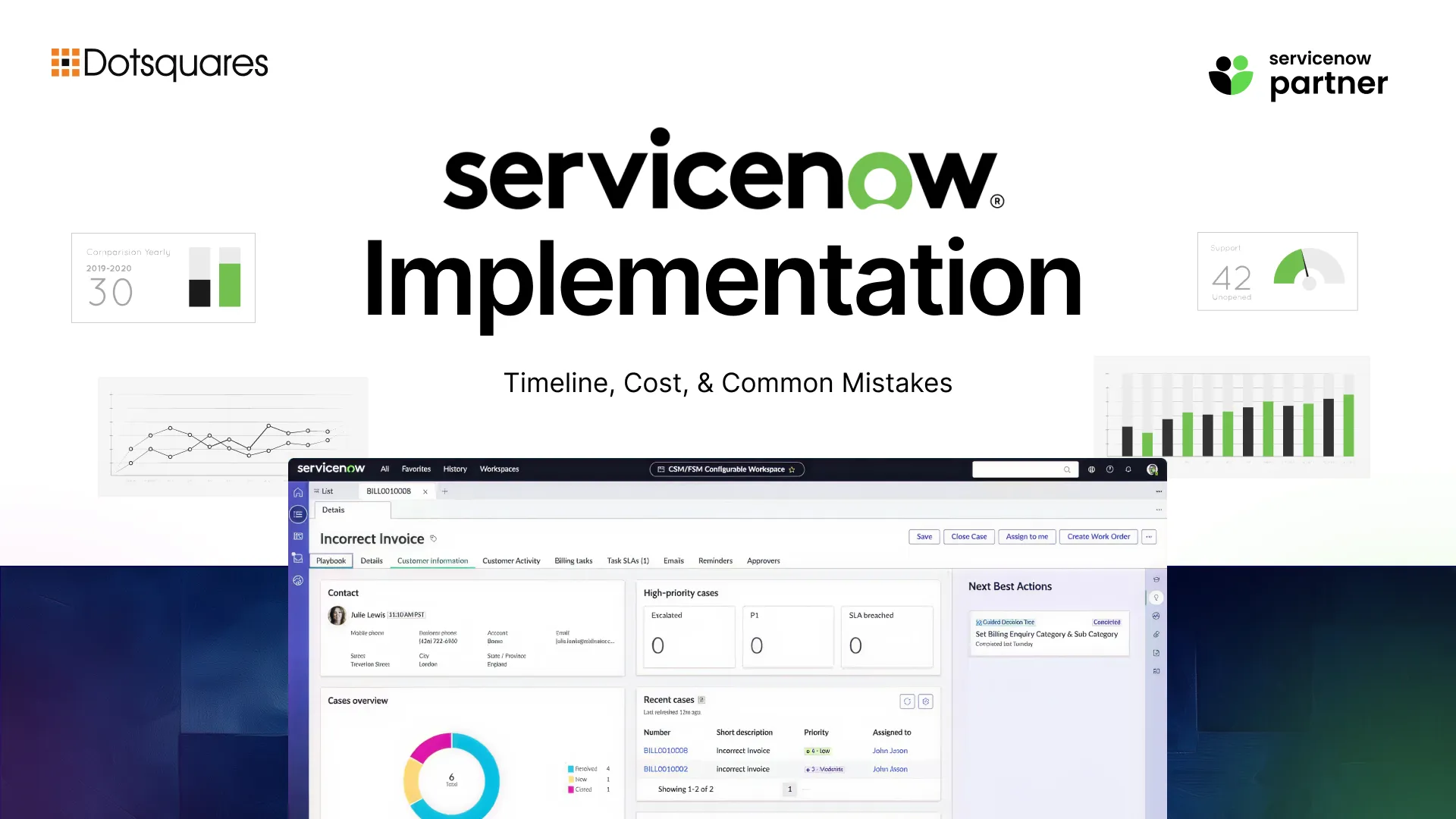
When a company makes the decision to use ServiceNow, the first meeting will be lively and enthusiastic about the many benefits of ServiceNow, such as automating processes with Artificial Intelligence, having a single location for all business operations, etc. However, once the project begins, most companies begin to see the number of technical and physical complexities of completing the implementation of ServiceNow. An implementation is more than installing an application on a computer; it represents a major change in how an organisation runs their business (service delivery and data management).
This guide will identify real-world issues associated with a ServiceNow implementation today by focusing on the components of a ServiceNow implementation, including timelines and cost factors, as well as areas where seasoned IT professionals (IT directors, IT managers, etc.) often get caught.
In simple terms, ServiceNow is a massive platform. Whether you are starting with IT Service Management (ITSM) or diving straight into Employee Experience (EX) and HR, the implementation is a multi-layered process. It isn't a single event but a journey that transforms your internal culture as much as your technical stack.
Recently, we’ve seen how businesses are pushing these boundaries even further. For instance, the Teleperformance ServiceNow AI transformation shows how integrating GenAI and automation can fundamentally change the speed of service, but getting to that stage requires a rock-solid foundation.
At Dotsquares, one of the most common questions we get is, "When can we turn on the system?" The short answer is that it depends on your project scope, but generally, most successful implementations will take between three (3) and nine (9) months for the first part of the project.
Here’s a simple breakdown of the project timeline.
When budgeting for ServiceNow implementation services, many leaders make the mistake of only looking at the license cost. In reality, the license is often just a portion of the total investment.
So, why does the cost vary so much?
ServiceNow is a powerful tool, but it isn't magic. Most "failed" implementations aren't due to technical glitches; they are due to human and strategic errors.
Many companies try to launch every module at once. This usually leads to a system that is too complex for employees to use. A phased approach is almost always better. Start with a core module, prove the value, and then expand.
A classic mistake is trying to make ServiceNow look and behave exactly like your old, broken legacy system. ServiceNow is built on "Best Practices." The more you customise the core code, the harder it becomes to upgrade to new versions like Xanadu or Washington. Stick to "configuration" over "customisation" whenever possible.
You can build the most beautiful portal in the world, but if your staff finds it confusing, they won't use it. Training and internal "selling" of the platform are just as important as the code.
If you put bad data in, you get bad reports out. Without a clear owner for data quality, your ServiceNow instance will quickly become a "data swamp" rather than a "data lake."
Because the platform is so vast, most businesses find that they need external guidance to avoid the pitfalls mentioned above. ServiceNow consulting services provide that outside perspective. They bring the experience of dozens of other implementations, knowing exactly which features are worth the investment and which ones are just "noise."
Professional consultants help you align your technical goals with your business strategy. They ensure that your implementation isn't just an IT project, but a business transformation.
The ServiceNow platform is quickly evolving. Businesses have begun to develop their own applications through the rise of "low-code" and "no-code" options, thus creating new possibilities for non-technical end users to create applications. In addition, the ServiceNow integration of Generative AI (Now Assist) will drastically change our interaction with Service Desks.
To maximise your long-term ROI, it is critical that you stay on top of Future ServiceNow Trends. You need to build a solution that prepares your system for a future of AI-based services.
At the end of the day, a successful ServiceNow implementation is about balance. You need the technical skill of a ServiceNow Developer, the strategic vision of ServiceNow implementation services, and a clear understanding of your own internal processes.
Don't look at ServiceNow as just another software purchase. Look at it as a way to clear out the manual, repetitive tasks that hold your business back. If you take the time to plan, avoid the trap of over-customisation, and focus on the user experience, you will see a return on investment that goes far beyond just "better IT."
If you’re ready to start your journey or need a "health check" on your current instance, explore how Dotsquares can help guide your ServiceNow consulting services and turn your digital strategy into a reality.



 October 15, 2026
Learn how low-code integration connects business apps and APIs, its key benefits, common use cases, limitations, and when to choose custom integration.
Keep Reading October 15, 2026
Learn about SAP BW to cloud migration, including benefits, challenges, AWS options, cost factors and planning steps for a successful migration.
Keep Reading October 12, 2026
Learn how React Native works, where it saves time and cost, which industries use it, and whether it's still a good choice in 2026.
Keep Reading