
Is Your Business AI-Ready?

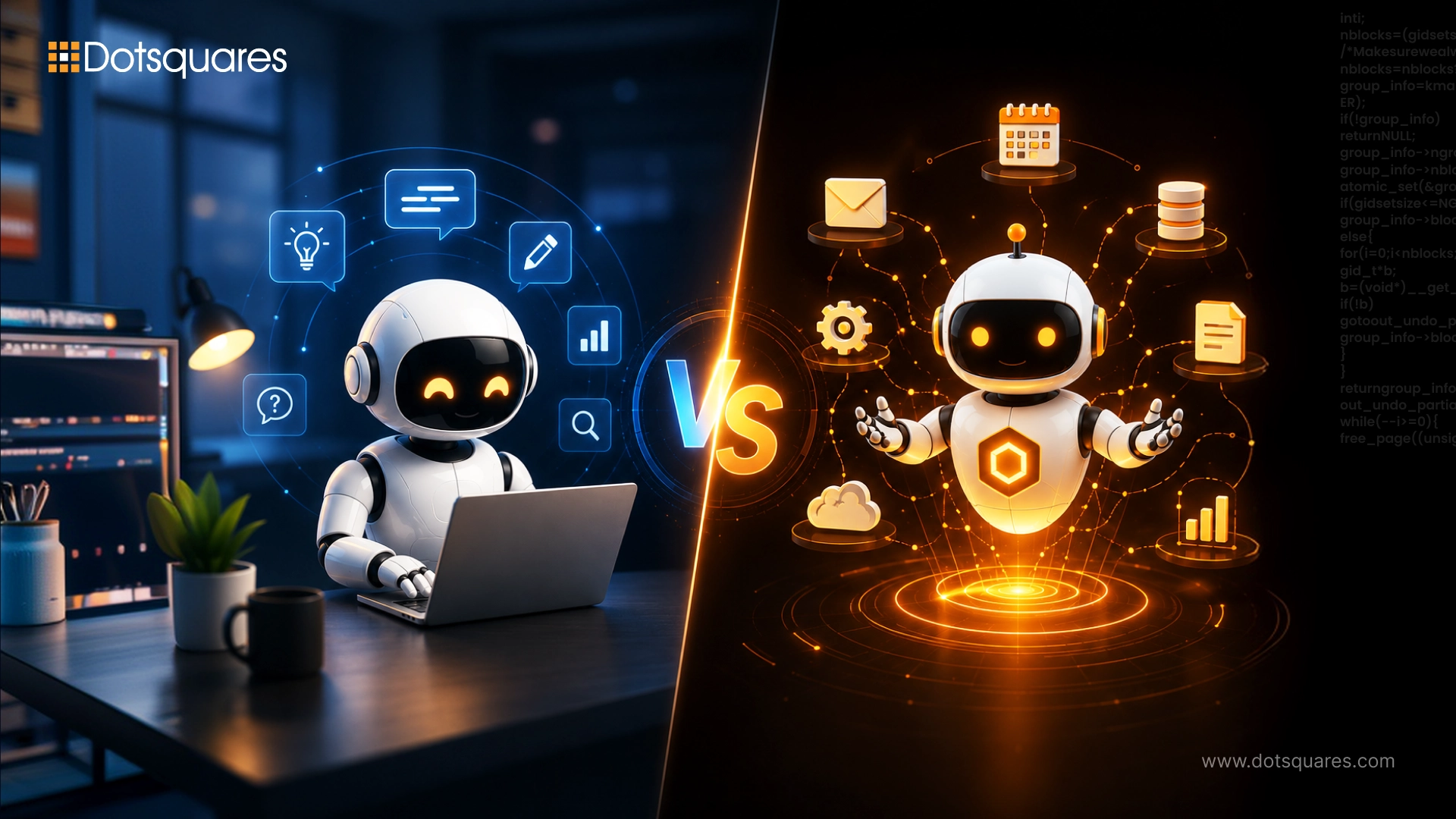
The use of artificial intelligence (AI) in business has completely changed the way of working in the office. The entrance of AI has made it easier to automate repetitive tasks and make decisions more productive. The development of AI technology has made organisations adopt various solutions that do not just assist workers but also perform complex workflows automatically. This development has led to two key terminologies in AI, which are: AI Copilot and AI Agent.
Even though the two terms are sometimes used interchangeably, there is a difference between the two. The major point of difference is in how autonomy, decision-making, and execution of workflows in the two AI terms are conducted. Both AI Copilot and AI Agent use some similar technologies, including LLMs, NLP, and machine learning.
An AI copilot can be defined as a digital assistant designed to assist users and enhance their productivity. It helps employees in performing routine tasks such as drafting emails, summarising meetings, analysing data, generating code, creating reports, and answering questions using natural language. The noticeable feature of an AI copilot is that it doesn’t remove the need of humans in performing any activity but helps them in finishing that task successfully. It provides realistic information to employees based on the data collected from actual users and available within the organisation. It doesn’t insist user take any decision based on its recommendations and allows him to use his discretion before reaching any decision. This makes AI copilots ideal for improving efficiency without removing human judgement from the process.
Today, AI copilots are widely used in productivity applications, CRM platforms, collaboration tools, and software development environments to help employees work smarter and faster.
AI agent is a more sophisticated AI technology used to perform specified tasks with less human interaction. Instead of reacting to individual commands, it understands a goal, creates a plan of action, communicates with several programs, makes decisions within set limits, and performs the entire workflow. In contrast to AI copilots, AI agents are capable of monitoring progress, adjusting to changes, and taking the next right step without the need for continuous prompts from a user. When organisations consider implementing self-governing AI solutions, they often encounter similar AI technologies called 'generative AI' and 'agentic AI'. Knowledge about all these AI technologies helps understand better how AI for enterprises develops. Gen AI vs AI Agents vs Agentic AI gives a good understanding of the differences between these AI technologies and how they can be applied in practice. For instance, an AI agent responsible for customer support can get a request, check customer details, read data in CRM, write down a proper response, escalate the situation if needed, save information in databases, and close the customer support ticket – all without constant human supervision.
Though the technologies used in AI copilots and AI agents may be similar, there is a difference in their uses and objectives.
The main aim of using an AI copilot is to help users perform a task in a more efficient way. This technology helps boost productivity of employees through giving them suggestions, answering any questions, and performing some mundane operations, leaving the decision-making on the side of humans.
AI agents have much larger objectives since they are designed not to help perform one particular task but to reach a certain goal. They identify the steps needed to achieve it and then perform those steps, constantly assessing their performance. Simply speaking, AI copilots help people perform tasks, while AI Agents perform those tasks themselves.
One of the main distinguishing features of both AI agents and copilots is their human involvement in the process. AI copilots need to be activated by the user, review results, and authorise the completion of the process. Human involvement is essential in all operations.
AI agents have more autonomy because, after being provided with objectives, permissions, and company rules, they are capable of carrying out an action without the need for human intervention unless it is required for authorisation or exceptions.
AI copilots help in making decisions by analysing information available and suggesting courses of action. Nevertheless, they do not make any independent critical decisions about the business operation.
Reasoning abilities of AI Agents help in evaluating the situation, prioritising actions, problem-solving, and making a decision without needing further human input. Such capability allows for automation of business processes through AI Agents.
AI copilots are built to help users in task completion. These Copilots perform their functions by writing documents, summarising the outcome of the meeting, analysing the report, and generating software code based on user prompts.
AI agents work in a goal-oriented way. These agents break down big goals into small goals, coordinate activities between various applications, monitor workflow progress, and adapt workflows as and when required.
It makes AI agents better candidates for automation within enterprises.
AI copilots can understand the context of the ongoing conversation and enterprise data and respond appropriately. The key function of these copilots is to help users during the ongoing conversation.
AI agents stay aware of the whole workflow process. They can remember the past action performed, keep track of ongoing activities, analyse the results achieved, and make better decisions based on historical context.
In most cases, AI copilots increase efficiency in one specific app, for example, an office suite, CRM system, or programming environment.
On the other hand, AI agents are meant to manage operations not only within but also between different enterprise systems such as ERP systems, databases, APIs, messaging platforms, clouds, and business applications.
Such orchestration between systems is a unique feature of Agentic AI systems when intelligent systems coordinate their operations in order to produce a full result.
AI copilots are applied to the following: • Email writing • Report writing • Software coding • Meeting summaries • Presentation preparation • Business data analysis • Sales and customer service teams
AI agents are applied to the following: • Customer service automation • Invoice processing • Onboarding employees • Optimising supply chains • Procurement automation • IT services management • Cybersecurity
It all comes down to what business objective you are seeking to achieve. In case of increasing productivity, speeding up content production, and facilitating decision-making, you should opt for AI copilots.
If you wish to automate the whole workflow from start to finish, save effort, and increase efficiency, then AI agents offer far more value.
AI copilots and AI agents do not compete against each other, but rather complement each other. Nowadays, businesses employ AI copilots to assist their employees, as well as AI agents to perform automated tasks in the background.
AI copilots and AI agents reflect the various levels of enterprise AI maturity. AI copilots help human beings become more productive by providing them with help, while AI agents can plan and execute business processes without any human intervention to achieve some objectives.
The emergence of AI will mean that organisations using collaborative and autonomous AI are well placed to become more efficient and complete their digital transformation.



 October 16, 2026
Learn how E-commerce security protects your online store from fraud, data breaches, and bots. Explore threats, PCI DSS, and best practices.
Keep Reading October 15, 2026
Learn how low-code integration connects business apps and APIs, its key benefits, common use cases, limitations, and when to choose custom integration.
Keep Reading October 15, 2026
Learn about SAP BW to cloud migration, including benefits, challenges, AWS options, cost factors and planning steps for a successful migration.
Keep Reading 6 min read