Tech
Building AI-Powered Knowledge Assistants for Healthcare Organisations
 4 min read
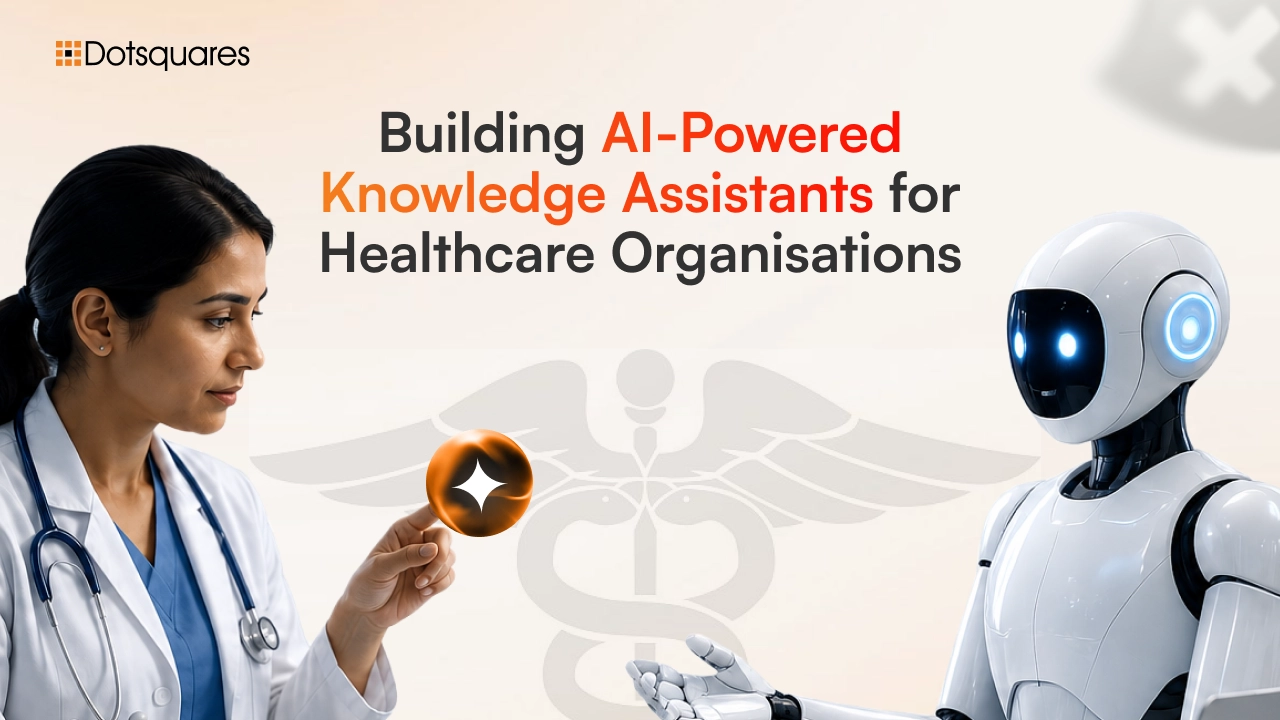
Walk into any busy hospital ward and ask a senior nurse how much time they spend searching for information during a shift. The answer will surprise you. Clinical guidelines buried in three different systems, drug references that haven’t been updated since the last software migration, patient history split across two portals that don’t talk to each other. Most healthcare staff have accepted this friction as part of the job, despite the impact it can have on efficiency.
AI-powered knowledge assistants have moved beyond evaluation stages and are now used by clinical and administrative teams during everyday operations. The gap between organisations that have built this infrastructure and those that haven't is widening fast.
This Is Not a Chatbot
The distinction matters more than most people realise.
A chatbot fields predefined queries and routes users to static content. A knowledge assistant understands intent, pulls from live organisational data and returns answers specific to the question, not the nearest keyword match.
Think about what that means practically:
- A pharmacist checking a contraindication doesn’t need a list of search results; they need the right answer, in context, right now
- A billing coordinator verifying a payer policy doesn’t need a help desk ticket; they need the actual clause surfaced immediately
- A newly onboarded clinician asking about internal protocols does not need to wait for a senior colleague; the answer should already be accessible
That specificity is what separates genuinely useful healthcare IT solutions from technology that looks impressive in a demo and gets abandoned six months post-launch.
What Organisations Are Actually Building
The healthtech software development work happening in this space typically centres on a few core technical decisions.
The first is how data gets ingested and structured. Healthcare data is notoriously fragmented: clinical notes, scanned forms, EHR entries, lab reports, payer contracts. Getting this into a format an AI system can work with accurately requires real investment upfront. Organisations that skip this step and go straight to model deployment regret it.
The second is the retrieval architecture. Most serious implementations use a retrieval-augmented generation approach, where the system pulls relevant documents from the organisation’s own knowledge base before generating a response. This matters in healthcare more than almost any other sector because the cost of a hallucinated answer is not a minor inconvenience; it’s a clinical risk. Custom healthcare software built for this use case needs retrieval pipelines that are tight, auditable and regularly evaluated against ground truth.
The third is access control. Access permissions affect how information moves across the organisation and who can use it. Clinical staff, administrative teams and support personnel often require different levels of access based on their responsibilities. A custom AI healthcare solution can apply those permissions throughout the system. Patient data, internal protocols, financial records and operational documents each carry their own sensitivity and compliance requirements.
Speaking of compliance, HIPAA doesn’t leave much room for improvisation. Every data access event needs to be logged, and every query traceable. This is one of the biggest gaps in off-the-shelf tools and one of the clearest arguments for purpose-built healthtech software development services over generic enterprise AI platforms.
Where Healthcare Organisations Are Seeing Real Value
Staff time is the most immediate impact. When clinicians spend a significant part of their day retrieving information rather than applying it, an AI layer that handles retrieval changes the math considerably, with meaningful downstream effects on burnout.
Beyond that, the value shows up in a few specific areas:
- Clinical decision support: Surfacing relevant protocols at the moment a clinical question arises, without a separate lookup or leaving the workflow
- Patient-facing tools: Through healthcare mobile app development, organisations are extending these capabilities to patients for medication reminders, symptom triage and post-discharge follow-up
- Onboarding: New staff in complex healthcare environments get a 24/7 resource for procedural questions, reducing dependency on senior colleagues for basic information
Healthcare mobile app development services that build patient-facing assistants will have to think hard about plain-language communication, accessibility and what happens when a patient’s question falls outside the assistant’s scope. The edge cases matter as much as the happy path.
Why So Many Implementations Fail
The pattern is consistent. A general-purpose model gets deployed without domain-specific fine-tuning. The underlying data quality was never addressed. The rollout skipped the pilot phase. Clinical staff were not involved in workflow design. Nobody planned for change management.
Healthcare software experts who have shipped production systems in clinical environments ask different questions than general-purpose development teams. They know that a system that demos well in a conference room can fall apart under real-world usage. The domain knowledge that distinguishes a capable development partner from a capable software shop is not something that can be acquired mid-project.
Organisations serious about custom HealthTech software for knowledge management should be looking for partners who understand clinical workflows, EHR software solutions, regulatory environments and the practical difference between a prototype and a production system before signing a contract, not after the first deployment fails.
The organisations building this infrastructure now are making a long-term operational bet that will pay off. If you want to understand what a knowledge assistant built specifically for your organisation could look like, Dotsquares’ healthcare IT team can walk you through it.


Related Post

 October 15, 2026
Low-Code Integration: What It Is, How It Works and When Businesses Should Use It
Learn how low-code integration connects business apps and APIs, its key benefits, common use cases, limitations, and when to choose custom integration.
Keep Reading October 15, 2026
SAP BW to Cloud Migration: Benefits, Challenges and Planning Steps
Learn about SAP BW to cloud migration, including benefits, challenges, AWS options, cost factors and planning steps for a successful migration.
Keep Reading October 12, 2026
Mobile App Development with React Native and What You Need to Know
Learn how React Native works, where it saves time and cost, which industries use it, and whether it's still a good choice in 2026.
Keep Reading