Tech
Lovable Pricing Guide 2026: Plans, Pros, Cons & Best Alternatives
 6 min read
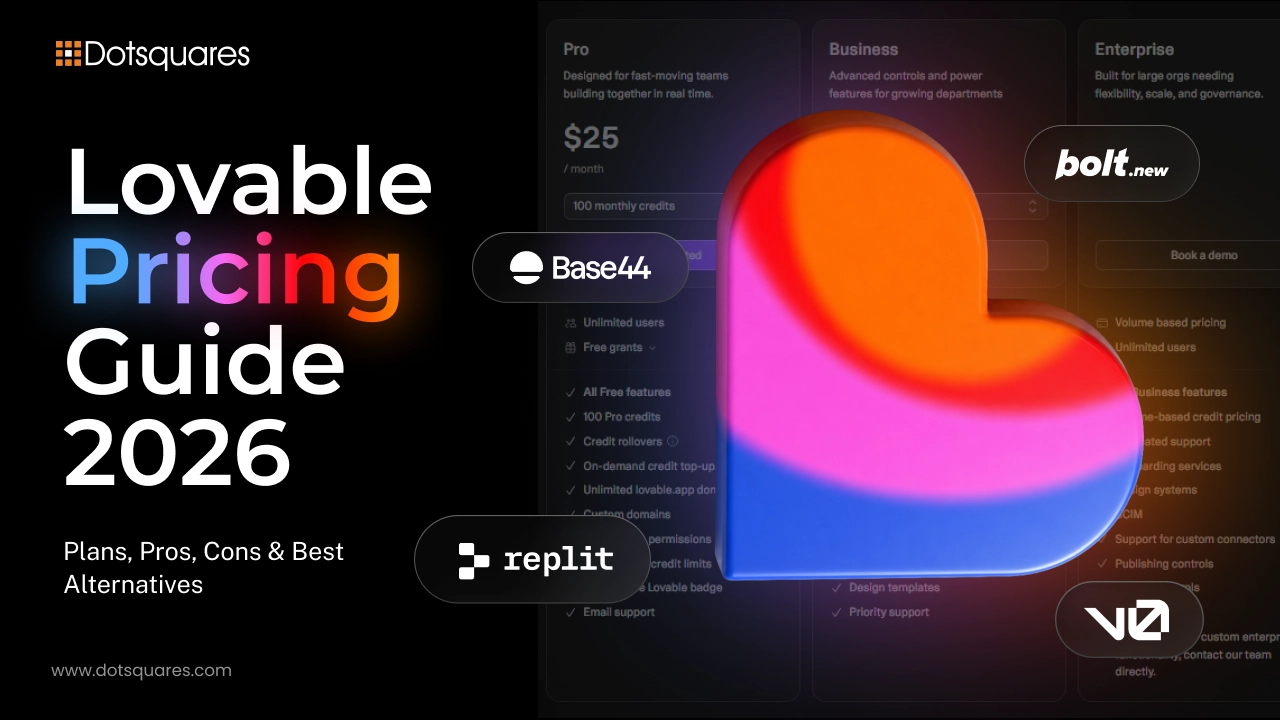
Lovable went from a launch in 2024 to a $6.6 billion valuation in under a year, which tells you the demand is real. What it doesn't tell you is what you'll actually pay once you're past the demo and into a genuine build.So here's the complete Lovable pricing breakdown, what you'll actually spend beyond the subscription, and whether Lovable or one of its best alternatives is the right choice for your project. Consider this the lovable buying guide and lovable pricing 2026 breakdown we wish existed before we started comparing tools ourselves.
What Is Lovable?
Lovable is an AI-powered app builder that turns plain-language prompts into working full-stack applications, built on React and Supabase by default. Describe what you want, and it generates the frontend, wires up the backend, and gets you to a live URL considerably faster than a traditional build. It's one of the more prominent names in what's now widely called vibe coding, alongside tools like Bolt, v0, and Replit.
The core pitch is speed without needing an engineering team on day one, which is exactly why it's found traction with founders, product managers, and agencies building demos live during client meetings. That said, "fast to build" and "ready for serious production traffic" are two different things, a distinction worth keeping in mind before treating a Lovable prototype as a finished product.
While Lovable is excellent for rapid prototyping, businesses with complex workflows, third-party integrations, or long-term scalability requirements often move towards custom software development to gain greater flexibility and control.
Key Features of Lovable
- Natural-language prompting that generates full-stack code, not just UI mockups
- Built-in Supabase integration for authentication, database, and storage
- Two-way GitHub sync, so code can move between Lovable and a traditional IDE
- Custom domain support and white-label branding removal on paid tiers
- Real-time multiplayer collaboration for teams working on the same project
- AI-powered penetration testing, added in March 2026, priced separately at $100 per scan
Lovable Pricing Plans
|
Plan |
Price |
Monthly Credits |
Key Features |
|
Free |
$0/month |
5 daily (up to 30/month) |
Public projects only, core AI generation, no custom domain |
|
Pro |
$25/month |
100 |
Private projects, custom domains, branding removal, Code Mode |
|
Business |
$50/month |
200-250 |
SSO, data opt-out, shared team credit pool |
|
Enterprise |
Custom (often $500+/month) |
Custom limits |
Audit logs, dedicated onboarding, priority support, AI gateway access |
Annual billing saves roughly 16-17% off the monthly rate, and unused credits on paid plans roll over month to month as long as the subscription stays active, daily free-tier credits reset every 24 hours and don't carry over.
Lovable Pricing Comparison
Credit-based pricing sounds simple until you actually start building. A basic styling tweak costs around 0.5 credits, while something like authentication can run 1.2 to 3 credits depending on complexity, and a typical MVP burns through 150-300 credits over a few weeks of active iteration. Top-up pricing adds another wrinkle: Pro users pay roughly $15 for 50 extra credits, while Business users pay $30 for the same 50, effectively double the rate on the more expensive plan.
There's also a cost most buyers miss entirely: once your app is deployed, Lovable Cloud bills separately for hosting and runtime AI usage beyond a small free allowance ($25/month hosting credit, $1/month AI usage credit bundled in). An idle prototype costs little. An actively used app can push your real monthly bill noticeably above the plan's sticker price.
Compared to flat-fee competitors, this is where Lovable's model genuinely diverges. Cursor, Windsurf, and v0 mostly charge a predictable monthly fee with usage limits baked in, rather than metering every single prompt. Lovable's credit system can work out cheaper for a small team building in short bursts, but it's harder to budget for with any real precision, especially once a project moves from prototyping into active daily iteration.
Pros of Lovable
- Genuinely fast path from prompt to a live, working full-stack app
- Strong Supabase integration handles auth, database, and storage without manual setup
- Real-time collaboration suits agencies building live during client meetings
- Credit rollover on paid plans is more forgiving than a hard monthly reset
- Built-in security testing option addresses a genuine, common vibe-coding weakness
Cons of Lovable
- Credit-based pricing makes total cost genuinely hard to predict in advance
- Deployed apps consume credits and Cloud usage even when you're not actively building
- Free tier is workable for learning but too limited for anything beyond a simple prototype
- Locked into Supabase by design, less flexible than tools offering broader backend choice
- Business-tier top-up pricing is proportionally worse value than Pro-tier top-ups
Best Lovable Alternatives
|
Tool |
Best Use For |
Free Tier |
Starting Price |
Rating |
|
Bolt.new |
Stack-flexible prototyping (Vue, Svelte, React) |
1M tokens/month |
$20/month |
4.3/5 |
|
v0 (Vercel) |
UI-first component generation |
Limited free tier |
$20/month |
4.2/5 |
|
Cursor |
Developers wanting deep codebase control |
Limited free tier |
$20/month |
4.6/5 |
|
Windsurf |
Budget-friendly IDE-based coding assistant |
Free daily quota |
$15/month |
4.3/5 |
|
Replit |
Cloud IDE with built-in hosting and database |
Free tier available |
Effort-based, can scale fast |
4.1/5 |
Lovable vs Competitors
|
Factor |
Lovable |
Bolt.new |
v0 |
Cursor |
|
Pricing |
Credit-based, $25-$50/month + Cloud usage |
Token-based, $20/month |
Flat + usage, $20/month |
Flat, $20/month |
|
Ease of Use |
Very high, built for non-developers |
High |
High for UI, weaker for full-stack |
Lower, requires coding knowledge |
|
AI Quality |
Strong for CRUD and full-stack logic |
Strong, more framework flexibility |
Excellent for UI, weaker at backend |
Excellent for complex, multi-file logic |
|
Deployment |
Built-in Lovable Cloud hosting |
Built-in hosting |
Vercel-native deployment |
Requires external deployment |
|
Backend Support |
Deep, Supabase-native |
Flexible across providers |
Limited, frontend-focused |
Full control, developer-managed |
|
Customization |
Moderate, some Supabase lock-in |
High |
Moderate |
Very high |
|
Collaboration |
Real-time multiplayer |
Individual-focused |
Individual-focused |
Git-based team workflows |
Conclusion
Lovable earns its popularity honestly, it's genuinely one of the fastest ways to go from an idea to a working full-stack app without writing code. But the credit-based pricing model means the sticker price is rarely the real price, especially once a deployed app starts consuming Cloud usage on top of your monthly plan. For teams that need production-grade reliability, deeper customization, or a mobile app rather than a web prototype, that's usually the point where bringing in proper mobile app development services makes more sense than stretching a vibe-coding tool past what it was built for. If you've already built something in Lovable and need it running as a native app, our guide on converting a Lovable web app to iOS and Android walks through exactly how that transition works.
Frequently Asked Questions
What is the best Lovable alternative?
It depends on your priority. Bolt.new suits stack-flexible prototyping, Cursor suits developers wanting deep codebase control, and Windsurf offers the most budget-friendly option for IDE-based coding assistance.
Does Lovable support production apps?
Lovable can deploy working production apps with databases, authentication, and payments for simpler use cases, though most teams building complex, high-scale systems eventually move the code to a properly engineered backend and dedicated hosting.
Which AI app builder is best in 2026?
There isn't a single winner across the board. Lovable leads for CRUD-heavy full-stack apps, v0 leads for UI-focused work, Bolt leads for framework flexibility, and Cursor leads for developers who want full codebase control.
How much does Lovable cost in 2026?
Plans run from free (5 daily credits) up to $50/month for Business, with Enterprise pricing custom-quoted. Real costs often run higher than the sticker price once credit top-ups and Lovable Cloud hosting usage are factored in.
Can I build production-ready apps with Lovable?
Yes, for simpler applications. For anything handling sensitive data, high traffic, or complex business logic, a proper security review and infrastructure hardening beyond what Lovable provides out of the box is generally recommended before real users depend on it.


Related Post

 October 16, 2026
E-commerce Security: Protect Your Store From Cyber Threats
Learn how E-commerce security protects your online store from fraud, data breaches, and bots. Explore threats, PCI DSS, and best practices.
Keep Reading October 15, 2026
Low-Code Integration: What It Is, How It Works and When Businesses Should Use It
Learn how low-code integration connects business apps and APIs, its key benefits, common use cases, limitations, and when to choose custom integration.
Keep Reading October 15, 2026
SAP BW to Cloud Migration: Benefits, Challenges and Planning Steps
Learn about SAP BW to cloud migration, including benefits, challenges, AWS options, cost factors and planning steps for a successful migration.
Keep Reading