
Is Your Business AI-Ready?

Walk into almost any leadership meeting in 2026 and someone will proudly mention the company's "AI strategy." Ask them to actually define it, though, and things tend to get vague fast. A chatbot here, a pilot project there, maybe a subscription to a tool half the team forgot they had. Is that AI maturity? Or is it just AI activity dressed up to look like progress?
That distinction matters more than most leaders realise. A recent survey of 4,500 executives put the average enterprise AI maturity score at just 51 out of 100 in 2026. Up from 35 the year before, sure, but still barely past the halfway mark. Meanwhile, close to 90% of organisations report using AI somewhere in their operations, and only a small fraction have anything to show for it in hard numbers. Spending is up. Confidence is up. Results? Not so much.
So where does your business actually stand? Not where you assume it stands, or where the last vendor pitch made it sound like it stood, but where it really is. That's exactly what this guide is here to help you figure out. We'll break down what an AI maturity model actually measures, why guessing your way through AI investment is an expensive habit, and how a proper AI readiness assessment gives you a straight answer before you commit another budget cycle to the wrong priorities.
An AI maturity model is basically your guide to the extent to which AI has become an integral part of your day-to-day business operations, but not how many AI features have been lying around unused in someone's browser. It goes beyond the number of tools adopted and poses a more challenging question: does AI generate real-world outputs that you can point towards, or has it still managed to find a comfortable pilot environment?
Gartner's widely referenced framework breaks this into five stages: Foundational, Emerging, Operational, Scaled, and Transformational. Move from ad-hoc experimentation with no coordination, to early pilots, to AI embedded in a handful of processes with clear ownership, to AI running across functions with measurable returns, and finally to AI reshaping how decisions get made at every level. Most companies, if they're honest, are stuck somewhere in the first two stages.
Think of it less like a scoreboard and more like a mirror. A good maturity model shows you where the gaps actually are, not where you assumed they'd be.
Let's ground this in numbers instead of guesswork, because the gap between AI ambition and AI reality is wider than most leadership teams realise.
None of this means AI doesn't work. It means most companies are further behind on the foundational work, data, governance, and workflow integration, than their AI spend suggests. That's exactly the gap an AI maturity assessment for enterprise organisations is designed to surface.
So what does each stage actually look like on the ground? Here's the plain-language version.
Foundational. AI conversations are happening in meetings, but there's no real coordination behind them. Maybe a few people are playing around with ChatGPT. There's curiosity, not strategy.
Emerging. Small pilots start popping up in individual departments. Marketing tries an AI writing tool, ops tests a chatbot. Executive interest is growing, but nothing is connected or measured consistently.
Operational. AI gets embedded into a few defined processes with someone actually accountable for outcomes. This is usually where organisations start asking harder questions about data quality and security.
Scaled. AI capabilities are deployed across multiple functions, and leadership can point to measurable ROI, not just anecdotes. Governance stops being an afterthought and becomes part of how projects get approved.
Transformational. AI is no longer a "project." It's part of how the business thinks, decides, and competes. Very few organisations are genuinely here yet, and that's fine, most aren't supposed to be in 2026.
Knowing which stage you're actually in, rather than which stage your slide deck claims, is the entire point of running an honest assessment.
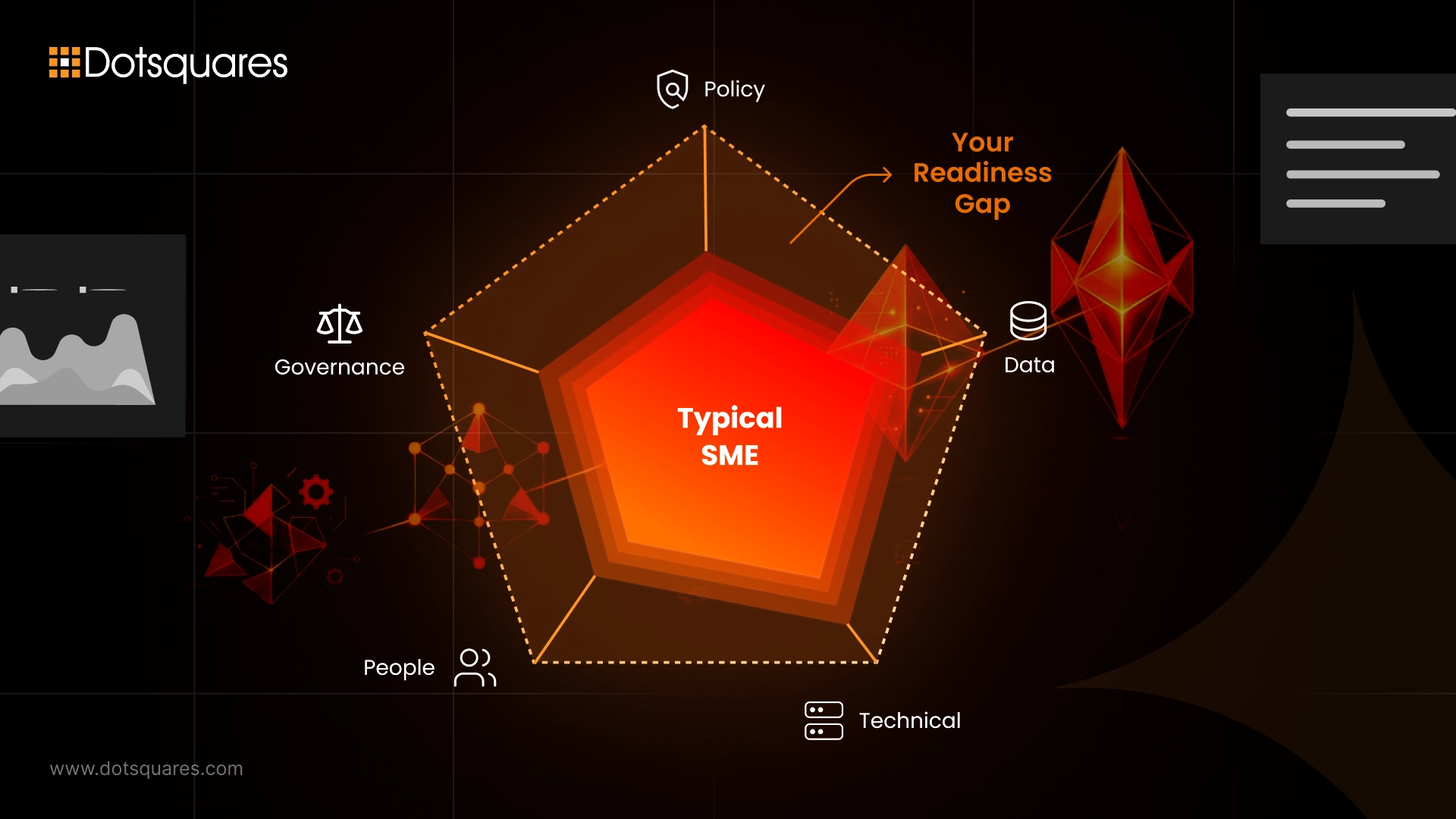
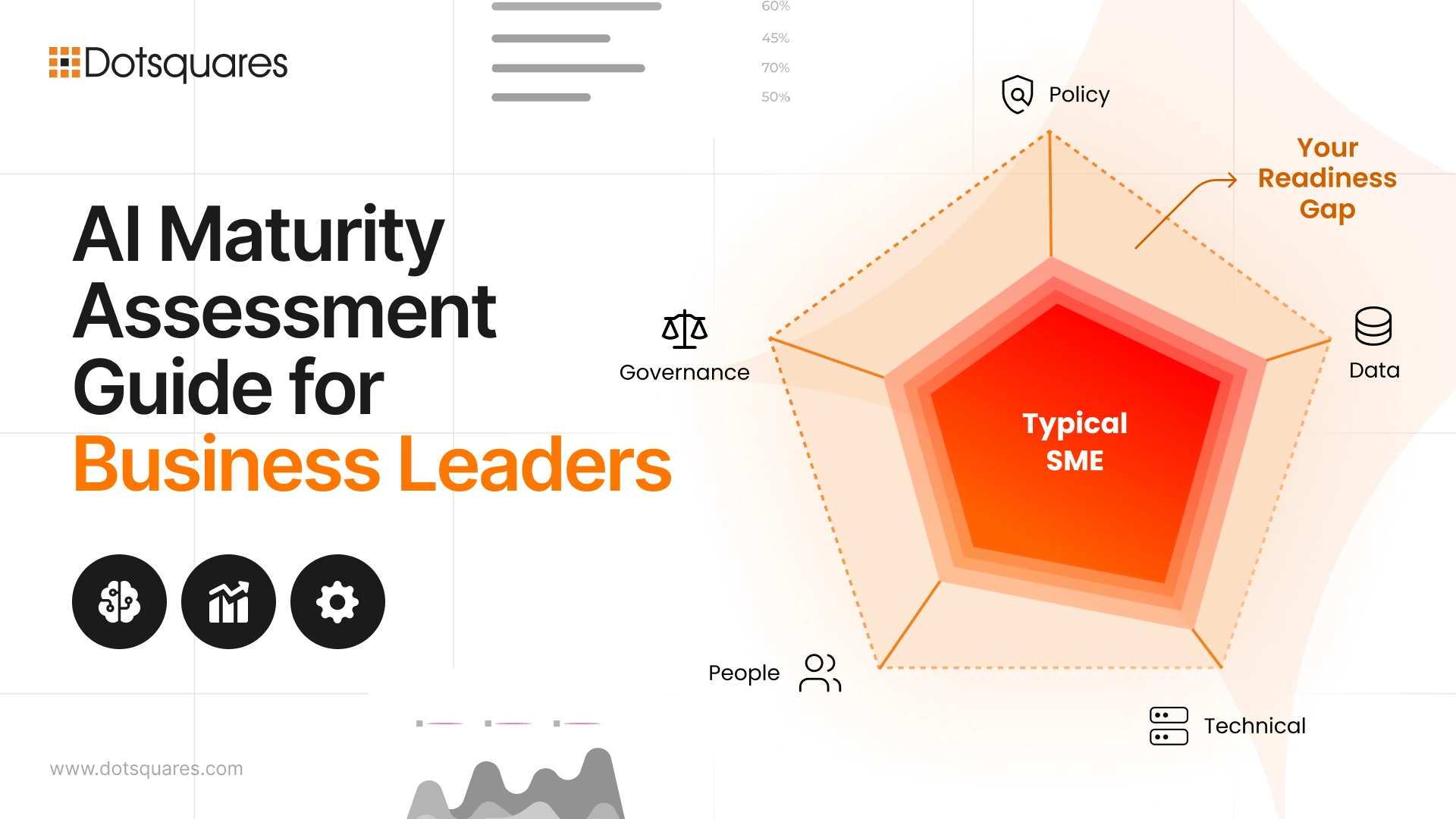
A proper AI maturity assessment framework doesn't just ask "do you have an AI tool?" It looks across five interconnected pillars, because a business can be advanced in one area and still be stuck in another.
Strategy and alignment. Is AI tied to specific business goals, or is it just something the board wanted to hear about? Leadership sponsorship matters here more than budget size.
Data and integration. Can your systems actually feed clean, connected data to an AI model, or is everything sitting in silos that nobody wants to touch? This is where most maturity gaps quietly hide.
Technology and tooling. Are you running fragmented point solutions, or a stack that can scale without falling over the moment usage grows?
Talent and culture. Do your teams have the skills and confidence to actually use AI in their daily work, or is adoption limited to a handful of enthusiasts?
Governance and risk. Is there a real policy for how AI gets approved, monitored, and audited, or is everyone quietly building their own "shadow AI" workflows without anyone in IT knowing?
Score yourself honestly across all five, and you'll usually find the picture looks very different from department to department. Your engineering team might be miles ahead of your finance team, and that's completely normal.
There is no six-month consulting engagement needed to provide a worthwhile first read on your standing. A practical AI readiness assessment can help you identify gaps in your strategy, data, technology, talent, and governance before making major investments. Here's a simple way to do it.
To begin with, you must do a truthful review. Make a list of all AI tools pilots experiments currently at work in the company, even the ones you never approved officially. You can be quite surprised, as it turns out there is quite a lot of AI use going on in "shadows".
Besides, the use of AI should be measured with function, not just company-wide. In such a case as one company-wide score is not only hiding but actually misleading. You are better served to evaluate different departments like sales service marketing, and IT together as their readiness levels will seldom be exactly alike.
Data issues should be your first consideration. There is no way that AI investment will solve the scattered data problem in your company if your data resides in many separate, disconnected systems. You need to first tackle the plumbing, so to speak.
The last thing they suggest you to do is: measure the results instead of measuring work done. Do not consider success in how many people have logged in to an AI tool. Instead, success should be measured as actual changes like time saved, error rate decreased, and revenue generated.
Pressure-test your governance. Ask who approves a new AI use case today. If the honest answer is "nobody, really," that's your starting point for fixing things.
If you want a more structured starting point, our detailed AI readiness assessment guide walks through this in more depth, and our AI readiness checklist gives you a quick way to sense-check where the obvious gaps sit before you go further.
Most organisations don't get stuck because of bad technology. They get stuck because of decisions that seemed reasonable at the time.
Chasing tools before strategy is the most common one. A flashy new AI platform doesn't fix a business problem that was never clearly defined in the first place. Ignoring data quality is another. Teams get excited about models and forget that even the best AI is only as good as what it's fed.
Governance is something important. When the leadership layer in the company is not involved in managing AI risks, it becomes difficult for other departments to work together effectively without being able to share the tools they create. In the worst case, each department will end up with its own tools which leadership is not even aware of. Besides, treating AI development like an IT project rather than a business one means it stays isolated with no possibility of spreading throughout the company.
Our breakdown of common AI integration challenges goes deeper into exactly where these breakdowns tend to happen and how to avoid them before they cost you a year of progress.
An assessment is only useful if it leads somewhere. Once you know your current stage, the next step is building a roadmap that's realistic rather than aspirational.
Start with the pillar showing the widest gap, usually data or governance, and fix that before adding new AI use cases on top of a shaky foundation. Prioritise one or two high-impact workflows tied directly to revenue or cost, rather than trying to automate everything at once. From there, you can look at where Custom AI/ML Solutions make sense for your specific business problems instead of generic, off-the-shelf tools that don't quite fit how your teams actually work. As agentic AI matures, many enterprises are also exploring Custom Agentic AI Development to move beyond simple chatbots into systems that can actually plan and execute multi-step tasks, provided the governance and data foundation is ready to support it.
You can absolutely run a first-pass assessment internally, and you should. But scaling from "we ran an assessment" to "AI is producing measurable business value" usually benefits from outside perspective, mainly because it's hard to be objective about your own organisation's blind spots. Good examples of AI maturity consultants have a broad understanding of how AI implementation works in different industries from the many case studies they have examined. It is these consultants who are able to detect exactly what the bottleneck is in the operation of the company and propose the best solutions much quicker than the staff of a company who would only have to discover and figure things out by themselves gradually from the beginning. That is why a company's AI development plan would be greatly enhanced by engaging the assistance of expert consultants, Mostly when it involves developing new AI tools and scaling up the use of AI, since getting the blueprint of the entire AI development and integration architecture right from the very start is the key.
What's the difference between AI adoption and AI maturity?
Adoption just means people are using AI tools. Maturity means AI is embedded into workflows and actually producing measurable business outcomes.
How often should we run an enterprise AI assessment?
Once a year at minimum, though fast-moving organisations often benefit from a lighter check-in every six months given how quickly the technology and internal usage shifts.
Do we need outside help for an AI maturity assessment, or can we do it internally?
You can start internally with a basic self-assessment, but bringing in outside expertise usually surfaces blind spots your own team is too close to see.
What's the biggest blocker to AI maturity in most companies?
Fragmented data and unclear governance, far more often than a lack of good AI tools or talent.
Is agentic AI the same as being "AI mature"?
No. You can run agentic AI pilots and still be at an early maturity stage if there's no governance, integration, or measurable outcome behind it.
Guessing your AI maturity level rarely ends well, and the cost of getting it wrong shows up later as wasted budget and stalled projects. A proper Enterprise AI assessment gives you a clear, honest starting point instead. If you're ready to move past pilot mode and build a roadmap that actually holds up, our team is glad to walk through it with you and figure out what your next practical step should look like.


 October 15, 2026
Learn how low-code integration connects business apps and APIs, its key benefits, common use cases, limitations, and when to choose custom integration.
Keep Reading October 15, 2026
Learn about SAP BW to cloud migration, including benefits, challenges, AWS options, cost factors and planning steps for a successful migration.
Keep Reading October 12, 2026
Learn how React Native works, where it saves time and cost, which industries use it, and whether it's still a good choice in 2026.
Keep Reading 11 min read