Tech
What is AI Readiness Assessment and Does Your Business Actually Need One?
 8 min read
There's a growing gap between understanding the potential of Artificial Intelligence (AI) and knowing how to apply it effectively within a business. While AI has become one of the most talked-about technologies in recent years, many organisations still struggle to determine where it fits, which processes it can improve, and whether they have the right foundations in place to support it. The result is often uncertainty, wasted investment, or AI initiatives that fail to deliver meaningful business value.
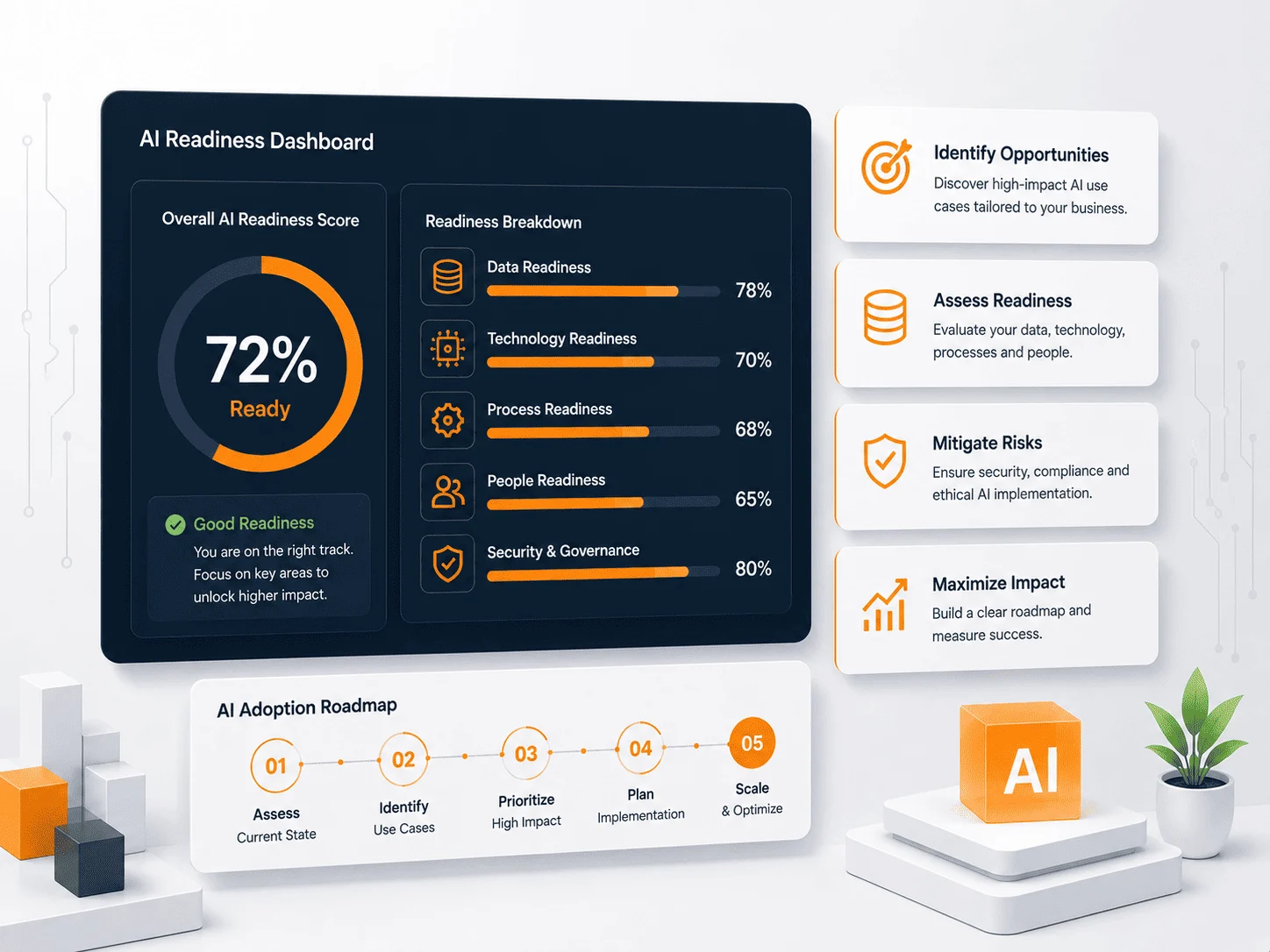
An AI Readiness Assessment helps bridge that gap. It is a structured evaluation designed to measure how prepared your business is to adopt AI successfully. By assessing factors such as data quality, technology infrastructure, business processes, workforce capabilities, and governance, it provides a clear picture of your organisation's AI maturity. Rather than jumping into AI because competitors are doing it, businesses can make informed decisions based on their actual readiness, opportunities, and challenges.
Whether you're considering AI-powered automation, predictive analytics, customer service chatbots, or generative AI solutions, an AI Readiness Assessment helps answer the most important question: Is your business truly ready to unlock the value of AI?
Why Most AI Projects Fail Before They Start
The statistics on AI project failure are worrth understanding before anything else. Research from Gartner, RAND Corporation reveals that between 70% and 85% of AI projects end in failure. McKinsey's 2025 State of AI survey discovered that although 88% of organisations have implemented some form of AI in their business functions, only 1% consider themselves truly mature in their AI usage. In the 2026 State of AI in the Enterprise report by Deloitte, it was revealed that only 34% of business leaders see AI as an opportunity for process reimagination while the rest simply use it to enhance their existing workflows.
The RAND Corporation identified the three most common reasons projects fail: the business didn't understand or trust the AI outputs, the problem wasn't well-defined before implementation started, and the data infrastructure wasn't fit for purpose. Every single one of those is something a readiness assessment catches, before money is spent, not after. Many of these issues are closely related to the practical AI integration challenges organisations face when introducing AI into existing systems and workflows.
In the UK, the data from British Chambers of Commerce released early 2026 indicates that 54% of UK companies are now using AI actively, a rise from 35% in 2025. Then again, the YouGov survey separately found that only 31% of SMEs have adopted AI Really. That is a gap between trying AI and actually implementing it, which is precisely where most of businesses are right now.
What an AI Readiness Assessment Actually Covers
An AI Readiness Assessment isn't a single interview or a checklist you fill in online. Businesses looking to prepare for an assessment often benefit from reviewing an AI readiness checklist for businesses to understand the common requirements around data, processes, governance, and technology.
- Data. AI models are only as good as the data that feeds them. The assessment looks at whether your data is accessible, structured, and consistent, or whether it's scattered across spreadsheets, three different CRM systems, and a filing cabinet. Research from 2026 suggests that 67% of SMBs have data in multiple siloed systems with no centralised strategy. That's fixable, but it needs to be identified before implementation begins.
- Processes. AI amplifies whatever process it's applied to, including broken ones. Before deploying any automation or AI layer, the underlying workflow needs to be documented and understood. If your customer onboarding process is inconsistent, AI will make it inconsistently faster. The assessment maps which processes are candidates for AI and which need human attention first.
- People and skills. The Kyndryl 2025 Readiness Report revealed that 86% of large enterprises are concerned about the availability of the right talent to achieve their AI ambitions. For small and medium-sized enterprises, this issue becomes even more pronounced. The report also points out that one of the biggest challenges of AI are lack of skills and knowledge related to AI in the team, and training for AI should be done before adoption, not afterwards.
- Technology and infrastructure. This covers your current ERP CRM communication platforms, etc. and from the point of view of these, the assessment envisages the features of AI-layer to be connected with them. In many cases, a non-invasive AI integration is possible, but only when a few very specific infrastructure requirements have been met. The assessment can also help determine whether an off-the-shelf AI solution is sufficient or whether a more tailored approach is required through custom AI app development.
- Leadership and governance. As a BCG survey, more than 45% of leaders admit to having no clear guidelines or restrictions for AI use in their own organisations. The assessment determines whether there is leadership consensus on AI goals, and also if a governance structure exists that covers data usage, approval levels, and how AI-assisted decisions are audited.
Typically, a thorough assessment takes three to four weeks. The end product is not a report gathering dust on the shelf, but rather it is a well-ordered execution plan: which processes can be implemented with AI right away, which ones need groundwork first, and what the realistic timeline and return on investment is.
Why the Mayor of London's £12M Initiative Makes This Even More Timely
Back in June 2026, the Mayor of London revealed a 12 million AI support package for SMEs. It is a programme run by London & Partners and, after consulting with the AI and Jobs Taskforce chaired by Baroness Martha Lane-Fox, it was designed to offer AI readiness assessments, allocate business mentors as experts, and provide guidance on adoption to the businesses of London.
The initiative exists because only 16% of London SMEs are currently using AI tools, despite most business owners believing AI will be critical to their competitiveness within five years. The programme targets a 35% productivity gain for participating businesses.
This matters for two reasons. First, the government's own analysis confirms that readiness, not access to technology, is the real barrier. Second, businesses that are already assessment-ready when this support becomes available will move from assessment to implementation far faster than those starting from scratch.
The OECD released its equivalent SME AI Readiness Tool in May 2026 during the G7 French Presidency, based on an SME AI Adoption Blueprint which was prepared during the 2025 Canadian G7 Presidency. Really this is now a G7-level priority shows how deeply governments and international bodies are concerned about the SME AI gap.
Is Your Business Ready for AI?
London's £12M AI support initiative highlights a challenge many businesses face: successful AI adoption starts with readiness, not technology.
At Dotsquares, we help organisations identify AI opportunities, assess their data and systems, and create a practical roadmap for implementation.
- ✓ Identify high-value AI use cases
- ✓ Assess data and technology readiness
- ✓ Review security and governance requirements
- ✓ Discover automation opportunities
- ✓ Receive a tailored AI adoption roadmap
What Happens After an Assessment
An assessment produces three things a business can act on immediately.
A clear baseline, knowing exactly where the organisation sits across data, processes, people, technology, and governance removes the paralysis that comes from vague uncertainty. Most organisations discover they're further along than they thought in some areas and further behind in others.
A use-case shortlist. Most businesses arrive at an assessment with a long list of AI ideas and no way to prioritise them.The assessment helps identify which Custom AI/ML Solutions are most likely to deliver measurable business value based on current operational needs.
A sequenced roadmap. This isn't a list of everything that needs doing, it's a practical plan that distinguishes what needs to happen immediately from what can wait, and sequences the work in the order that produces results fastest.
The Businesses That Move First
Support programmes and government initiatives tend to benefit a specific type of business: not the ones that rush in unprepared, and not the ones that wait for everything to be perfectly clear. The ones that get the most out of these windows are the ones that arrive with clear questions, documented processes, and some understanding of where their data and team gaps are.
An AI Readiness Assessment is how you get there.
At Dotsquares, we work with UK businesses on structured AI Readiness Assessments that map current operations, identify viable use cases, and produce a prioritised implementation roadmap, without the commitment of a full transformation project before you know what you're actually dealing with.
If you're exploring what AI could genuinely do for your business, the right starting point isn't a demo. It's an honest diagnostic.


Related Post
 October 15, 2026
Low-Code Integration: What It Is, How It Works and When Businesses Should Use It
Learn how low-code integration connects business apps and APIs, its key benefits, common use cases, limitations, and when to choose custom integration.
Keep Reading October 15, 2026
SAP BW to Cloud Migration: Benefits, Challenges and Planning Steps
Learn about SAP BW to cloud migration, including benefits, challenges, AWS options, cost factors and planning steps for a successful migration.
Keep Reading October 12, 2026
Mobile App Development with React Native and What You Need to Know
Learn how React Native works, where it saves time and cost, which industries use it, and whether it's still a good choice in 2026.
Keep Reading