Tech
Building an AI-Powered Traffic and Congestion Analysis Platform
 4 min read
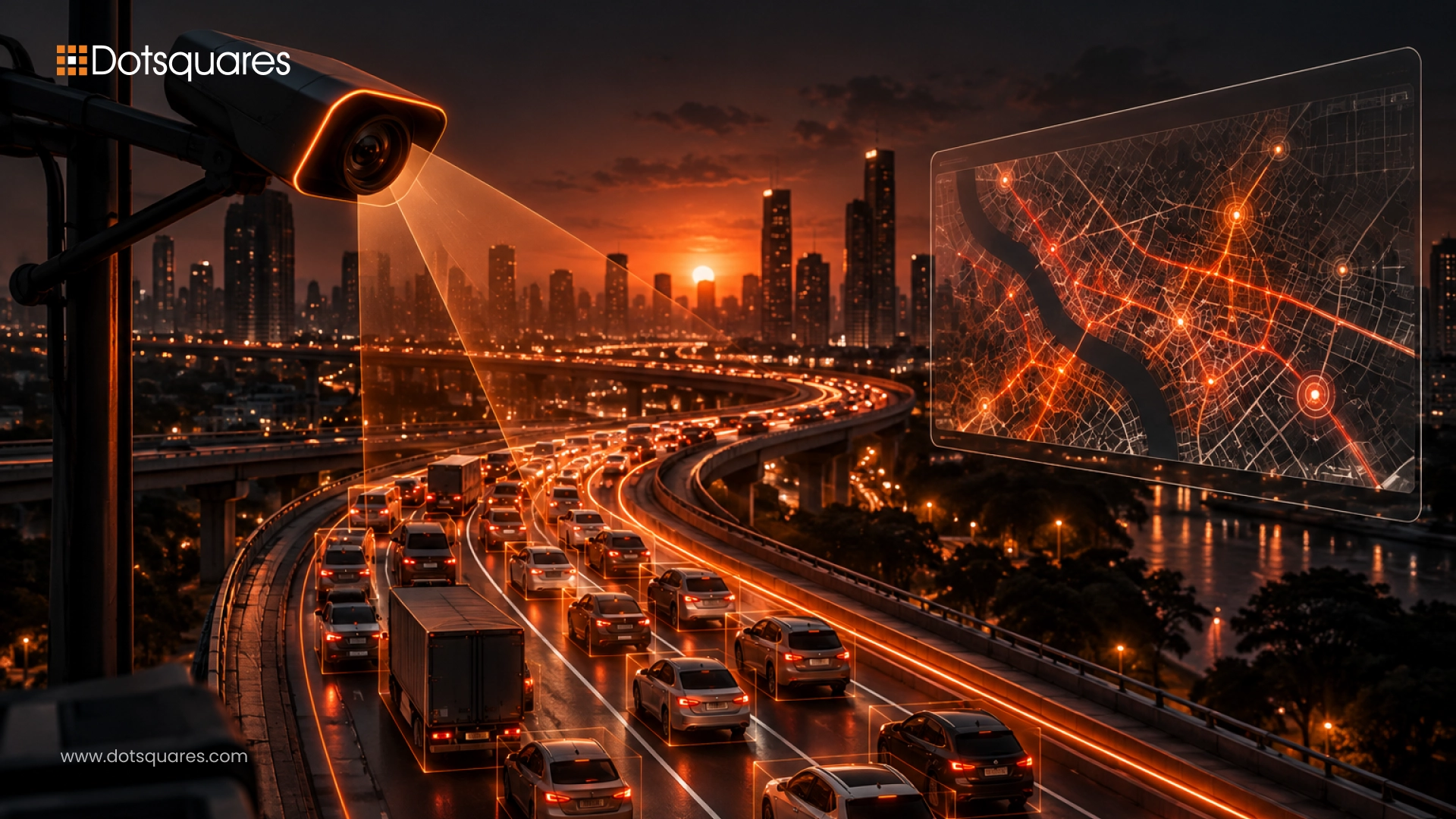
Most cities aren't short on traffic cameras. They're short on anyone who has time to actually watch them all. A single busy intersection generates hours of footage every day, and multiply that across a city's worth of junctions, and you end up with more surveillance than any team could realistically review in real time. Congestion builds, accidents happen, and half the time nobody in the traffic control room finds out until well after the fact.
That gap is what a transportation technology client asked us to close, and it's why we can't name them here, but the platform we ended up building is worth breaking down regardless. It takes live camera feeds from across a city, works out what's actually driving through them, and turns that into something a traffic authority can act on in the moment rather than after the fact.
The Problem Wasn't a Shortage of Data
Traffic authorities generally have plenty of raw footage. What they don't have is a way to turn that footage into something usable fast enough to matter. A handful of scattered, disconnected camera systems doesn't add up to visibility, it just adds up to more screens. Monitoring stays manual, response times lag, and every additional intersection makes the whole setup harder to keep on top of.
There's also a technical wall behind the operational one. Processing several live video streams simultaneously, at the resolution needed to reliably tell a motorcycle from a car, takes real computational muscle. Most legacy traffic systems simply weren't built with that kind of load in mind, and bolting AI onto infrastructure that can't handle the data volume tends to fall apart the moment it leaves a pilot environment.
What Went Into the Build
Vehicle detection that runs on its own. Everything else in the system depends on this part working reliably. Computer vision watches the live feeds and classifies what's moving through, cars, buses, trucks, motorcycles, without a person tagging a single frame by hand.
A dashboard that replaces a wall of screens. Instead of switching between separate systems for every junction, traffic teams get one web-based view covering every connected location, so patterns across the network are visible at a glance rather than pieced together after the fact.
Congestion analysis that actually points somewhere. Vehicle movement data gets turned into flagged bottlenecks and congestion zones, giving traffic planners something concrete to act on when it comes to adjusting signal timing rather than a guess based on complaints.
Reporting that doesn't need a human to sift through hours of clips. Peak-hour patterns, traffic trends, and road usage get compiled automatically, which matters far more for long-term planning than a database of unreviewed video ever would.
Infrastructure that doesn't buckle as more cameras get added. Built on scalable cloud infrastructure from the start, specifically so a rollout across dozens of intersections doesn't grind the whole system to a halt the way an under-engineered pilot often does.
Alerts before someone has to call it in. The system watches for stalled vehicles, sudden slowdowns, and other signs something's gone wrong, and pushes that straight to authorities instead of waiting for it to be reported the old-fashioned way.
The Difference It's Making
Traffic teams working with this platform aren't staring at a dozen separate feeds anymore, and a lot of the manual watching that used to eat up staff time simply isn't necessary now. Congestion data feeds directly into decisions about signal timing, and incident alerts give authorities a real head start instead of finding out secondhand.
It doesn't take traffic engineers out of the loop, and it isn't meant to. It clears out the part of the job that never needed a human watching a screen for eight hours, and leaves the actual decision-making to people who are better placed to make it.
Why This Matters Beyond One City
AI-adjusted signal timing isn't a novelty running in two or three showcase cities anymore. Recent 2026 deployments have reported travel time reductions between 25 and 40 percent in some areas, with overall delay reductions landing closer to 15 to 30 percent, and given that the average driver already loses somewhere near 100 hours and over a thousand dollars a year to congestion, according to recent traffic scorecard data, it's easy to see why municipal budgets are starting to treat this as core infrastructure rather than a nice-to-have.
Getting a system like this working properly takes more than a camera and a model, though. It takes custom AI development solutions tuned to how a specific city's traffic actually moves, IoT development services capable of pulling reliable data from dozens of live feeds at once, and cloud development services built to process all of it without falling over the moment traffic doubles. Put those three together correctly, and AI-powered traffic solutions stop being a pilot project and start being something a city can actually run on.


Related Post

 October 16, 2026
E-commerce Security: Protect Your Store From Cyber Threats
Learn how E-commerce security protects your online store from fraud, data breaches, and bots. Explore threats, PCI DSS, and best practices.
Keep Reading October 15, 2026
Low-Code Integration: What It Is, How It Works and When Businesses Should Use It
Learn how low-code integration connects business apps and APIs, its key benefits, common use cases, limitations, and when to choose custom integration.
Keep Reading October 15, 2026
SAP BW to Cloud Migration: Benefits, Challenges and Planning Steps
Learn about SAP BW to cloud migration, including benefits, challenges, AWS options, cost factors and planning steps for a successful migration.
Keep Reading