
Is Your Business AI-Ready?

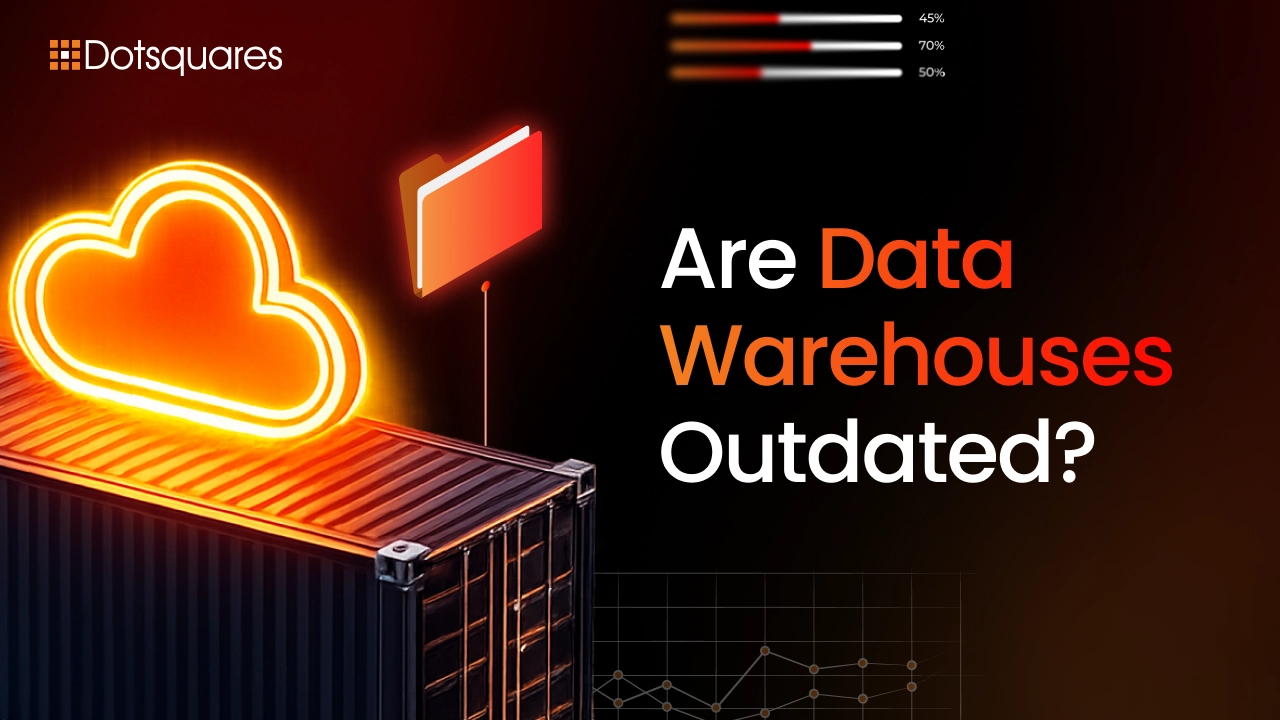
Data has become one of the most valuable assets for businesses in today’s business environment. Organisations collect information from different sources, including websites, mobile applications, IoT devices, customer interactions, social media platforms, and enterprise systems. With the increasing quantity of data, businesses have now started doubting the ability of traditional data warehouses due to the dynamically technical world.
With the emergence of data lakes, lakehouses, cloud-native analytics platforms, and artificial intelligence, many industry experts have announced the end of data warehouses. Surprisingly, the reality is not as it sounds. It would be interesting to know that instead of becoming outdated, data warehouses are expanding to meet modern business requirements.
A data warehouse is a centralized storage platform developed to store, organize, and analyze structured business data. It collects information from multiple sources, cleans and transforms it, making it suitable for use in making reports, business intelligence, and decision-making.
For decades, data warehouses have served as the backbone of businesses to make decisions with their precise analyses. They provide consistent data quality, governance, security, and reliable reporting capabilities that organisations depend on for strategic planning.
The vast technological developments in recent years have fueled the perception that data warehouses are losing their importance. This is due to the following reasons:
Traditional data warehouses were mainly designed for storing structured data, which was clean and analysed. The data they stored was numerical. Today, organisations collect vast amounts of unstructured and semi-structured data, including videos, images, logs, emails, and social media content. Managing these different formats of data types can be challenging for traditional warehouse architectures.
Data lakes emerged as a more flexible method of data storage. They allow organisations to store raw data in its original format without requiring predefined schemas. This flexibility makes them attractive for data science, machine learning, and projects requiring large-scale data analysis.
Today, instead of relying on the available data stored in systems, businesses prefer to work on real-time information rather than waiting for batch processing cycles. Traditional warehouses lack the efficiency to deliver the speed and flexibility required by modern applications and AI-powered systems.
The emergence of cloud platforms has transformed the concept of data management by offering scalable storage and computing resources. Organisations can now process a huge volume of datasets without investing huge funds on upgrading their in-house infrastructure. Thus, providing multiple options to businesses to manage their data volume without any dependence on traditional warehousing approaches.
Despite these challenges, data warehouses continue to play a critical role in enterprise data strategies.
Businesses require accurate and trustworthy information for making future strategies and decisions. Data warehouses provide structured data information compliant with data quality controls and security measures that help organisations maintain confidence in their analytics.
Executives, managers, and analysts rely on consistent reporting and dashboards. Data warehouses remain one of the most effective platforms for delivering reliable business intelligence and performance monitoring.
It is mandatory for many industries to follow strict regulations regarding data management and reporting. The structured nature of data warehouses make it easier for them to follow rules and regulations strictly according to government requirements.
For complex SQL queries, financial reporting, and historical trend analysis, data warehouses are highly required for superior performance compared to less structured alternatives.
Considering the above-mentioned reasons today, businesses are shifting towards the adoption of a hybrid approach known as the data lakehouse.
A data lakehouse carries the combination of flexibility and scalability of data lakes, merged with the governance, performance, and reliability of data warehouses. This architecture enables organisations to manage structured, semi-structured, and unstructured data on a centralised platform.
Many modern platforms are adopting lakehouse architectures because they support both traditional analytics and advanced AI workloads while reducing data duplication and operational complexity.
The future is not about choosing between data warehouses or data lakes; today, organisations are looking for a data solution that carries the powers of warehouses, lakes, lakehouses, streaming systems, and AI tools.
Cloud-native data warehouses now offer greater scalability, flexibility, and support for multiple workloads. This indicates that data warehouses are not moving out from the scene but becoming an essential component of a large data environment.
So, are data warehouses outdated? The answer is no.
Although traditional warehouses may not be strong enough to deal with the huge volume of data, the actual objective of data warehousing remains the same. Businesses still need trusted, governed, and high-performance-oriented data for decision-making. What has changed is the way data warehouses are deployed and integrated with other technologies. This is where modern Data Engineering services play a critical role in helping organisations build scalable, cloud-ready, and real-time data ecosystems.


 October 15, 2026
Learn how low-code integration connects business apps and APIs, its key benefits, common use cases, limitations, and when to choose custom integration.
Keep Reading October 15, 2026
Learn about SAP BW to cloud migration, including benefits, challenges, AWS options, cost factors and planning steps for a successful migration.
Keep Reading October 12, 2026
Learn how React Native works, where it saves time and cost, which industries use it, and whether it's still a good choice in 2026.
Keep Reading 4 min read