Tech
How to Choose a Technology Stack for Your Business Application
 12 min read
Technology stack decisions are made once and lived with for years. Get them right and you have a foundation that scales without drama. Get them wrong and you spend the next few years working around limitations that should not exist, or rebuilding from scratch at significant cost.
According to industry statistics, 66% of technology projects go over budget, and a considerable proportion of those overruns comes from architectural decisions made in the beginning, such as stack selection. The technology you choose at the beginning of your project will shape what you can do, what are the expenses for scaling it, how many qualified professionals can be hired and how easy it will be to maintain that technology in three years.
This is a practical guide for business decision-makers and technical leaders who want to make their choice as based on logic and reasoning, not based on what was popular at the time the discussion started.
What Is a Technology Stack and Why Does It Matter?
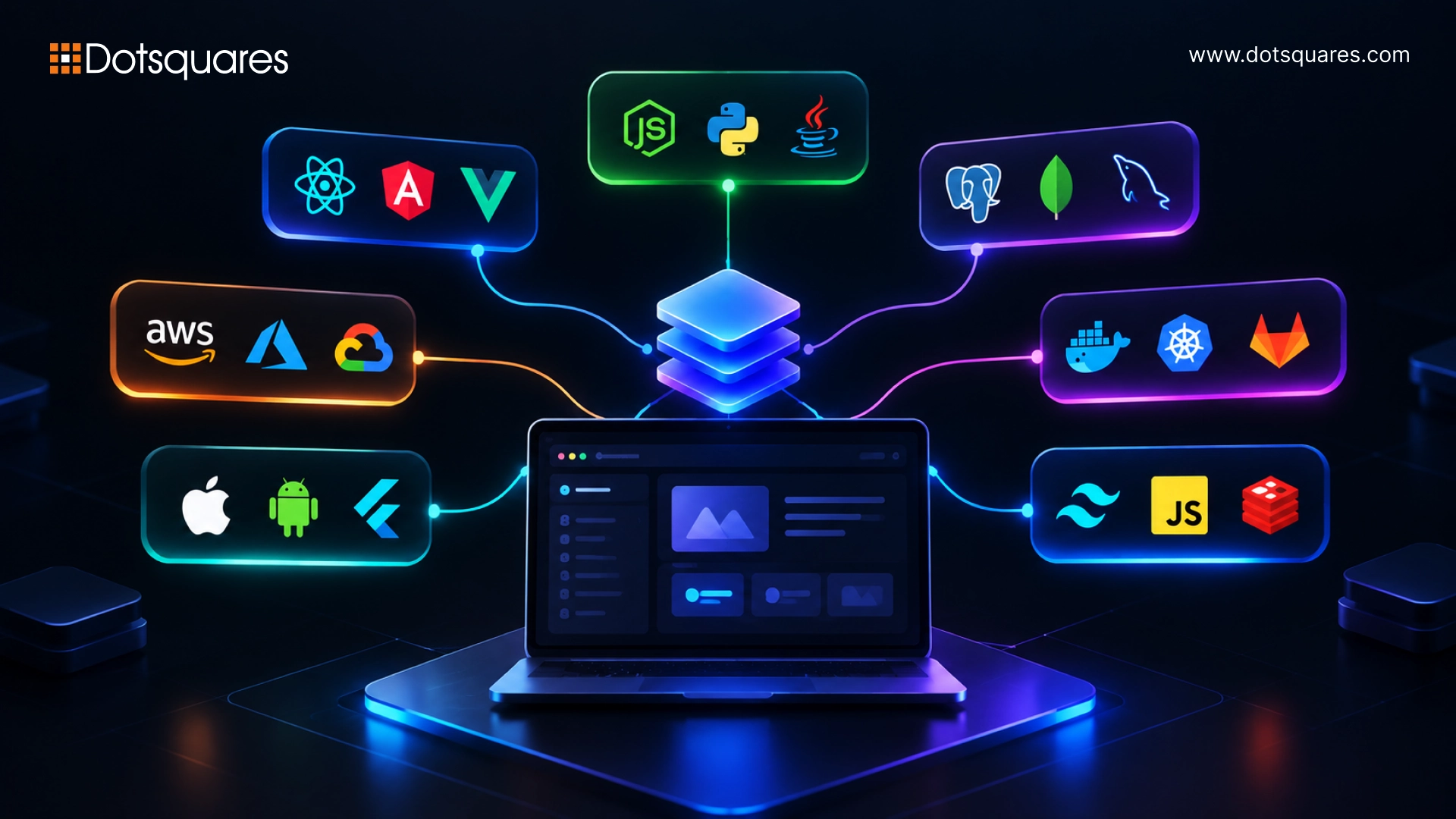
A technology stack can be defined as the totality of programming languages, frameworks, libraries, databases, and infrastructure tools which are being used for creating and operating a certain software application. Every application has one, whether the decision was made deliberately or by default.
The Four Layers of a Modern Stack
- Frontend - what users interact with directly. Frameworks like React, Angular, and Vue.js handle the interface layer. React commands roughly 41.6% usage among professional developers according to the 2024–25 Stack Overflow Developer Survey, making it the most commonly used frontend framework globally
- Backend - the application logic, server-side processing, and business rules. Node.js leads backend web frameworks for JavaScript stacks; Django dominates Python backends; Java Spring Boot and .NET cover enterprise requirements. JavaScript usage across frontend and backend sits at approximately 93.4% among developers surveyed
- Database - where application data lives. Relational databases (PostgreSQL, MySQL) handle structured data with complex relationships; NoSQL databases (MongoDB, Redis) suit flexible or high-velocity data patterns
- Infrastructure - how the application runs and scales. Cloud platforms (AWS, Azure, GCP), containerisation (Docker, Kubernetes), and CI/CD pipelines form the deployment and scaling layer
Stack choices directly affect development speed, application performance, scaling cost, and the size of the talent pool available to maintain what you build. A poor choice in one layer cascades into problems across all the others.
What Should Businesses Consider Before Choosing a Tech Stack?
The most common mistake in stack selection is starting with the technology rather than the application. The right question is not "what is popular right now?"; it is "what does this application need to do, at what scale, and who will maintain it?"
- Application type and complexity - a customer-facing SaaS platform has different requirements from an internal operations tool or a data processing pipeline. The use case drives the architecture, not the other way around
- Expected scale - a business expecting 1,000 users at launch needs a different database strategy from one expecting 1,000,000. Building for your actual scale rather than hypothetical scale avoids unnecessary complexity early and avoidable rewrites later
- Team expertise - the best stack is one your team can actually build with. A technically superior choice that your available developers do not know well will deliver worse outcomes than a more conventional choice executed by people who know it deeply
- Time to market - startups and MVPs need speed; enterprise applications can prioritise robustness over velocity. The stack should match the delivery timeline, not just the end state
- Long-term maintenance - developer availability matters over the life of the application, not just at build time. Choosing an obscure framework because it solves today's problem elegantly creates a serious hiring problem in year three
- Security and compliance requirements - regulated industries (finance, healthcare, legal) need stacks with proven security tooling and mature compliance support built in, not bolted on
How to Choose the Best Technology Stack for a Web Application
MERN stack (MongoDB, Express, React, Node.js) retains its top position among technology solutions in 2026 for web apps, providing full JS environment for developing both frontend and backend and essentially avoiding context-switching for the development teams. As indicated by the recent statistics, 70% of companies creating web or mobile apps use MERN or MEAN stack.
On other hand, Django + React significantly dominates among technologies used for data-driven apps in HealthTech, FinTech, and other analytics platforms. Python's ecosystem of tools for working with data – NumPy, Pandas, connection with machine learning libraries and others – becomes of great service.
Java Spring Boot and .NET technologies are widely used in large companies in banking, insurance, healthcare industries and everywhere where one is focused on long-term stability, compliance requirements, and experience of working on Java or .NET outweighs the development speed requirements.
Choosing a Tech Stack for Mobile App Development
The central decision in mobile tech stack selection is native versus cross-platform:
- React Native - single codebase, deploys to iOS and Android. Suitable for most business applications, faster and cheaper to build and maintain than two native apps. The dominant choice for cross-platform in 2026
- Flutter - Google's cross-platform framework, growing market share in 2026, strong performance profile and consistent UI across platforms. Increasingly favoured for applications needing a highly polished visual experience
- Native (Swift for iOS, Kotlin for Android) - the choice for applications requiring device-specific capabilities, maximum performance, or AR/VR functionality. Higher cost to build and maintain but no compromises on platform capability
Which Technology Stack Is Best for Different Applications?
SaaS / Business Tools
MERN or MEAN stack, full JavaScript, fast development, good scaling characteristics. React frontend, Node.js backend, MongoDB or PostgreSQL depending on data structure needs.
Data-Heavy / FinTech / HealthTech
Django + React, Python backend integrates cleanly with data processing and ML libraries. PostgreSQL for relational data with strong compliance tooling.
Enterprise / Regulated Industries
Java Spring Boot or .NET + React or Angular, proven stability, mature security tooling, large developer talent pool, long-term vendor support.
MVP / Early-Stage Product
React + Node.js + Firebase or Supabase, fastest path to a working product. Managed backend services reduce infrastructure overhead at low scale.
Cross-Platform Mobile
React Native for most applications; Flutter for visually complex apps. Both significantly reduce mobile development cost versus maintaining separate native codebases.
AI-Integrated Applications
Python backend (FastAPI or Django) + React frontend. Python's ML and AI library ecosystem, TensorFlow, PyTorch, LangChain, Hugging Face, is unmatched for AI-intensive applications.
How Cloud Technology Fits Into Your Tech Stack
The infrastructure layer is where many businesses underinvest in thinking at the stack selection stage. Cloud is not just a hosting decision; it shapes what is possible in terms of scaling, redundancy, and deployment speed.
- AWS, Azure, and GCP each bring different strengths. AWS has the broadest service catalogue and the largest market share. Azure is the default for Microsoft-ecosystem businesses and enterprise organisations with existing Microsoft contracts. GCP leads on data and ML infrastructure
- Containerisation via Docker and Kubernetes enables uniform deployments of applications within different platforms and uniform scaling of applications without any modifications in its design, which is crucial for applications that anticipate large growth.
- Serverless architecture (AWS Lambda, Azure Functions) is best suited for irregular workloads that have sudden fluctuations and which eliminate the need for provisioning and maintenance of the servers needed only from time to time.
Dotsquares' Cloud Development Solutions cover architecture design, cloud migration, and infrastructure optimisation across AWS, Azure, and GCP, including containerisation and serverless deployments where they are the right fit for the application's load profile.
How APIs and AI Influence Your Technology Choices
As far as 2026 goes, very few business programs are developed in seclusion. They establish connection links to outside applications, systems, as well as AI possibilities, while the need for such links plays an important role in determining which route to take regarding the technology stack.
APIs and Integration Requirements
- In the case when the application needs to be integrated with CRM software, payment systems, ERP, and other systems, the backend framework must have a powerful support of REST and GraphQL, available with most of today’s frameworks, yet the particular technology, and complexity of integration being performed, should still influence decision making process regarding the backend technology to use.
- Smartly developed APIs allow you to secure your product for future upgrades; in the case of the properly implemented API layer, one will be able to add new user interfaces, mobile applications, and any other integration solutions without any modification of the core application.
Custom API Development done right at the architecture stage prevents the expensive integration work that results from applications that were not designed to connect to anything outside themselves.
AI Integration
- If the application will incorporate AI features, recommendations, predictions, natural language interfaces, document processing, the backend stack needs to support AI model integration cleanly
- Python is the default choice here due to its ML library ecosystem; applications built on other backend stacks typically call Python microservices for AI functionality
- LLM integration (OpenAI, Anthropic, open-source models via Hugging Face) requires specific infrastructure considerations, latency management, token cost optimisation, and output validation that are easier to design in from the start than to retrofit
Dotsquares' AI/ML Development Solutions integrate into existing tech stacks and guide stack selection when AI is a core application requirement rather than a future-state consideration.
Build vs Choose: Standard Stack or Custom?
Most applications are built on well-understood, open-source technology stacks, React, Node.js, PostgreSQL, AWS, because those stacks have large developer communities, strong tooling, extensive documentation, and predictable behaviour. That is the right default for most projects.
When Standard Stacks Work Well
- The application's requirements fit within what the standard stack was designed for
- Hiring developers with the right expertise is straightforward and competitive
- The development team has strong existing knowledge of the chosen technologies
- Long-term community support and framework stability are predictable
When Custom Development Is the Better Answer
- Industry-specific requirements that off-the-shelf frameworks do not address without significant workarounds
- Performance, security, or compliance requirements that pre-built solutions cannot reliably meet
- Applications with unique business logic that existing platforms cannot express cleanly
- Proprietary processes or competitive differentiation that cannot be built within the constraints of standard tooling
Custom Software Development Services yield much better long-term results in such scenarios than pushing a complicated requirement into a framework that it was not created to handle. Generally, the initial funding spent on custom development is compensated by the reduced maintenance and better operating parameters for the whole application.
For the most part, the maintenance issue is disregarded. A framework that fits perfectly at the moment and has a dwindling number of developers associated with it becomes a problem in three years when there is a need to recruit developers or update dependencies. Such an aspect as popularity of the framework and the size of the developer community counts for more than just tradition.
How to Future-Proof Your Technology Stack
Future-proofing does not mean picking whatever framework is most modern. It means making choices that age well.
- Choose modular architecture - microservices or well-separated monolith layers allow individual components to be upgraded or replaced without rebuilding the whole application. A monolith is fine to start with; a tightly coupled monolith becomes a problem
- Prefer managed services for non-core infrastructure - databases, authentication, file storage, email delivery. Using managed services for these removes maintenance overhead from your team and keeps focus on the application logic that actually differentiates your product
- Build with APIs in mind - an API-first architecture allows the application to connect to new services, expose functionality to partners, or add new client applications without major structural changes
- Document architectural decisions - the team that built the application is rarely the team that maintains it three years later. Decision documentation is what allows new developers to understand why the stack is built the way it is
- Plan for AI integration - even if AI is not a day-one requirement, building with a Python-compatible integration layer means AI capabilities can be added without architectural rewrites when the business is ready for them
FAQs
What is the best technology stack for a web application?
There is no single answer, it depends on your application type, team expertise, and scale requirements. MERN (MongoDB, Express, React, Node.js) is the most widely adopted full-stack JavaScript option. Django + React suits data-heavy applications. Java Spring Boot or .NET are the enterprise defaults. The best stack is the one that matches your specific requirements, not the most popular one in a general ranking.
How do I choose a tech stack for my business?
Analyze the functionality of the application to be developed, the people who will use it, and the scale which is to be taken into consideration. Then assess the level of expertise of your team, the situation in the hiring sphere, and your needs in terms of maintenance.
What tech stack is best for a scalable web app?
Scalability depends more on architecture than stack. A well-architected MERN or Django application deployed on Kubernetes will scale better than a poorly architected application built on any framework. That said, Node.js handles concurrent connections efficiently for real-time applications; PostgreSQL scales well with proper indexing; and cloud-native deployment on AWS, Azure, or GCP provides horizontal scaling regardless of the application stack.
What is the best tech stack for mobile app development?
For most business applications, React Native or Flutter provide the best balance of development cost, performance, and maintainability, a single codebase deploying to iOS and Android. Native development (Swift for iOS, Kotlin for Android) is warranted for applications requiring device-specific capabilities or maximum performance, but comes with higher build and maintenance costs.
How often should a technology stack be updated?
Dependencies and frameworks should be updated on a rolling basis, security patches promptly, major version upgrades typically annually. A full architectural re-evaluation is warranted when the application's requirements have outgrown the current stack's capabilities, when the developer community for a framework is declining significantly, or when new technology enables meaningfully better outcomes than the current stack can deliver.


Related Post

 October 26, 2026
Foldable Phones and Agentic AI: The Future of Adaptive Mobile App Development
Explore how foldable phones and agentic AI are shaping mobile app development, with insights into adaptive design, automation, use cases and modernisation.
Keep Reading October 26, 2026
How Much Does It Cost to Build an MVP App?
Discover the MVP app development cost in 2026-27, including feature-wise pricing, key cost factors, development timelines, and tips to reduce expenses.
Keep Reading October 22, 2026
Critical PHP Security Advisory: What Dotsquares Is Doing to Protect Your Platform
Learn how Dotsquares is addressing critical PHP security vulnerabilities through version checks, compatibility testing, security patches and client updates.
Keep Reading