
Is Your Business AI-Ready?

Tech
 8 min read
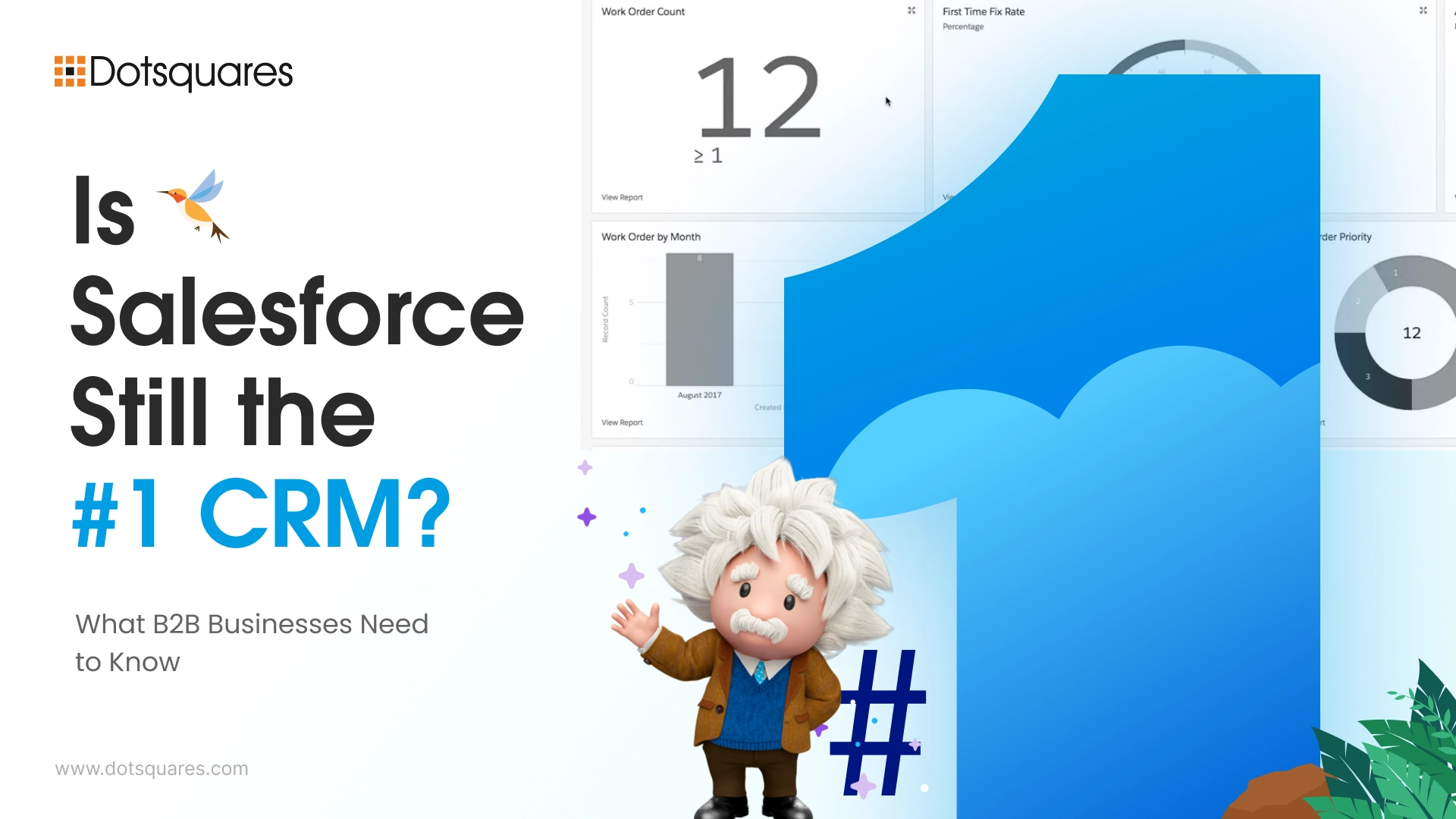
If you run a B2B business and you're evaluating CRM options in 2026, Salesforce will come up within the first five minutes of any serious conversation. It's been the market leader for 13 consecutive years according to IDC. Still, market leadership should not be taken as a thing that perfectly fits the requirement. This mainly applies to B2B companies that have complicated sales cycles, carry out long-term accounts, and have multiple stakeholders involved in each deal. Because of this, here is an honest perspective on what Salesforce really is, what it does well, and if it should be a part of your business.
No, it's not. And that's the honest answer.
Initially, Salesforce was simply a sales tool that was cloud-based when it was launched in 1999, but by 2026 it has become one of the world's most complete enterprise platforms, with $41. 5 billion revenue in FY2026 and a customer base comprised of over 150,000 companies worldwide including nearly 90% of the Fortune 500.
So what is it, exactly?
Is Salesforce a CRM? Sure, a CRM (Customer Relationship Management) system is a software that consolidates all your customer contact details, monitors your sales pipeline, automates your customer follow-ups, and offers your whole sales team a unified perspective of every account. Salesforce has 20. 7% share of the global CRM market which is more than the combined CRM revenues of Microsoft Oracle Adobe, and SAP.
Is Salesforce the same as SAP? No actually this confusion is more common than you might expect. The thing is SAP is mainly an ERP system. It handles such back-office operations as finance procurement inventory, supply chain. Then again, Salesforce handles front office activities including sales, marketing, and customer relationships. So, they are two separate tools designed for different purposes. Check the below for a detailed comparison.
Is Salesforce just software? Technically yes But calling it simply "software" lacks accuracy. Imagine it rather as the operating system of your business when it comes to managing customer relationships. On top of that, it has AI analytics integrations, and automation all.
This is one of the most searched comparisons in enterprise software, and it usually comes from businesses that have heard both names and aren't sure what the difference actually is.
Here's the direct version:
|
Salesforce |
SAP |
|
|
Primary use |
CRM - sales, service, marketing |
ERP - finance, procurement, supply chain |
|
Best for |
Revenue growth, customer management |
Operational management, back-office processes |
|
Implementation |
Cloud-native, faster to deploy |
Complex, longer implementation cycles |
|
Ease of use |
More intuitive for sales teams |
Steep learning curve, requires specialist knowledge |
|
CRM market share |
20.7% |
3.1% |
|
Pricing |
From $25/user/month |
Enterprise licensing, typically higher upfront |
Verdict for B2B owners: If your main focus is on increasing sales, supporting customer management, and equipping your sales force with a tool that genuinely assists them Lastly deals, opt for Salesforce. However, if your company heavily leverages SAP for financial and supply chain operations and a CRM that's integrated with that back-office system is a necessity for you, then SAP CRM modules as an extension would be a logical choice.
For most growing B2B businesses that don't have an existing SAP footprint, Salesforce wins this comparison clearly.
Here's what Salesforce actually looks like inside a B2B operation:
Every deal is tracked from first contact to close. Reps log calls, emails, and meetings automatically. Team leaders are able to gauge the progress of each deal, identify stagnation points, and analyze the overall health or weakness of the pipeline. A B2B software firm that was part of the 2026 CRM research study boosted its forecast accuracy from 62% to 89% within half a year of Salesforce adoption. Besides that, they also managed to cut down their average sales cycle by 12 days.
As B2B sales can involve several contacts, departments, and decision-makers within the same company, Salesforce creates a comprehensive profile for each account, listing each call email contract, and interaction in one place. The relationship history doesn't get stored in someone's email inbox anymore; it is the system that holds it.
The buying process in B2B can be lengthy. A lead who accesses a whitepaper today may not be willing to make a purchase for another six months. Marketing Cloud takes care of the nurture sequence by sending automated and personalized emails, content triggers, and re-engagement campaigns, which maintains your company's presence in front of the prospect without the need for your manual intervention at each touchpoint.
Usually, retaining a client is less costly than acquiring a new one. Service Cloud detects counseling support ticket fluctuations, reaction times, and other engagement signals to identify at-risk customers before they decide to churn. Customer success teams have 30-day alerts ahead of the contract renewal time and full access to what was agreed upon during the initial sale.
Immediate graphical representations of data reveal pipeline condition, the performance of each sales representative, win ratios per type of deal, and expected revenues. Executives no longer base their decisions on gut feelings but rather on actual data insights.
As Salesforce itself puts it, a B2B CRM should provide "a single source of truth for all customer interactions." The businesses that get the most out of Salesforce are exactly those, the ones that use it as the one place where everything lives, not just a contact database.
Salesforce has a wide product suite. Not all of it is equally relevant to every B2B business. Here's a B2B-focused breakdown:
|
Salesforce Product |
What It Does |
B2B Relevance |
|
Sales Cloud |
Manage leads, pipelines, deals |
Must-have for B2B sales teams |
|
Service Cloud |
Customer support and ticketing |
High, essential for post-sale retention |
|
Marketing Cloud |
Email, SMS, ad campaigns |
Strong for demand generation and nurture |
|
Data Cloud |
Unified customer data and AI |
Growing fast, key for AI-powered insights |
|
Agentforce (AI) |
Autonomous AI agents across products |
Increasingly central, $1.4B ARR, up 114% YoY |
|
Tableau |
Analytics and reporting |
Useful for revenue and pipeline insights |
|
Commerce Cloud |
B2B/B2C e-commerce |
Situational |
|
MuleSoft |
Connect existing systems and tools |
Situational, valuable in complex IT environments |
|
Slack |
Team collaboration |
Included in many enterprise plans |
Sales Cloud and Service Cloud are the two products most B2B businesses should start with. They're the core, everything else builds on top of them. Agentforce is worth paying attention to now: it reached $1.4 billion in combined ARR with Data Cloud by Q3 FY2026 and is already being used by B2B teams to automate lead qualification, draft outreach, and handle routine service queries without human input.
If you're trialling Salesforce or onboarding your team, here's the quick version:
First-time users will be prompted to set up multi-factor authentication, mandatory for all Salesforce users since 2022. If you're an admin setting up a new org, Salesforce Trailhead has free guided setup walkthroughs that are genuinely useful.
Based on market share, analyst rankings, and actual adoption across B2B businesses:
20.7% global market share. Ranked #1 by IDC for 13 consecutive years. The enterprise standard for B2B companies managing complex sales cycles, large account portfolios, and multi-team operations. Sales Cloud, Service Cloud, and Agentforce are the core products for B2B use.
5.2% market share and the closest contender to Salesforce. Businesses heavily invested in the Microsoft environment will naturally choose it; the integration with Teams Outlook SharePoint, and Azure is excellent. Also, it's experiencing rapid growth, with a 23% revenue increase in FY25 Q4.
The dominant choice for SMB and mid-market B2B companies. Known for its generous free tier, strong marketing tools, and ease of adoption. Particularly well-suited to businesses where marketing and sales need to work closely together and where implementation simplicity matters.
The global CRM market is expected to reach $126.2 billion in 2026, growing to $254.3 billion by 2032 at a 12.4% annual growth rate. All three of these platforms are growing, the real question is which one fits your size, complexity, and growth plans.
Reportedly, Salesforce was ranked the #1 CRM in 2026, and that is truly the case for most B2B businesses having a growing sales team, complex accounts, or major revenue targets. It definitely deserves the #1 position because of the comprehensive offering of products that it has, the AI component through Agentforce, and In reality it has maintained its status as a market leader for the past 13 years.
But, the most suitable CRM is that which matches the reality of your business practices. In fact, poor implementations commonly result in the businesses having only expensive contact lists, whereas good implementations result in businesses experiencing the full benefits of a CRM product.
Dotsquares is a certified Salesforce summit partner with experience implementing Salesforce across B2B businesses in technology, real estate, professional services, and more. If you're evaluating Salesforce or ready to get started,get in touch with the team, we'll help you build it the right way.



 October 16, 2026
Learn how E-commerce security protects your online store from fraud, data breaches, and bots. Explore threats, PCI DSS, and best practices.
Keep Reading October 15, 2026
Learn how low-code integration connects business apps and APIs, its key benefits, common use cases, limitations, and when to choose custom integration.
Keep Reading October 15, 2026
Learn about SAP BW to cloud migration, including benefits, challenges, AWS options, cost factors and planning steps for a successful migration.
Keep Reading