
Is Your Business AI-Ready?

Tech
 11 min read
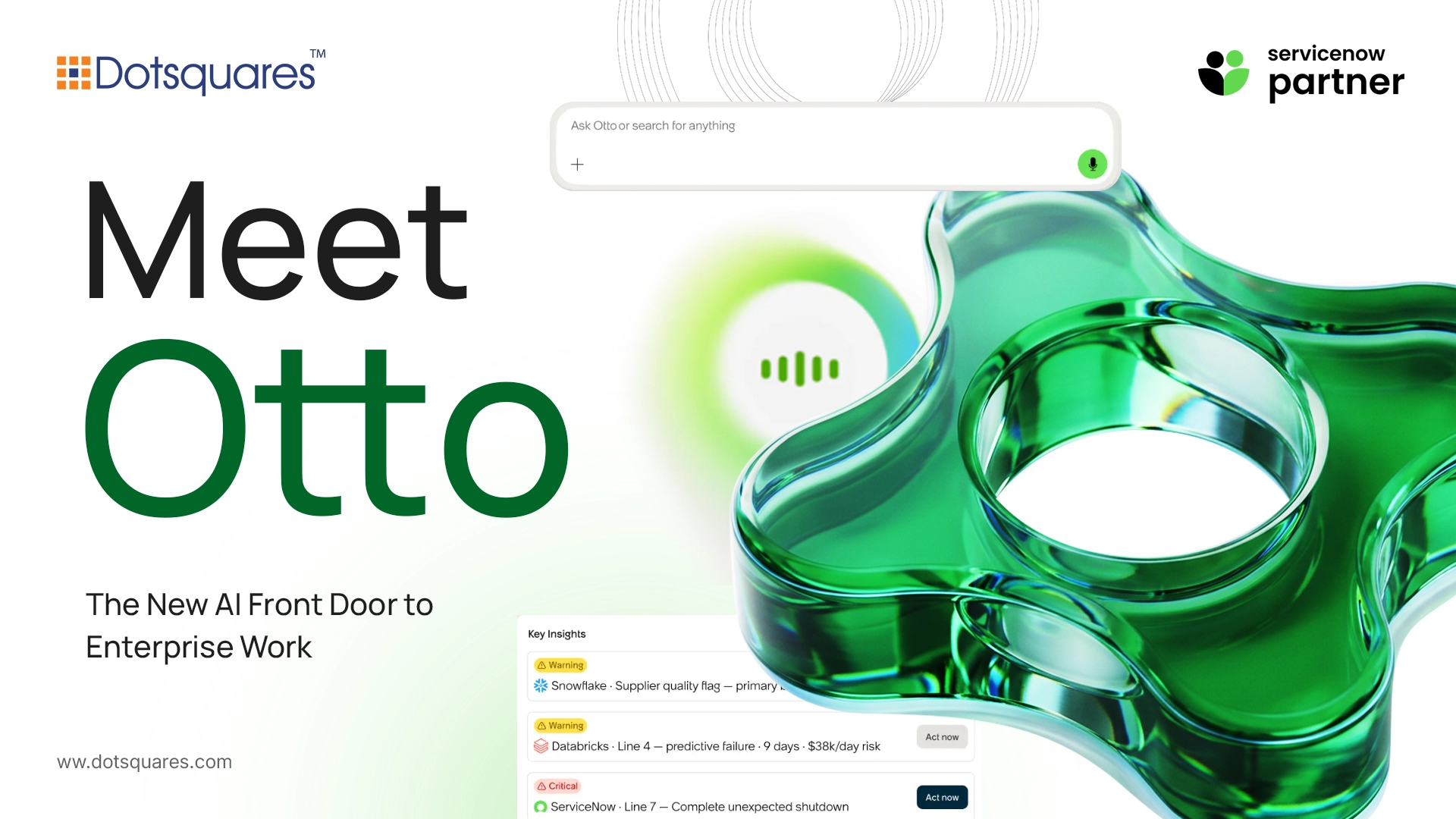
At its Knowledge 2026 event in Las Vegas on 5 May 2026, ServiceNow unveiled Otto, a unified AI experience designed to transform how work is managed across the enterprise. Positioned as an AI Front Door to Enterprise Work, Otto brings together Agentic AI, workflow automation, and enterprise-wide orchestration within a single platform.
The concept is straightforward: users can make requests in natural language, while Otto coordinates the underlying processes required to complete the task. Whether the request comes from an employee, customer, or business partner, the platform is designed to move beyond information retrieval and actively execute work across systems and workflows.
Unlike traditional AI assistants that primarily provide recommendations or surface relevant information, Otto is built to take action. By combining AI-driven decision-making with workflow automation, it aims to reduce manual intervention and accelerate business operations across departments.
As enterprises continue exploring practical applications of AI, this shift from AI-assisted work to AI-executed work represents a significant step forward in enterprise automation.
ServiceNow Otto is a unified AI experience that combines the capabilities of ServiceNow AI Experience, Now Assist, and Moveworks into a single enterprise AI platform. Designed to serve as the front door to enterprise work, Otto enables users to submit requests, automate tasks, access information, and orchestrate workflows through a conversational interface.
Together, these three things become a single front door into every system, department, and workflow an enterprise runs, accessible through conversational AI, enterprise search, voice agents, and a data querying interface, on both mobile and web.
As Nenshad Bardoliwalla, ServiceNow's Group VP of AI, described it at the press briefing: "Otto is ServiceNow's new AI experience that turns intent into enterprise work for every person and across every workflow."
ServiceNow refers to the challenge Otto addresses as the "completion problem" in enterprise AI.
Here's what that means in practice. Most major software vendors, Microsoft, Salesforce, SAP, Oracle, have shipped AI capabilities inside their own platforms. Microsoft Copilot lives in Microsoft 365. Salesforce Agentforce operates within Salesforce. SAP Joule works inside SAP.
The result? Most enterprise employees already have multiple AI assistants across the tools they use daily. And yet, the work of connecting those tools, routing a request, getting an approval from another department, chasing a document that's sitting in a different system, updating a ticket and notifying a stakeholder, still falls on the human.
Every individual AI assistant is smart within its own walls. None of them can complete a workflow that crosses those walls. That's the completion problem.
Otto's architecture is built specifically to solve it. It sits across systems, not inside one of them, searching across documents, databases, SharePoint, wikis, and third-party tools simultaneously, routing requests to the right workflow, getting approvals across departments, and bringing tasks to a conclusion without the employee having to hand-off between systems manually.
Otto reaches users through four channels:
Conversational AI: Natural language input, type what you need, the way you'd describe it to a colleague. Otto understands intent, identifies the relevant systems, and routes the request to completion. No navigating between portals. No knowing which tool handles which request type.
Enterprise Search: Otto searches across all connected systems simultaneously, documents, databases, SharePoint libraries, internal wikis, third-party platforms, and returns answers filtered by the user's role, location, and department. This isn't a keyword search. It's a context-aware query that returns what the user is actually allowed to see and what's actually relevant to them.
AI Voice Agents: Voice-based queries and requests, supported across multiple languages. The same workflow completion capability, accessible without typing.
AI Data Explorer: Plain-language analytics, ask a business question, get a structured data response. Instead of building a report or querying a database directly, users describe what they want to understand about their operations and Otto surfaces the analysis.
All of this is governed through AI Control Tower, which logs every interaction, maintains audit trails, and ensures that every decision made by Otto is explainable and reviewable. That governance layer is what separates Otto from a general-purpose AI assistant, it's built for regulated environments where accountability matters.
Otto launched in May 2026 inside two products:
ServiceNow EmployeeWorks alone generated six deals exceeding $1 million each in net new annual contract value within one month of launch. That's a meaningful signal of how seriously enterprise buyers are taking this category.
The full rollout across all ServiceNow products is planned over the coming year.
Even if your organisation doesn't run on ServiceNow, Otto's announcement is significant because of what it signals about the direction enterprise software is heading.
The era of individual AI tools embedded in individual platforms is starting to give way to cross-system AI orchestration. The question enterprises are increasingly asking isn't "does our CRM have AI?" but "do we have an AI layer that can coordinate work across our CRM, our ITSM, our HR systems, and our finance platform, without making employees act as the connective tissue between them?"
That's the question Otto is trying to answer for ServiceNow customers. Other platforms are racing to answer the same question in their own way. Microsoft Copilot is expanding its cross-application orchestration. Salesforce Agentforce is deepening its cross-system reach. SAP Joule is doing the same within the SAP ecosystem.
The competitive framing matters: ServiceNow's advantage is that approval workflows, service management processes, and operational task routing have lived inside ServiceNow for years. The AI layer doesn't need to figure out how to trigger those workflows, it's built on top of them.
Otto has strong architecture, but no enterprise technology announcement comes without legitimate questions. A few worth having answers to before any serious evaluation:
Data governance and sovereignty: Otto is a SaaS deployment, enterprise data is processed within ServiceNow's cloud infrastructure. For organisations in regulated industries with data sovereignty requirements, or those running air-gapped environments, this architecture needs careful evaluation. It doesn't currently support private cloud or on-premise deployment.
Permission federation across third-party systems: Otto's enterprise search reaches across SharePoint, Salesforce, Jira, and other connected systems. The depth to which it respects document-level and record-level permissions within each of those third-party systems, not just which tools it can reach, but what it should and shouldn't surface to which user, is a critical implementation detail for compliance-sensitive organisations.
Knowledge and process quality as the real dependency: A conversational front door is only as useful as the underlying information it's routing against. If internal knowledge bases are outdated, workflows are inconsistent, or process documentation is missing, Otto will amplify those gaps as much as it resolves them. The harder work before deployment is getting enterprise data and processes into a state where an agentic system can act on them reliably.
Otto's launch changes the implementation conversation for ServiceNow. The platform was already moving toward agentic workflows with the Moveworks acquisition and the AI Experience layer announced at Knowledge 2025. Otto packages all of that into a named, accessible experience, and brings the user-facing layer of the platform to the forefront in a way it hasn't been before.
For organisations already on ServiceNow, this is the moment to ask whether the foundational work is in place to take advantage of Otto when it becomes available across the full platform. Clean data, well-documented workflows, accurate knowledge content, and role-based access configurations that are actually current, these aren't Otto-specific requirements, but they determine whether Otto works well or creates new problems alongside old ones.
For organisations evaluating ServiceNow for the first time, Otto is now a central part of the product story, and it's worth understanding what the implementation journey looks like before the AI experience layer, not just what Otto looks like once it's running.
ServiceNow's framing of Otto as the "front door" to enterprise work is well-chosen. The front door is the first experience. It sets the tone. It determines whether what's on the other side feels accessible or intimidating.
For most enterprise employees, the systems they work across daily are still closer to a maze than a door. Multiple logins, multiple portals, multiple tools, and the AI embedded in each one only sees its own corner of the problem.
Otto is a bet that the next phase of enterprise AI isn't more AI in more tools. It is a single experience that comprehends your needs and takes care of everything else. It remains to be seen if that bet will be successful, based on the quality of the workflows, data, and governance that underpin it, but the direction is correct.
Dotsquares collaborates with companies to implement ServiceNow, create AI integration strategy, and carry out digital transformation projects. If your organisation is considering how Otto or the wider ServiceNow AI roadmap can be incorporated into your environment, Dotsquares team is a very good point to begin that discussion
Discover how ServiceNow, Agentic AI, and intelligent workflow automation can help your organisation streamline operations, improve productivity, and accelerate digital transformation.
ServiceNow Otto is a unified AI experience that combines AI Experience, Now Assist, and Moveworks to help employees search, automate, and complete work across enterprise systems through a single intelligent interface.
Unlike traditional AI assistants that primarily provide recommendations or answers, Otto is designed to orchestrate workflows and execute tasks across multiple systems, helping users move work from request to completion.
The completion problem refers to the gap between receiving AI-generated insights and successfully completing a business process. Otto addresses this challenge by coordinating workflows, approvals, and actions across enterprise applications.
No. Otto is designed to integrate with enterprise applications, knowledge bases, collaboration platforms, and third-party systems, enabling users to complete work across multiple business environments.
Moveworks provides conversational AI and enterprise search capabilities that enable users to find information, access services, and interact with business systems using natural language conversations.
Organisations can improve employee productivity, reduce manual processes, accelerate service delivery, strengthen workflow automation, and create a more connected enterprise experience through AI-driven orchestration.
Yes. ServiceNow Otto is designed to provide a consistent AI-powered experience across web and mobile platforms, enabling users to access workflows, services, and enterprise applications from anywhere.
Yes. By combining AI, workflow automation, enterprise search, and orchestration capabilities, Otto helps organisations modernise operations, improve efficiency, and accelerate digital transformation initiatives at scale.



 October 16, 2026
Learn how E-commerce security protects your online store from fraud, data breaches, and bots. Explore threats, PCI DSS, and best practices.
Keep Reading October 15, 2026
Learn how low-code integration connects business apps and APIs, its key benefits, common use cases, limitations, and when to choose custom integration.
Keep Reading October 15, 2026
Learn about SAP BW to cloud migration, including benefits, challenges, AWS options, cost factors and planning steps for a successful migration.
Keep Reading