Tech
Agentforce vs Einstein Copilot: What Salesforce Users Actually Need to Know
 6 min read
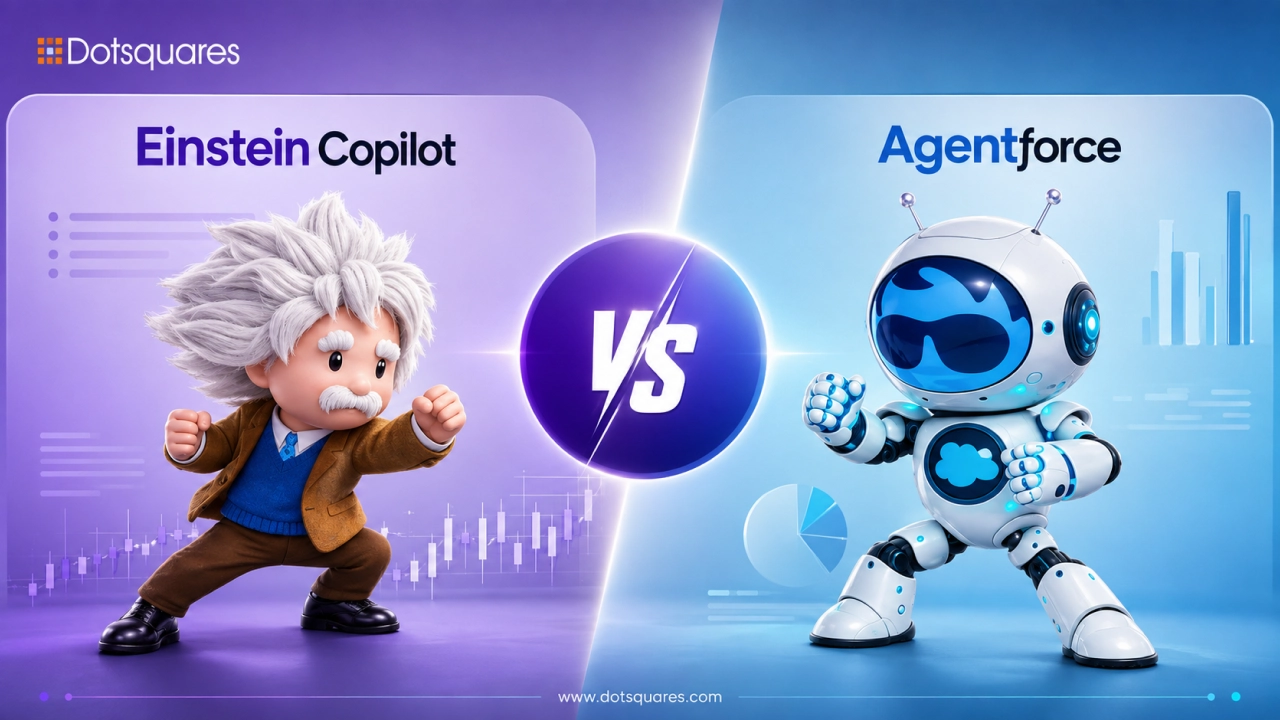
If you've been searching "Agentforce vs Einstein Copilot" and coming away more confused than when you started, you're not alone, and honestly, Salesforce's own naming choices are a big part of the problem. Here's the twist most comparison articles gloss over: Einstein Copilot was technically renamed to Agentforce back in January 2025. Same product, new name, no functional change at the time.
So why does everyone, including Salesforce's own marketing in places, still talk about them like they're two different things? Because in practice, they've since diverged. What started as a rename has grown into two genuinely distinct approaches to AI inside Salesforce, one built around assisting a human who's still driving, the other built around agents that act on their own. Getting this distinction right matters, because picking the wrong one, or assuming you need both when you only need one, is an expensive mistake to make.
Agentforce vs Einstein Copilot Comparison: Core Differences
Think of it this way. Einstein Copilot, now often labeled Agent Studio in Salesforce's interface, is built for assisted productivity. A sales rep can ask it "show me all open opportunities from premium accounts that haven't been touched in 30 days," and it pulls that answer instantly, no report-building required. It drafts emails, retrieves records, surfaces insights, all while a human stays firmly in the driver's seat, reviewing and acting on what Copilot hands them.
Agentforce is a different animal entirely. It's built for autonomous execution, agents that can be triggered by an event, work through a multi-step process, make decisions based on defined rules, and interact directly with customers or backend systems without waiting for a human to approve each step. Where Copilot answers a question, Agentforce actually goes and resolves the case, books the meeting, or routes the escalation on its own.
The practical difference comes down to this: if your team needs faster answers and smarter suggestions while still making the final call themselves, that's Einstein Copilot territory. If you need something to actually run a process end-to-end without a person babysitting every step, that's what Agentforce is built for. Plenty of mature Salesforce orgs end up using both, Agentforce handling high-volume, repetitive front-line work, Copilot making every human-handled conversation faster and better-informed.
Agentforce vs Einstein Copilot Pricing: What You Will Actually Pay
This is where the two products genuinely part ways, and where a lot of budgeting mistakes happen. Einstein Copilot follows a familiar, predictable model, seat-based pricing, generally landing somewhere in the range of $75 to $500 per user per month depending on your edition and bundle, either included in Einstein 1 Sales or Service editions or added on to an existing Sales Cloud or Service Cloud license.
Agentforce pricing works completely differently, priced per conversation rather than per seat. Salesforce's published list price sits around $2 per conversation for the standard tier, with volume discounts typically negotiated at enterprise scale. That structural shift matters, your Agentforce bill scales with how much your agents actually do, not with how many employees you have.
Here's the part that catches a lot of businesses off guard: Agentforce requires Data Cloud as a mandatory prerequisite, and that licensing is separate, often starting in the high five figures annually for mid-market organizations. Once you factor in Data Cloud, Agentforce platform fees, and professional services, a realistic first-year cost for a moderate deployment, think tens of thousands of conversations, can land anywhere from $200,000 to $400,000 for a mid-to-large organization, with per-user-equivalent costs often working out to somewhere between $100 and $300 a month once Data Cloud is included.
The takeaway on Agentforce vs Einstein Copilot pricing: Einstein Copilot gives you predictable, budgetable spend. Agentforce can be genuinely cost-effective for high-volume, repetitive workflows, but it comes with a real upfront investment and ongoing consumption cost that needs careful modeling before you commit.
Agentforce Implementation: What It Takes to Go Live
Agentforce implementation is not a quick toggle-on feature, and treating it like one is exactly why so many rollouts stumble. A few numbers are worth sitting with before you plan a deployment. Recent 2026 industry analysis found that 77% of B2B Agentforce deployments run into failure specifically because of data quality issues, and only about 31% of deployments are still actively running six months after go-live. That's not a Salesforce product problem so much as an organizational readiness problem, agents built on messy, inconsistent, or incomplete data simply can't perform reliably, no matter how good the underlying model is.
A realistic Agentforce implementation involves several distinct phases: getting Data Cloud properly configured and connected to clean, unified data sources, defining the specific use cases and decision rules the agent will operate under, building and testing the agent in a sandbox environment against real scenarios, setting up proper escalation paths for when the agent hits something it can't resolve, and only then rolling out to production with close monitoring in the first weeks. Skipping the data readiness step in particular is the single most common reason implementations stall out or get quietly abandoned.
If you're also weighing whether a lighter-weight option makes more sense for your specific use case, it's worth understanding how Agentforce compares to Prompt Builder before committing to a full autonomous agent build.
Which One Does Your Business Need: Agentforce or Einstein Copilot?
The honest answer depends less on budget and more on what problem you're actually trying to solve.
Choose Einstein Copilot if your team's biggest bottleneck is finding information faster, drafting communications quicker, or getting smarter recommendations while a human still makes every final decision. It's the safer, more predictable starting point, especially for organizations still building out clean, reliable data practices.
Choose Agentforce if you have a genuinely high-volume, repetitive process, routine customer service inquiries, lead qualification, order status checks, that's currently eating significant human hours and follows rules consistent enough for an agent to execute reliably without constant human oversight. Given that adoption data shows only around 5.3% of Salesforce's customer base has actually deployed Agentforce as of early 2026, and just 6% carry a paid license, this is still genuinely early-stage technology for most organizations, which isn't a reason to avoid it, but it is a reason to go in with realistic expectations and solid planning rather than assuming it'll work out of the box.
For a lot of businesses, the real answer is both, Einstein Copilot supporting your team's day-to-day productivity, and Agentforce handling a narrow, well-defined slice of high-volume work where autonomous execution genuinely makes sense.
Making the Right Call: How a Salesforce Consulting Company Can Help
Given how much nuance sits underneath "Agentforce vs Einstein Copilot," from pricing structure to data readiness to which workflows actually justify autonomous execution, this isn't really a decision to make off a comparison chart alone. A genuine Salesforce consulting partner can assess your actual data quality, map your specific workflows against what each product is realistically built to handle, and help you avoid becoming one of the majority of Agentforce deployments that stall out from rushed, under-prepared rollouts.
Whether that means a properly scoped Einstein Copilot rollout, a narrow, well-tested Agentforce pilot, or help to build custom Salesforce agents tailored to your specific process, working with a team that's actually implemented both, not just read the pricing page, makes the difference between a tool your team adopts and one that quietly gets abandoned within six months.
If you're ready to figure out which path actually fits your business, get in touch with Dotsquares. As a Salesforce consulting company with hands-on experience across both Einstein and Agentforce deployments, we can help you make this call with real data behind it, not guesswork. You can also hire a Salesforce developer from our team to scope, build, and support whichever path makes sense for where your business actually is today.


Related Post

 October 16, 2026
E-commerce Security: Protect Your Store From Cyber Threats
Learn how E-commerce security protects your online store from fraud, data breaches, and bots. Explore threats, PCI DSS, and best practices.
Keep Reading October 15, 2026
Low-Code Integration: What It Is, How It Works and When Businesses Should Use It
Learn how low-code integration connects business apps and APIs, its key benefits, common use cases, limitations, and when to choose custom integration.
Keep Reading October 15, 2026
SAP BW to Cloud Migration: Benefits, Challenges and Planning Steps
Learn about SAP BW to cloud migration, including benefits, challenges, AWS options, cost factors and planning steps for a successful migration.
Keep Reading