Tech
Moving from File-Based Integration to a Centralised Cloud Data Platform
 3 min read
When an organisation expands, its core data often sits trapped inside separate systems. Financial software, operations databases, and customer relationship management (CRM) tools usually run independently from one another.
To build unified reports, companies often rely on scheduled file exports, such as sending automated data sheets to an SFTP server or a shared folder every night. While this method is common, it creates ongoing maintenance issues. If a file transfer faces a network delay or a formatting change, the entire morning reporting cycle fails, requiring manual troubleshooting to get the dashboards back online.
This use case outlines how a business replaced inconsistent file transfers with a direct, automated architecture using microsoft fabric development.
The Operational Reality: Inconsistent Transfers and Siloed Storage
Before updating the infrastructure, the data environment relied on legacy pipelines that caused several specific operational bottlenecks:
- File Dependency Issues: One primary system exported a single 100MB file to an SFTP server once a day. Any failure during this transfer broke the data refresh cycle, causing significant delays during month-end financial reporting.
- Scattered Storage Layers: Roughly 10GB of transactional data was spread across older SQL databases and SharePoint folders. This fragmentation led to data redundancy and unnecessary cloud storage costs.
- Underutilised Systems: The company managed an active CRM platform, but its data remained entirely isolated and was never included in core business reports.
- Limited Monitoring: The entire extraction process ran as a single batch at 5 AM. The system lacked real-time alerting, meaning processing failures went unnoticed until users opened outdated dashboards later in the morning.
The Solution: A Unified Data Platform
To resolve these pipeline issues permanently, the data infrastructure was migrated into a single, integrated Microsoft Fabric environment.
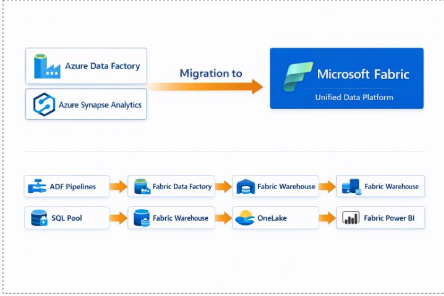
The new framework handles data ingestion, processing, and reporting through a structured, automated workflow.
1. Direct API Ingestion with Automated Recovery
Instead of generating intermediary text files every night, the platform connects directly to the source system application interfaces (APIs) using secure tokens.
- Built-in Retry Logic: If a connection drops due to a temporary network disruption, the pipeline automatically retries the connection after a set interval, preventing total job failure without requiring manual tech support.
2. Centralised Lakehouse Storage
All incoming data now lands in a single cloud repository called OneLake, replacing the mismatched SharePoint and legacy database folders.
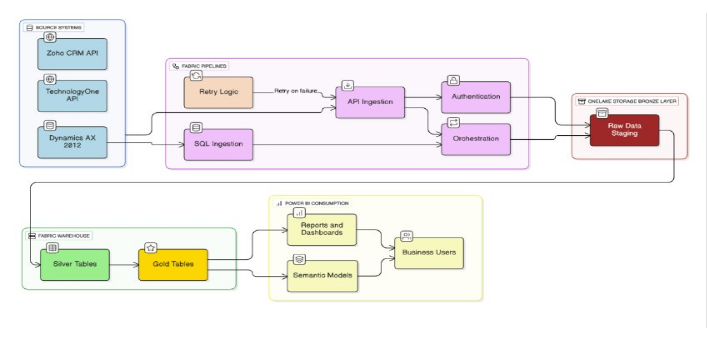
Data passes through standard stages: it is saved in its raw form, automatically verified for accuracy, and then written into structured tables within the data warehouse.
3. Star Schema Structure for Reporting Performance
To ensure reports load without delay, the warehouse arranges the data into a star schema model.
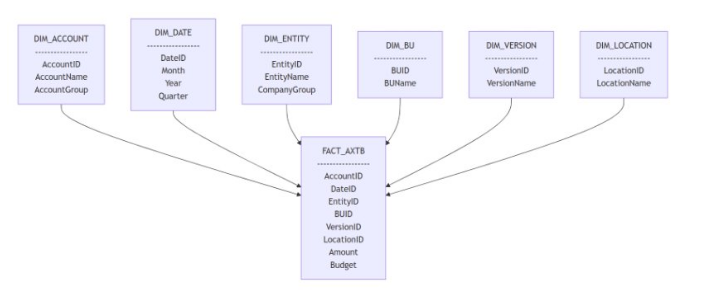
This design links core business metrics, like budgets and transaction amounts, directly to specific lookup categories (accounts, dates, entities, and branches). Because the database is organised this way, reporting tools can pull exact figures instantly without scanning unorganised records.
Measurable Project Outcomes
Consolidating the data environment produced clear improvements in both operational efficiency and monthly technology spending:
- 70% Reduction in Manual Tasks: By automating the ingestion pathways and removing manual file corrections, the team reduced repetitive maintenance labor by 50% to 70%.
- Faster Query Performance: Utilising Fabric's Direct Lake connection allowed reporting tools to pull live insights directly from the warehouse data, removing the need for slow, scheduled dashboard refreshes.
- Optimised Infrastructure Spending: Eliminating duplicate staging databases and moving to an on-demand, pay-per-use computing model lowered long-term total cost of ownership.
- New Analytics Streams Unlocked: Connecting the CRM platform directly to the central warehouse allowed the business to include customer tracking metrics in their executive dashboards for the first time.
Conclusion
Relying on scheduled file extracts to run corporate analytics creates avoidable operational risks when those files fail to load. Transitioning to a centralised cloud platform allows data pipelines to manage themselves securely in the background. With automated validation and direct connections in place, an organisation can stop spending time fixing broken spreadsheets and focus entirely on using accurate data to guide business decisions.


Related Post

 October 16, 2026
E-commerce Security: Protect Your Store From Cyber Threats
Learn how E-commerce security protects your online store from fraud, data breaches, and bots. Explore threats, PCI DSS, and best practices.
Keep Reading October 15, 2026
Low-Code Integration: What It Is, How It Works and When Businesses Should Use It
Learn how low-code integration connects business apps and APIs, its key benefits, common use cases, limitations, and when to choose custom integration.
Keep Reading October 15, 2026
SAP BW to Cloud Migration: Benefits, Challenges and Planning Steps
Learn about SAP BW to cloud migration, including benefits, challenges, AWS options, cost factors and planning steps for a successful migration.
Keep Reading