Manual vs Automation Testing: Choosing the Right Approach & Tools

Quality assurance is the foundation of successful software development. Yet every QA team eventually faces one big question - should testing be done manually, through automation, or a mix of both?
The truth is, each approach has its place. Manual testing brings human intuition and flexibility, while automation delivers speed, consistency, and scalability. The smartest teams use both and choose the right tools for each stage of their testing journey.
Below, we’ll explore the pros and cons of manual and automation testing, when to use each, and a few top frameworks and tools that can help you strike the perfect balance.
Manual Testing: Human Insight at Its Best
The manually tested and in another work actual result match to the expected result the system make ensure work properly
When you think of manual testing, picture a real person stepping through the application, clicking buttons, entering data, exploring weird edge cases—essentially acting like a real user. bellow mentioned makes manual testing valuable:
- Human intuition matters. Users don’t always behave in predictable ways. Manual testers can spot awkward layout issues, confusing flows, or UI inconsistencies that are hard to pre-program.
- Flexible and responsive. When a feature is in flux or the design is changing, writing automated tests can feel like a waste. In early development, manual testing lets you adapt quickly.
- Low barrier to get started. You don’t need to invest in test automation frameworks or deep programming skills to get immediate feedback.
Manual testing limitations -
- Time consuming: if multiple test cases running the same set of regression tests by hand gets tiring and error-prone.
- Hard to scale: as the application grows, it becomes difficult to test everything manually on every release.
- InShort: Manual testing is indispensable, especially in early stages, for usability, exploratory testing, and data quality management phases.
Automation Testing: Speed, Scale & Reliability
Automation testing replaces repetitive manual steps with scripts and software tools. Once written, tests can be reused across builds and environments, helping teams deliver faster with fewer bugs.
Benefits include:
- Fast regression cycles. You can quickly rerun thousands of tests after each change.
- Consistency. Automated tests avoid the variation and mistakes humans may introduce.
- Integration-friendly: Works perfectly within Custom Software Integration Services and CI/CD pipelines.
There are Automation drawbacks
- Upfront cost : There are multiple frameworks so we need to spend time designing a testing framework, writing good test code, and maintaining it.
- Brittleness : If the UI changes continuously, your automated tests will break and require updates in the code.
- Not applicable in all type testing : Exploratory testing, Monkey testing, UX feedback, and visual polish are still best done manually.
So, automation testing is a long-term investment. When the application is in stable mode and needs to run many tests frequently.
When we use there are suggested strategy
A balanced approach often works best. Here’s a rough guideline:
- Early development / new features → lean on manual testing.
- Once features stabilise → build automation for regression, smoke, and critical paths.
- Always use manual testing for ad hoc tests, usability, and visual checks.
- Use automation for load, stress tests, and cases that must be repeated often.
- Pick tools that match your expertise, team skills, and future growth plans.
Top Testing Tools & Frameworks
When it comes to tools, there’s no one-size-fits-all answer. The right choice depends on your tech stack, team skills, and testing goals. Here are some of the most trusted names across the industry:
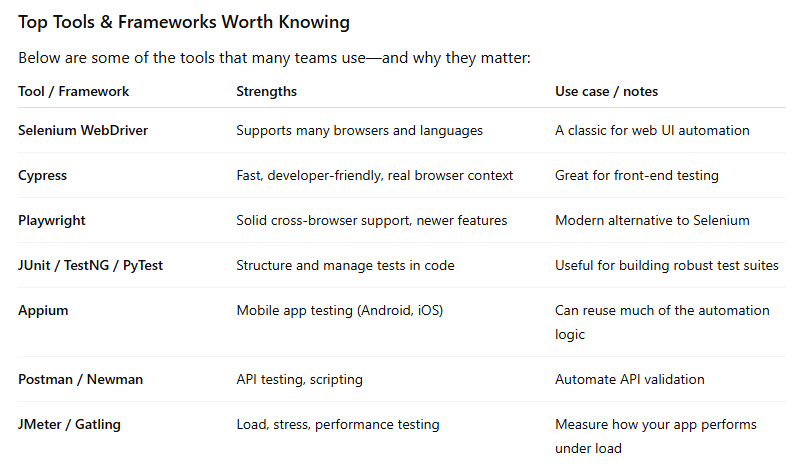
When comparing Cypress vs Playwright vs Selenium, the decision often comes down to flexibility vs simplicity vs speed. Many teams use a hybrid setup — for instance, Selenium for large web apps and Playwright for faster test runs.
Real-World Tips & Pitfalls to Watch Out For
Before automating, first test manual receive complete test case by manual QA team then can start automation testing
- Start with automating high-value, stable paths like login, Sign up, checkout, critical flows, Main requirement of project.
- Maintain test data carefully. Flaky or stale test data ruins trust in automation.
- Keep your automated tests fast, independent, and clean.
- Make sure you have reporting and visibility—knowing what failed and why is as important as having tests.
- Review automation periodically—what made sense 6 months ago may need refactoring.
Final Thoughts
Manual testing and automation testing complement each other, rather than compete. Manual testing lets you catch the human, visual, and unexpected issues. Automation benefits in the testing process as you improve your speed, repeatability, and scalability to keep confidence high as your product grows.
By choosing the right balance and the right tools, you’ll build a testing ecosystem that supports fast releases, high quality, and smooth software development across every project.


Related Post

 March 31, 2026
Power BI or Tableau: Which BI Tool Is Good for Your Business?
Compare Power BI and Tableau on cost, features, ease of use, and performance. Find the right BI tool for your business data and decision-making needs.
Keep Reading March 31, 2026
7 Key Benefits of Sitefinity That Drive Real Business Value
Discover 7 key benefits of Sitefinity CMS, including flexibility, integrations, security, and personalization to drive real business growth and digital success.
Keep Reading March 27, 2026
Fractional Real Estate Tokenisation: Benefits, Process & Future Trends
Discover how fractional real estate tokenisation works, including benefits, step-by-step process, and how it makes property investment more accessible & liquid.
Keep Reading