
Is Your Business AI-Ready?

Tech
 6 min read
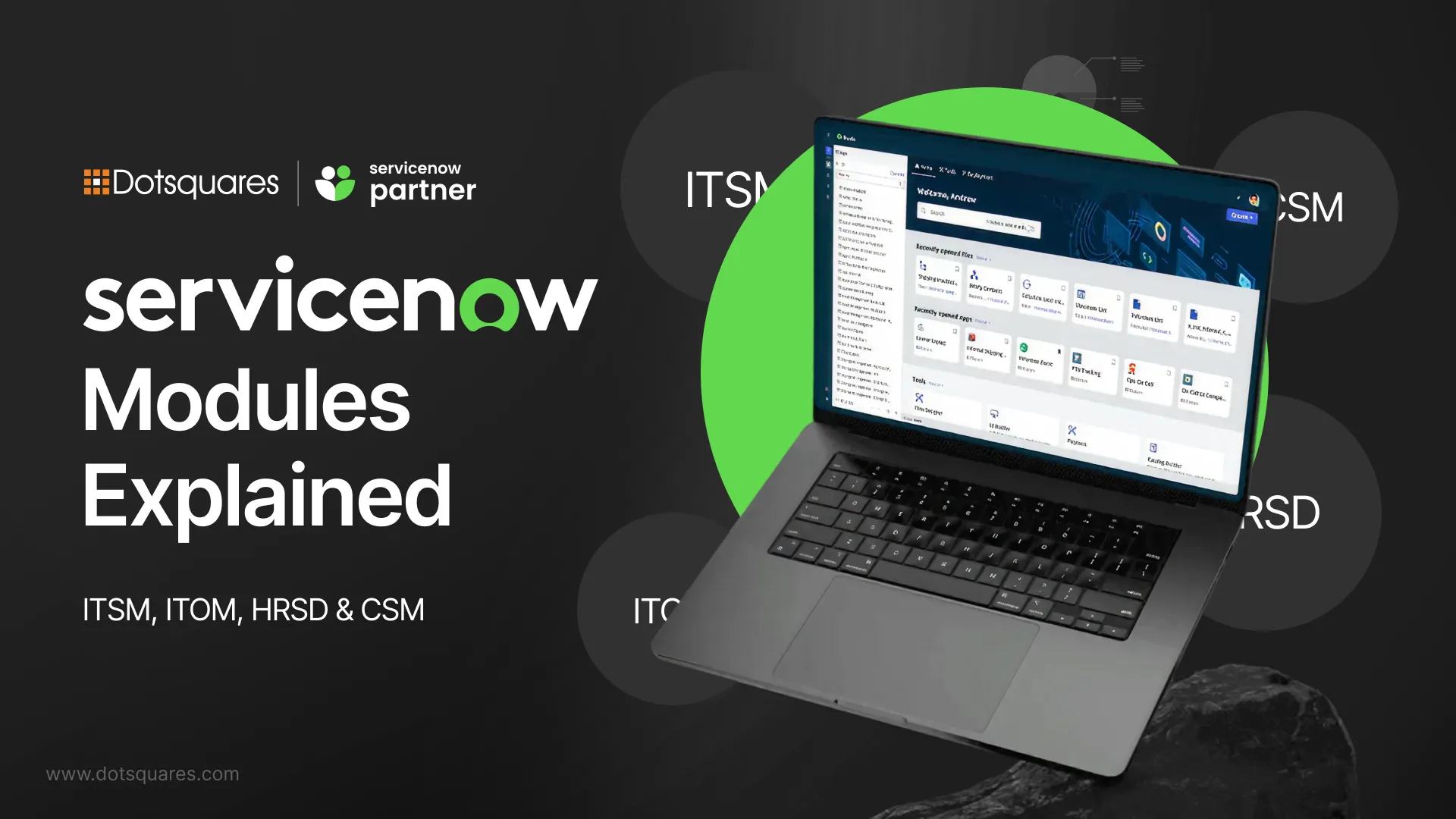
When a business first looks at ServiceNow, the sheer number of acronyms can be overwhelming. You hear about ITSM, then someone mentions ITOM, and suddenly you’re looking at HRSD and CSM. It’s easy to feel like you’re looking at an alphabet soup of technical jargon. But what do these modules actually do for your day-to-day operations?
In simple terms, ServiceNow is a "platform of platforms." It is designed to take the manual, messy work out of different departments and put it into a single, clean workflow. But you don't need every module at once. Most companies start with one core area and grow from there.
With this guide, you'll get to the bottom of the most frequently used ServiceNow modules, how they relate to each other, and why the right combination is the secret to a successful digital transformation.
If ServiceNow has a "home base," it is definitely ITSM. This is where most organisations begin. But what is it, exactly?
ITSM is the module that manages your IT help desk. Its the system that records a broken laptop, a forgotten password that needs to be reset, or a server that is down. ITSM has replaced handling such things through long email chains and sticky notes.
The main aim of ITSM is to render IT "invisible" by fixing it in an efficient way. It consists of:
When businesses look into ServiceNow implementation, ITSM is almost always the first item on the list because it provides an immediate return on investment by cutting down IT ticket resolution times.
While ITSM handles the "people" side of IT (the tickets and requests), ITOM handles the "machine" side. Think of ITOM as the nervous system of your IT infrastructure.
It gives you visibility. Many large companies don't actually know exactly how many servers they own or how their different software applications are connected. ITOM solves this through "Discovery." It maps out your entire network so you can see exactly what you have.
So why does this matter? Because if you know exactly how your systems are linked, you can predict when a failure is about to happen. You move from being "reactive" (fixing things) to "proactive" (preventing things from breaking in the first place).
Have you ever started a new job and spent the first three days waiting for your laptop, your email login, and your keycard? That is a failure of HR workflow.
HRSD takes the same logic used in IT help desks and applies it to Human Resources. In simple terms, it creates a "one-stop-shop" for employees. Whether they need to check their pay stub, request a leave of absence, or update their benefits, they do it through a single portal.
This is where we see the biggest impact of Custom AI Solutions. By using custom ai development services, companies can build "intelligent" assistants within HRSD. These aren't just basic chatbots; they are tools that can actually understand an employee's question and pull the specific policy they need, saving HR teams hundreds of hours of manual work every month.
We’ve all had the experience of calling customer support and having to explain our problem to three different people. It’s frustrating because the different departments aren't talking to each other.
CSM is designed to fix this. It connects your customer service team directly to your "back-office" teams (like engineering or finance). If a customer reports a bug in your software, the customer service agent can see the real-time status of the fix from the engineering team.
A major part of making this work smoothly is the use of ServiceNow playbooks. These are essentially "how-to" guides for complex tasks. By using ServiceNow playbooks automation, you can ensure that every customer issue is handled following the exact same high-quality steps, every single time.
Formerly known as ITBM, SPM is for the leaders who need to manage the company’s budget and project pipeline. It helps answer the question: "Are we spending our money on the right projects?"
It provides an easy way to manage and view Time, Resource Allocation, and Financial Goals for a project in one location. There shouldn’t be five different departments using five different project management tools; all project data should be stored in the ServiceNow solution, allowing executives an overview of whether or not their long-term strategic goals have been met.
With so many choices available, it is very easy to want to try to "do everything". However, attempting this would create a very costly and complex implementation.
The most successful companies usually take a phased approach. They might start with ITSM to get their IT house in order, then add ITOM for visibility, and eventually expand into HRSD or CSM as they become more comfortable with the platform.
This is where professional ServiceNow consulting services become vital. A consultant does not only instruct you on the usage of the software but also along with the decision of choosing the modules that will be the most beneficial for solving your specific business "pain points". They assist you in circumventing the "feature creep" that frequently results in huge and difficult, to, operate systems.
ServiceNow is not a one-size-fits-all solution; it's an ongoing process that requires constant management and adjustments. Many organisations consider hiring their own internal resources to do this, but find it too costly for each module they would want to support.
Thus, a majority prefer a ServiceNow Managed Service Provider Model. With this model, your organisation has access to a larger pool of talent who will continuously monitor and maintain your ServiceNow environment by applying the most current versions (for example: AI capabilities) and optimising workflows as your organisation expands. This enables your internal personnel to concentrate on performing their respective jobs while the Technical Service Provider addresses the platform.
At the end of the day, ServiceNow is about removing the friction from work. Whether it is through ITSM, HRSD, or the power of ServiceNow playbooks automation, the goal is to make things move faster and more accurately.
The "right" module for you depends on where your biggest bottlenecks are today. Is it your IT help desk? Your HR onboarding? Or perhaps your customer support? By choosing the right starter and getting help from ServiceNow consulting services, you can transform your company into a real digital-first business.
If you want to quit doing paperwork and start automation, it is time to consider how these modules can serve you.



 October 15, 2026
Learn how low-code integration connects business apps and APIs, its key benefits, common use cases, limitations, and when to choose custom integration.
Keep Reading October 15, 2026
Learn about SAP BW to cloud migration, including benefits, challenges, AWS options, cost factors and planning steps for a successful migration.
Keep Reading October 12, 2026
Learn how React Native works, where it saves time and cost, which industries use it, and whether it's still a good choice in 2026.
Keep Reading