
Is Your Business AI-Ready?

Tech
 10 min read
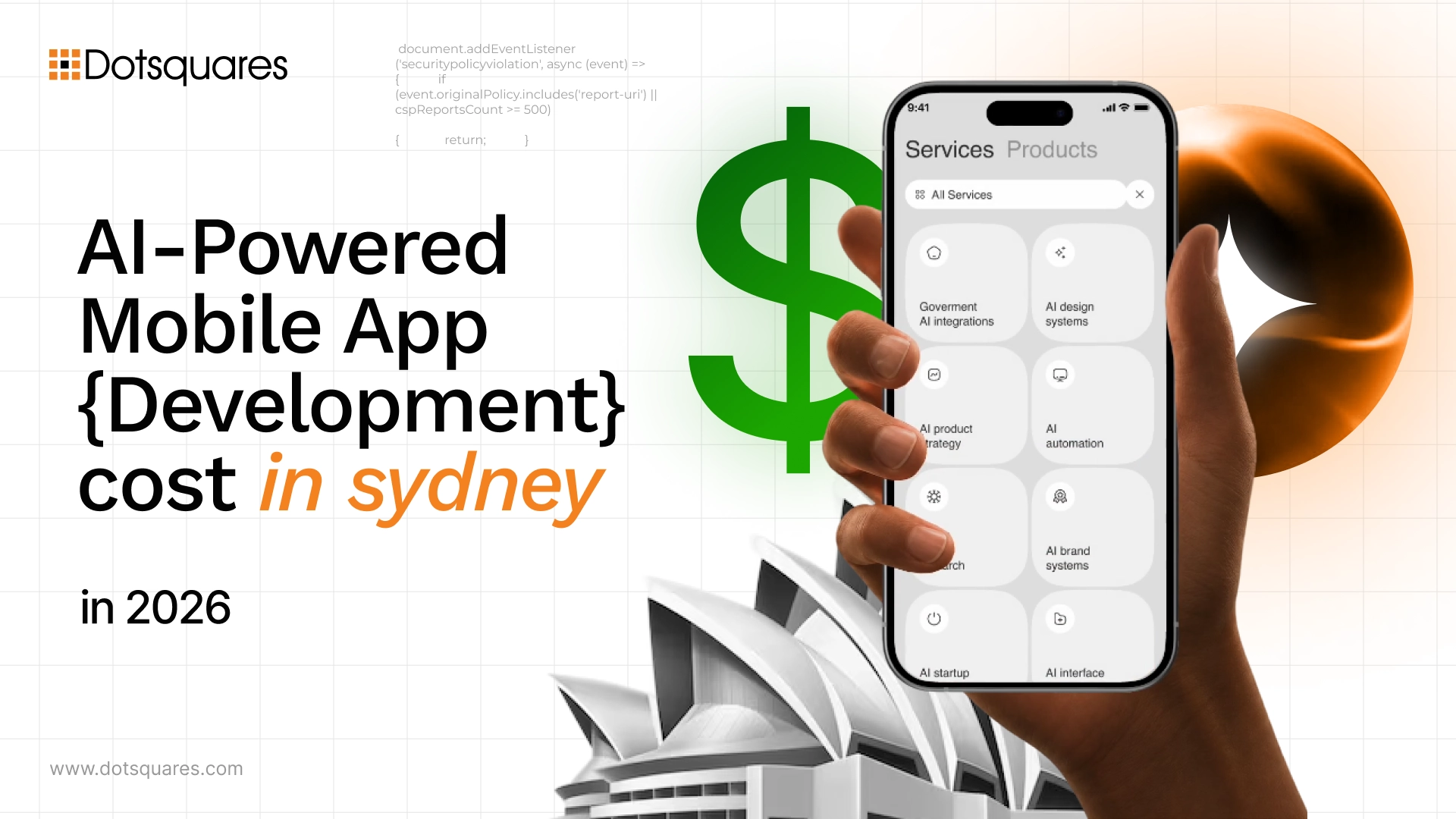
Let’s be completely upfront about building a mobile app today: the old playbook is officially out the window. If you are sitting in a boardroom in Sydney planning a new software project, you are no longer just asking how much it costs to build a standard application. Instead, the conversation has entirely shifted to AI-Powered App Development.
Whether it is embedding predictive engines, installing localized generative features, or launching autonomous agents, adding machine learning into the mix fundamentally changes your budget sheets.
Since the beginning of 2026, the whole issue of using intelligent automation has been moot. What the real question now is, is what is the real price to making an AI mobile app in Sydney? Without paying more than they need, businesses are still trying to work out how to handle this new financial setting. Let's look beyond the flashy tech sales pitches and share the real, down-to-earth numbers, timelines, and structural aspects that define your total investment.
Let me explain in the simplest way, it's not just about coding some lines that respond when the user presses the button. It's about developing software that cognitively functions, learns. changes, and even makes independent decisions.
When you undertake custom AI app development, your product stops being a static tool and becomes a dynamic ecosystem. This involves a heavy combination of:
In the end, it's about designing a more intelligent user experience. Since you're handling live data streams and a complicated infrastructure instead of simple front-end layouts, your timeline and cost for AI app development will be a lot different from those of a traditional software build. And this shift isn't unique to Sydney either, if you're weighing options across the country, it's worth seeing how app development costs stack up in Melbourne to get a fuller picture of the national pricing landscape.
How much money should you actually budget? Because development rates in Australia reflect local engineering expertise, building a product with a local Sydney agency involves distinct pricing tiers based on how deep the integration goes.
Here is a realistic AI app development pricing guide 2026 for the Sydney market, broken down by project complexity:
|
Complexity Level |
Key Characteristics |
Estimated Cost Range (AUD) |
Typical Timeline |
|
Simple AI Apps |
Pre-built API hooks (OpenAI/Gemini), basic customer support chatbots, smart data filtering, or simple automated text summaries. |
$30,000 – $75,000 |
2 to 3 months |
|
Medium-Complexity AI Apps |
Custom retrieval-augmented generation (RAG) systems, smart recommendation engines, personalized e-commerce feeds, and multi-system database integrations. |
$75,000 – $200,000 |
4 to 6 months |
|
Enterprise AI Apps |
Custom-trained proprietary models, autonomous business agents, advanced computer vision systems, massive data pipelines, and strict security compliance walls. |
$200,000 – $500,000+ |
6 to 12+ months |
Why is the price gap between a basic build and an enterprise system so massive? When you work on a custom mobile app development project, a few critical choices behind the scenes will drive your final invoice up or down:
In 2026, developers aren't building these complex systems from scratch with raw code. The choice of your foundational tech stack has a direct impact on your AI app development cost:
Different industries face completely different technical challenges and regulatory hurdles. For instance, a retail app doesn't have to deal with the strict legal privacy laws that protect medical data.
Here is how estimated development costs scale across different commercial sectors in Sydney:
|
Industry |
Primary AI Use Case |
Estimated Cost (AUD) |
Why Costs Are Higher / Lower |
|
Healthcare |
Diagnostic assistants, patient risk scoring, secure medical imaging analysis. |
$150,000 – $500,000+ |
Requires extreme data encryption, EHR integrations, and strict regulatory compliance. |
|
FinTech |
Real-time fraud detection, automated credit risk scoring, algorithmic trading. |
$150,000 – $450,000+ |
Demands institutional-grade security, instant data processing, and complex audit trails. |
|
E-commerce |
Hyper-personalized shopping feeds, visual search tools, smart inventory predictors. |
$80,000 – $250,000 |
Highly dependent on the scale of your inventory and user traffic volume. |
|
Education |
Automated grading helpers, customized adaptive learning paths for students. |
$60,000 – $180,000 |
Moderately priced, focused mainly on text processing and user progress tracking. |
|
Real Estate |
Automated property valuation engines, smart virtual property tours, lead scoring. |
$70,000 – $200,000 |
Relies heavily on public mapping APIs and historical market data integration. |
|
Travel & Hospitality |
Dynamic pricing models, autonomous booking assistants, itinerary planners. |
$75,000 – $220,000 |
Tied closely to live global flight and hotel inventory database syncs. |
|
Fitness & Wellness |
AI workout posture correction via camera, custom meal plan generators. |
$65,000 – $190,000 |
Computer vision features for movement tracking drive up the development hours. |
A lot of businesses make the mistake of thinking that once their app hits the Apple App Store or Google Play Store, the financial spending stops. With smart systems, that is never the case. You need to account for these ongoing operational bills:
We have seen incredible shifts in how software is put together over the last few months. If you are launching a project right now, you need to be aware of the dominant mobile app development trend shaping the market:
Taking a mobile app concept from a scribbled idea to a highly secure, functioning digital asset requires a precise balance of day-to-day business logic and cutting-edge platform engineering. You don’t have to figure out these complex budgets and architectures entirely on your own.
At Dotsquares, our core expertise is assisting businesses in eliminating the tech clutter and developing sleek, efficient software:
For a local Sydney project, a basic MVP using pre-built APIs generally starts around $30,000 to $75,000. Mid-level custom applications run between $75,000 and $200,000, while complex enterprise-grade systems utilizing proprietary models easily cross $200,000 to $500,000+.
The biggest cost drivers are data preparation (cleaning and labeling your records), your choice of model (using a simple third-party API vs. training a custom neural network), the complexity of your backend workflows, and the geographic location of your development team.
You should budget roughly 15% to 25% of your initial development cost annually to cover essential post-launch needs like cloud server fees, token usage, bug fixes, and continuous model retraining to prevent performance drops.
Yes, of course. In fact, very often, startups that eventually turn out to be successful begin by implementing really cheap ways, like the usage of pre-built commercial APIs to deploy a lean and very budget-friendly MVP before they decide to heavily invest in proprietary technology.
That would be if you managed to create a custom-trained model straightaway. But, if you wisely limit the functionality of the product, keep only the things that your users will definitely be happy with, and make use of existing open-source or commercial tools, the initial investment will be quite affordable for many nowadays businesses.
The simplest software can be ready and put into operation within around 2 or 3 months. The platform of a middle-sized company usually takes from 4 to 6 months, while a huge, tailor-made corporate system can need anywhere from 6 to 12+ months of continuous work by engineers.
So, we have made it to the final turn of our pricing breakdown. As we have read through all the different tiers, industries, and technical variables, the big takeaway is simple: intelligence is no longer a luxury feature, it is the absolute standard for modern mobile software.
Trying to release a standard, static app nowadays is almost like guaranteeing that you are going to lag behind your competitors straight away. But, If you understand how to balance your initial development needs, keep your data clean, and choose the right integration techniques, you can easily develop a high-performance product that will bring you great business value without exceeding your budget.
Ready to get an exact, tailored quote for your app idea? Contact our local Sydney specialist team today, and let’s design a clear, cost-effective path forward together!


 October 15, 2026
Learn how low-code integration connects business apps and APIs, its key benefits, common use cases, limitations, and when to choose custom integration.
Keep Reading October 15, 2026
Learn about SAP BW to cloud migration, including benefits, challenges, AWS options, cost factors and planning steps for a successful migration.
Keep Reading October 12, 2026
Learn how React Native works, where it saves time and cost, which industries use it, and whether it's still a good choice in 2026.
Keep Reading