Tech
Why Real Estate Builders Are Moving to AI-Powered CRM in 2026, And What EstateBuilder Does Differently
 8 min read
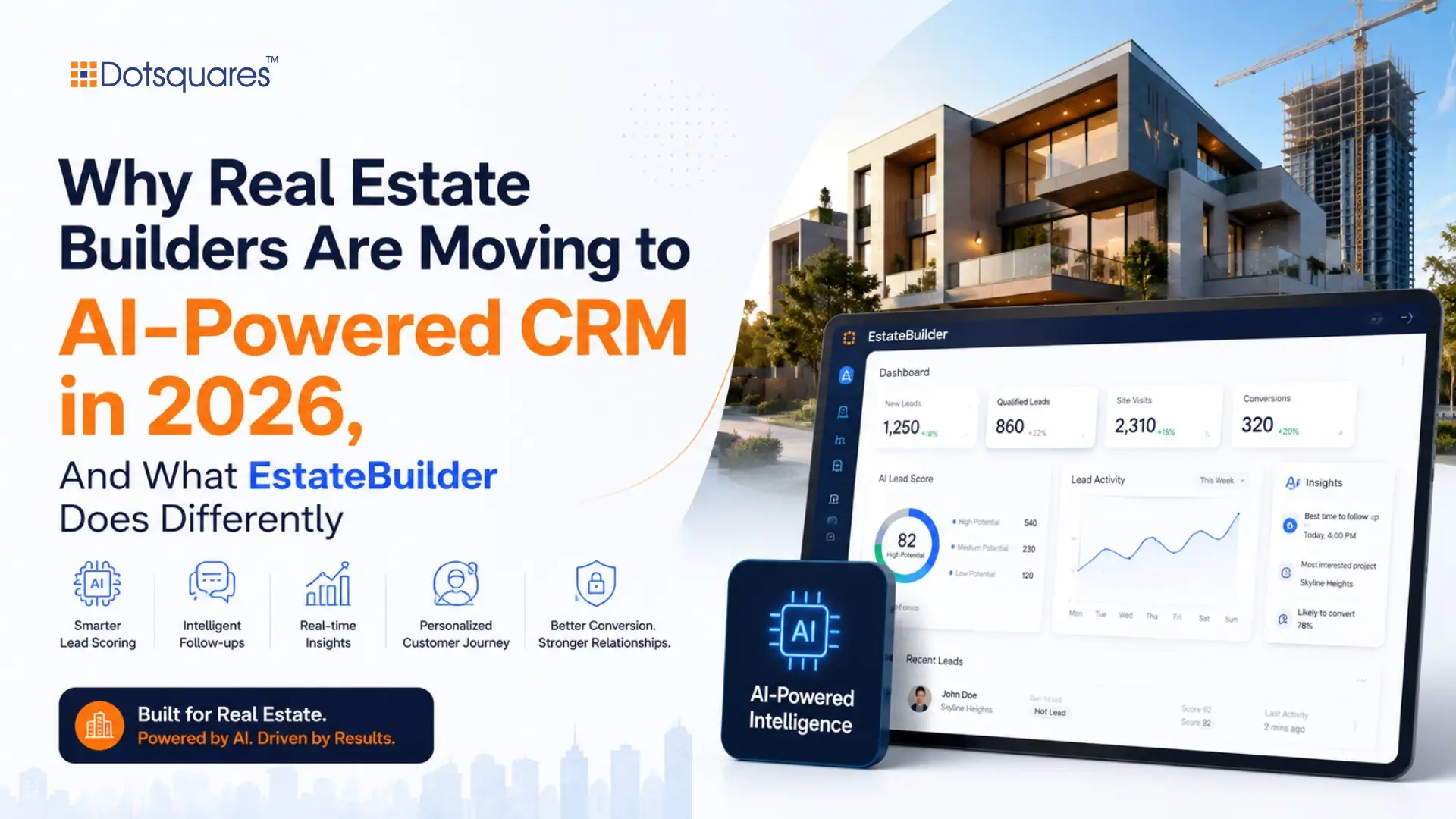
Real estate builders are not losing deals because of bad inventory or wrong pricing. They are losing them because their systems cannot keep up with how fast buyers expect to be handled today.
Walk into most real estate builder offices and you will find a surprisingly familiar setup, Google Sheets tracking leads, Gmail handling follow-ups, a standalone CRM that nobody fully trusts, and a Mailchimp account sending campaigns to a list that hasn't been cleaned in months. Each team, pre-sales, sales, booking, post-sales, has their own version of the truth, and reconciling those versions takes more time than anyone wants to admit.
The result is predictable. Leads slip through the cracks. Site visits don't convert because nobody followed up. Cost sheets go out with errors. Payment milestones get missed. And somewhere in the management committee, someone is trying to make decisions from a dashboard that's three days out of date.
This is not a people problem. It's a systems problem. And it's exactly what Salesforce, paired with Agentforce AI, is built to solve.
What Was Actually Going Wrong
Before talking about solutions, it's worth being specific about the problems, because they're more widespread than most builders acknowledge.
40% of leads affected
Lead Leakage
Manual data entry and missed follow-ups meant nearly half of all incoming enquiries never got a proper response.
45% error rate
Manual Cost Sheet Errors
Sales teams generating cost sheets by hand were producing errors that damaged buyer confidence and delayed decisions.
45% of payments missed
Payment Follow-Ups
Post-sales teams had no automated reminder system, so milestone payments were chased manually, and often too late.
30% of bookings delayed
Booking Bottlenecks
Unit locking and approval processes were handled manually, causing delays and scattered records across teams.
60% of CRM time wasted
No Unified Customer View
CRM teams spent more than half their time searching for customer history instead of actually helping customers.
60% blind spots
No Real-Time Dashboards
Management had no live view of sales performance or collections, making it impossible to catch revenue leakage early.
These are not edge cases. They are daily realities for most builder firms still running on disconnected tools. Research shows that 41% of real estate firms cite lead management as their single biggest operational challenge, and the numbers from this case study show exactly why.
Where Salesforce Comes In
The Salesforce implementation for this real estate builder was built on an Enterprise Edition licence, Sales and Service Einstein add-ons, Digital Engagement for WhatsApp and email, Agentforce with 100,000 Flex Credits, and Salesforce Data Cloud, all working together rather than as separate point solutions.
What does that actually change day to day?
For the pre-sales team, leads from every source, website, property portals, campaigns, are captured automatically. Deduplication runs in the background, so the same buyer enquiring twice doesn't create two separate records and two separate follow-up threads. Smart assignment routes leads to the right agent instantly, and the system sends an initial response via WhatsApp or email without anyone needing to pick it up manually. Lead leakage drops by 90%. First response time goes from hours to minutes.
For the sales team, cost sheets that used to take 30-45 minutes to generate, and frequently went out with errors, are now produced in under a minute with a single click. Live inventory means the unit shown to a buyer is always actually available. Follow-up automation ensures that a site visit which doesn't convert immediately doesn't just disappear from the radar.
+30% Lead Conversion
AI-Powered Lead Capture
Instant capture from all channels, AI qualification, smart routing, and automated first responses.
+70% Faster Documents
Automated Cost Sheets & Brochures
One-click generation with no manual errors. Sent directly to buyers via Email or WhatsApp.
+25% Site Visit Conversion
Seamless Visit Scheduling
Automated reminders for both buyers and sales agents. Better coordination, higher attendance.
+35% Collection Efficiency
Payment & Milestone Tracking
Real-time payment tracking with automated demand note reminders sent via WhatsApp and email.
+100% Booking Visibility
Centralised Booking History
Full traceability across every booking. Unit details, documents, and communication history in one place.
+50% Faster Issue Resolution
Case Management System
SLA-based workflows for customer complaints. No more issues falling through the cracks.
Where Estate AI Comes In
Estate AI is the AI-powered chatbot developed by Dotsquares, built directly inside the Salesforce and Agentforce infrastructure that powers the real estate CRM. It is not a generic chatbot bolted on as an afterthought — it is purpose-built for the property sales workflow, designed to handle the specific conversations, decisions, and scheduling tasks that buyers and builder teams deal with every single day.
What does Estate AI actually handle?
A buyer visits your website at 11pm and asks about a 3BHK unit in a specific budget range. Estate AI responds immediately, sharing floor plan details, current pricing, and live availability, qualifying the lead through conversation, and scheduling a site visit for the following morning. No human needed. No lead lost to a slow response. By the time your sales team starts their day, that buyer is already warm, qualified, and booked in.
Beyond initial enquiries, Estate AI manages the full property scheduling flow, including check-ins and check-outs for site visits. A buyer confirms their visit through the chatbot, receives automated reminders, and checks in on arrival, all handled without any manual coordination from your team and without disrupting anything already running in the system. Every step slots cleanly into the existing workflow rather than creating parallel processes that someone has to reconcile later.
What makes this particularly valuable for builder teams is the record-keeping. Every single message exchanged through Estate AI, every question asked, every detail shared, every scheduling confirmation, is logged automatically in Salesforce. Nothing falls through the cracks because someone forgot to update a record. Every team member who picks up that customer's query later has the full conversation history in front of them, from the very first message to the most recent interaction.
The ROI Numbers, Side by Side
The most useful way to look at this is to compare what the same business looks like across three states: no CRM, Salesforce CRM, and Salesforce with Agentforce AI.
|
Business Metric |
Without Salesforce |
With Salesforce CRM |
With Agentforce AI |
|
Lead Response Time |
8–12 hours |
1–2 hours (75% faster) |
Under 5 minutes (95% faster) |
|
Lead-to-Site Visit Conversion |
12–15% |
18–22% (+40%) |
24–28% (+70%) |
|
Site Visit-to-Booking |
8–10% |
12–14% (+40%) |
16–18% (+75%) |
|
Sales Cycle Duration |
60–75 days |
45–55 days (−25%) |
30–40 days (−45%) |
|
Document Generation Time |
30–45 minutes |
5–10 minutes (75% faster) |
Under 1 minute (95% faster) |
|
Payment Collection On-Time |
65–70% |
80–85% (+20%) |
90–95% (+35%) |
|
Customer Query Resolution |
24–48 hours |
8–12 hours (60% faster) |
Instant–2 hours (85% faster) |
|
Customer Satisfaction (CSAT) |
60–65% |
75–80% |
85–90% |
|
Annual Revenue Conversion |
Baseline |
+20–25% improvement |
+35–40% improvement |
These numbers come from the actual case study data and reflect annualised projections based on real implementation outcomes. The jump from Salesforce CRM to Agentforce AI is meaningful on every metric, but the base Salesforce implementation alone already represents a substantial operational improvement over the spreadsheet-and-Gmail setup that most builders are still running.
Who Feels the Difference Most
Every team in the builder's organisation ends up in a different place. The pre-sales team stops losing leads they never knew they had. The sales team spends less time on paperwork and more time with buyers who are actually ready to move. The booking team gets full traceability and automated approvals instead of chasing signatures. The post-sales team has a reminder system that doesn't rely on someone remembering to send an email.
For project heads, real-time inventory means the unit shown to a buyer at 3pm is the same unit that's still available at 5pm, no more inventory mismatch, no more embarrassing corrections. Parking allocation conflicts, which used to require back-and-forth between teams, are resolved at the system level. And for the management committee, live dashboards replace the end-of-month report that was already out of date by the time it arrived.
Real estate businesses using Salesforce consistently report improvements in lead conversion, client satisfaction, and sales team efficiency, and the data from this implementation backs that up at every stage of the customer journey.
Is This for Every Builder?
What if you're a mid-sized developer, not a large enterprise?
Salesforce serves real estate customers from large enterprises down to small and mid-sized businesses, and the implementation can be scoped to match where a business actually is. A developer with two active projects and a sales team of ten people doesn't need the full enterprise stack on day one. The architecture is modular, starting with lead management and basic automation, then layer in Agentforce capabilities as the team gets comfortable with the platform.
The honest caveat is that technology is only part of it. Adoption resistance is one of the most common reasons CRM implementations underperform, teams comfortable with spreadsheets revert to old habits without proper training and internal buy-in. Getting that right matters as much as getting the configuration right.
The bottom line:
Real estate builders are sitting on a process problem that technology can genuinely fix. The combination of Salesforce CRM and Agentforce AI addresses lead leakage, document errors, payment delays, inventory mismatches, and management visibility, all in a single connected platform.
The builders who move on this now are the ones whose buyers will have a faster, cleaner, more responsive experience through every stage of their purchase journey. In a market where trust and speed matter enormously, that's not a small advantage.
If you'd like to explore what this looks like for your specific setup, you can learn more about Dotsquares' Salesforce real estate CRM solutions here.
https://www.dotsquares.com/salesforce-consulting-services


Related Post

 October 15, 2026
Low-Code Integration: What It Is, How It Works and When Businesses Should Use It
Learn how low-code integration connects business apps and APIs, its key benefits, common use cases, limitations, and when to choose custom integration.
Keep Reading October 15, 2026
SAP BW to Cloud Migration: Benefits, Challenges and Planning Steps
Learn about SAP BW to cloud migration, including benefits, challenges, AWS options, cost factors and planning steps for a successful migration.
Keep Reading October 12, 2026
Mobile App Development with React Native and What You Need to Know
Learn how React Native works, where it saves time and cost, which industries use it, and whether it's still a good choice in 2026.
Keep Reading