Tech
Legacy to Cloud: Modernisation Strategies & Services 2026
 9 min read
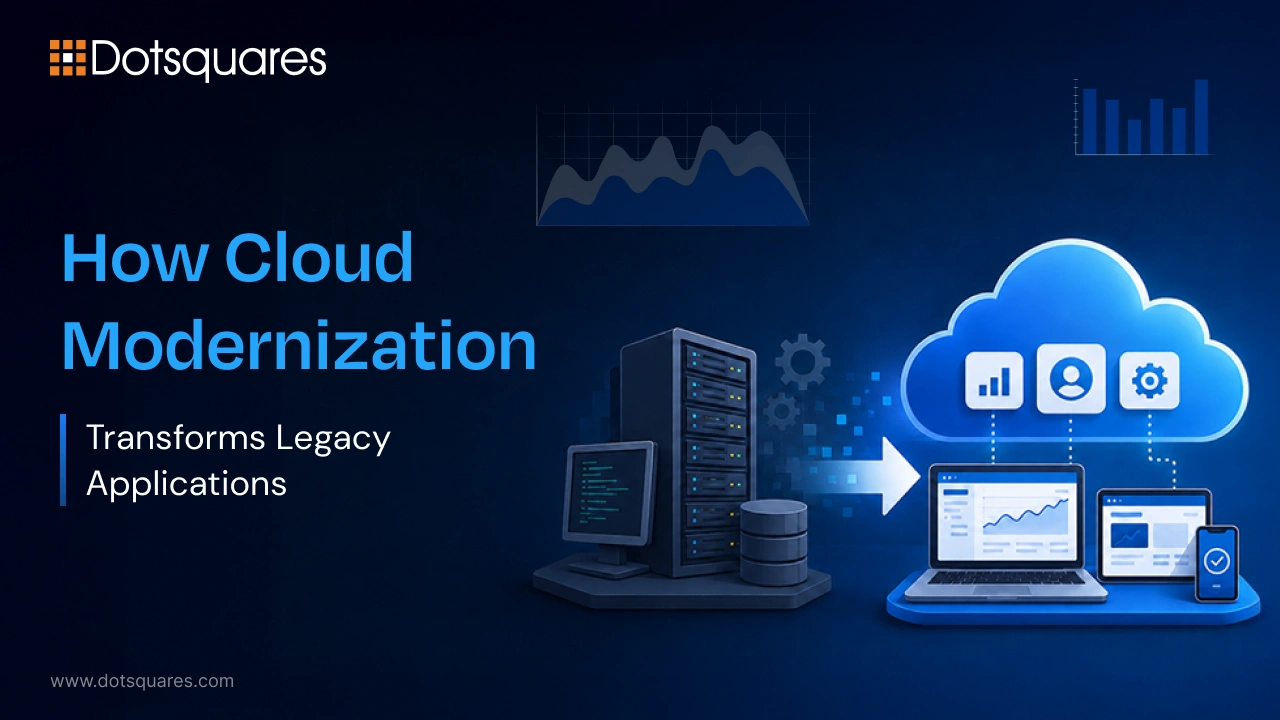
There is a question that comes up in almost every enterprise technology conversation right now: how do we move our legacy systems to the cloud without breaking what already works? It sounds straightforward, but anyone who has been through a real legacy modernization to cloud app modernisation project knows it rarely is.
Legacy applications, the ones that have been running your business for a decade or more, were not built for the world we operate in today. They were not designed for cloud-native architectures, microservices, or the kind of rapid deployment cycles that modern businesses depend on. And yet, simply replacing them is rarely the right answer either. That is exactly where cloud modernization and migration strategy comes in, and why getting it right matters more in 2026 than it ever has.
At Dotsquares, we work with businesses across industries who are somewhere on this journey, some just starting to assess their options, others mid-migration and looking for a clearer path forward. This guide pulls together everything you need to know before you make the call. You can also read more about how we approach this in our piece on Cloud Solutions for Modern Business.
Understanding Legacy Applications
When we talk about legacy applications, we do not just mean old software. In this context, “legacy” means any system that was built on an architecture or technology stack that no longer lines up with how your business actually needs to run.
In many cases, these systems follow similar architectural patterns. They’re commonly monolithic, so everything is tightly coupled and if you tweak one part, something else might get knocked over somewhere else too. They also lean on on-premises infrastructure, which can be a costly burden to maintain and honestly isn’t very friendly when you try to scale up. A lot of the time they keep years of business-critical data in formats, or in databases that newer systems find hard to integrate with smoothly. Plus the original builders have often moved on by now, so you’re left with legacy code where nobody really has the full picture.
Now, the real cost is not only the maintenance bill, even if that part is pretty significant. It’s also the pace you lose. When a single feature change takes months of careful testing, when the team spends more time babysitting older systems than delivering new capabilities, and when working with modern tools turns into its own little endeavor, then legacy stops being “just older” and becomes a competitive weight.
Key Benefits of Modernising Legacy Systems with Cloud Modernisation
The case for modernisation is not just about cutting costs, even if that part really does matter. Here are some of the benefits organisations see when they move their legacy applications to the cloud the right way.
- Faster deployment cycles: cloud native architectures and DevOps development services lets teams ship updates in days, rather than months and that shift changes what is commercially possible.
- Lower infrastructure costs too: pay as you go cloud pricing replaces fixed on premises hardware expenses while scaling resources more efficiently as operational demands grow..
- Better security posture: modern cloud platforms come with enterprise grade security controls, plus automatic patching and compliance frameworks, that older infrastructure just can not match, not really.
- Scalability on demand is also a big deal: cloud resources scale up or down depending on actual workload, so you do not end up with the over provisioning that a lot of legacy environments still rely on.
- Easier integration: because cloud based systems connect more naturally with modern APIs, data platforms, and third party services, in the real world.
- Improved developer experience: modern tooling, containerisation, and CI/CD pipelines make your engineering team significantly more productive
We covered this topic in more detail in our Azure Cloud-Based Data Solutions post, especially if you want to improve real-time analytics.
Traditional Approach to Modernisation
Before cloud modernisation became the “normal” thing to do, enterprises used to handle legacy systems a few different ways, kind of slowly and unevenly, and honestly understanding those paths sort of explains why cloud-first plans now feel so dominant.
The lift-and-shift approach, taking an application as-is and moving it to a cloud server, was popular early on because it was fast and low-risk. The problem is it delivers almost none of the actual benefits of cloud modernisation. You end up paying cloud costs while running an architecture that was designed for on-premises infrastructure.
Others went the full replacement route, ripping out the old system and building from scratch. This works in some cases, but it is expensive, time-consuming, and carries significant delivery risk. For organisations running core business-critical applications, a clean-slate rebuild is often too risky to justify.
The result is that most enterprises today are somewhere in the middle, with systems that have been partially modernised, migrated, or patched over the years, without a coherent strategy tying it all together. That is the starting point for most cloud modernisation service engagements in 2026.
Five Key Cloud Modernisation Strategies
There isn’t a single right path for cloud modernisation, but there are five established strategies that cover almost all scenarios. Which one fits best depends on the application itself, your business priorities and, how much transformation you can realistically absorb all at once.
|
Strategy |
What It Means |
Best For |
|
Rehost (Lift & Shift) |
Move the application to cloud infrastructure with minimal changes |
Fast migration, cost reduction on hosting, no architectural benefit |
|
Replatform |
Migrate with minor optimisations (e.g. managed database, container runtime) |
Getting some cloud benefit without a full rebuild |
|
Refactor / Re-architect |
Redesign the application to use cloud-native patterns, microservices, serverless, APIs |
Applications needing scalability, agility, and long-term flexibility |
|
Rebuild |
Rewrite the application from scratch using cloud-native tech |
When the existing codebase is unsalvageable or severely limits capability |
|
Retire / Replace |
Decommission redundant applications or replace with SaaS alternatives |
Rationalising the application portfolio and cutting maintenance overhead |
In practical terms, most enterprise modernisation programmes use a bit of these tactics across different applications, not always the same way. A well-structured cloud modernisation service engagement will look at each application separately, then suggest the most fitting path, rather than just pushing one single strategy onto everything.
Cloud Modernisation Services vs In-House Modernisation
This is the question every CTO and engineering leader eventually has to answer: do we build the capability to do this ourselves, or do we work with a specialist cloud consulting partner?
The honest answer is that it depends on where your team is right now, but most organisations underestimate how different modernisation work is from standard software development.
|
Factor |
Cloud Modernisation Service Partner |
In-House Team |
|
Speed to start |
Faster, experienced teams with established processes |
Slower, requires hiring, training, and tooling build-out |
|
Specialist skills |
Access to AWS cloud consulting services, Azure, GCP experts immediately |
Takes months to years to build internally |
|
Risk management |
Proven frameworks, migration tooling, and rollback plans |
Risk of learning lessons the expensive way |
|
Cost |
Predictable engagement cost with clear deliverables |
Hidden costs in recruitment, attrition, and extended timelines |
|
Long-term ownership |
Transition plan included, team takes ownership post-go-live |
Full ownership from day one, good if the capability exists |
|
Knowledge transfer |
Structured handover built into the engagement |
Knowledge stays entirely internal throughout |
For most mid-market and enterprise organisations, a hybrid approach works best, an experienced cloud consulting partner like Dotsquares leads the architecture and migration, works alongside your internal team, and transfers knowledge throughout the engagement. Your team gets a modern platform they understand and can manage, instead of one that feels difficult or unclear.
Choosing the Right Cloud Platform for Your Modernisation Journey
AWS, Azure, and Google Cloud are the three main platforms, and choosing between them is less about which is objectively better and more about which fits your situation. Here is a practical breakdown:
AWS
AWS is the most mature and has the broadest service catalogue. It is a strong default choice for organisations with no strong existing Microsoft or Google relationship, and it is where AWS cloud consulting servicesexpertise is most widely available.
Azure
Azure is the natural fit for organisations already running Microsoft workloads, Active Directory, Office 365, SQL Server. Azure cloud-based data solutions and analytics integrations are particularly strong, which is why many enterprises choose it for data modernisation programmes.
Google Cloud
Google Cloud is leading when it comes to data and AI capabilities, so it’s honestly worth serious consideration, especially for organisations where machine learning workloads are central to modernisation plans.
But even beyond the platform choice, cloud modernisation also spills into your DevOps maturity a lot. Getting the right CI/CD pipelines working, doing containerisation with Kubernetes, and using infrastructure-as-code through DevOps development services, it all becomes part of the same modernisation path, not just the migration itself. You can read more about this in our overview of Cloud Modernization.
Conclusion
Legacy systems are not just disappearing by themselves, and the longer they sit as they are, the bigger the gap gets between what your business can do today and what your competitors are already doing. Cloud modernization is not a one time project, it is more of a change in how your organisation builds, runs, and then keeps evolving its technology.
The good news is this does not need to happen all at once. A properly laid out cloud modernization and migration programme , with the right strategy matched to each application, can produce meaningful outcomes pretty fast while still keeping risk under control across the full journey. Not just speed, but a kind of steady reorientation.
If you are ready to take a clear-eyed look at where your legacy systems are holding you back and what a realistic modernization roadmap looks like for your business, the Dotsquares team is here to help, from initial assessment through to go-live and beyond.
Frequently Asked Questions
What is legacy modernization to cloud app modernisation?
It is the process of transforming outdated applications into cloud-ready or cloud-native systems to improve performance, scalability, and flexibility.
What does a cloud modernization service typically include?
It usually includes application assessment, migration planning, modernization, testing, deployment, and ongoing support.
What is the best cloud modernization approach for enterprises?
There is no one-size-fits-all approach. The right strategy depends on business goals, system complexity, and application needs.


Related Post
 October 15, 2026
Low-Code Integration: What It Is, How It Works and When Businesses Should Use It
Learn how low-code integration connects business apps and APIs, its key benefits, common use cases, limitations, and when to choose custom integration.
Keep Reading October 15, 2026
SAP BW to Cloud Migration: Benefits, Challenges and Planning Steps
Learn about SAP BW to cloud migration, including benefits, challenges, AWS options, cost factors and planning steps for a successful migration.
Keep Reading October 12, 2026
Mobile App Development with React Native and What You Need to Know
Learn how React Native works, where it saves time and cost, which industries use it, and whether it's still a good choice in 2026.
Keep Reading