
Is Your Business AI-Ready?

Tech
 5 min read
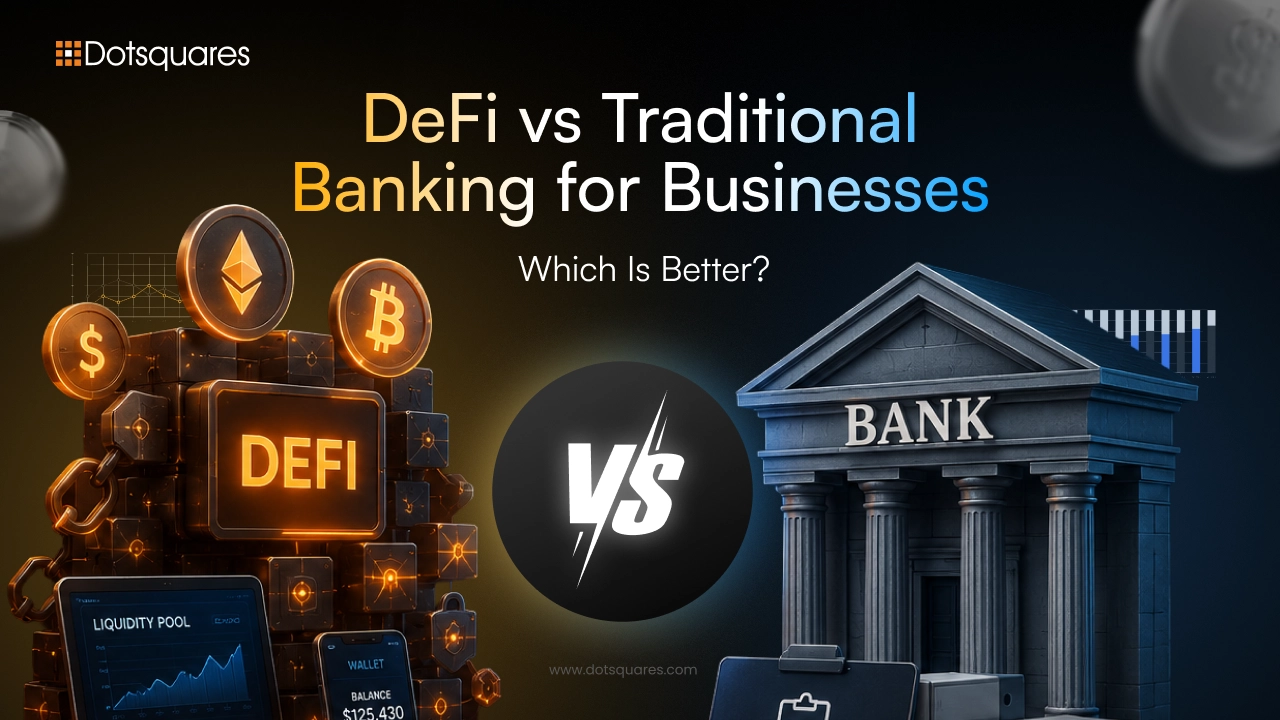
The increasing use of digital platforms has changed the working pattern of every industry, and the finance industry is no longer an exception. The entrance of digitisation has changed the way of managing funds. The entrance of decentralised finance has emerged as an alternative to the traditional banking system, facilitating people to perform financial activities powered by blockchain technology. DeFi offers solutions that offer greater accessibility, transparency, and efficiency.
Understanding the differences between DeFi and traditional banking can help businesses make appropriate decisions about managing payments, loans, investments, and financial operations.
Traditional banking refers to the financial services provided by institutions managed and controlled by the government, such as commercial banks and credit unions. These institutions act as mediators between businesses and financial services.
Businesses and individuals acquire the services of traditional banks for saving their funds, getting loans, making international transactions, and regulatory compliance. These banks are operated and governed by the government and provide protection to customers according to applicable rules and regulations.
Decentralised Finance, commonly known as DeFi, is a financial system powered by blockchain technology and ends the need for middlemen or mediators. DeFi platforms use smart contracts to perform financial activities, for instance, lending, borrowing, and managing financial assets.
Businesses can use DeFi services through digital wallets and blockchain networks. These platforms allow users to perform financial activities directly with one another while maintaining transparency through publicly accessible ledgers.
Before applying for loans or permission to access any financial services offered by traditional banks, businesses have to follow a long procedure, including approval by top bank authorities. The working process of traditional banks is often lengthy and time-consuming; even tasks like opening an account or acquiring a loan are performed between 8 to 10 days.
On the other side, DeFi platforms can be accessed from any corner of the world and typically require only a digital wallet and internet connection. Businesses can access financial services almost instantly without lengthy approval processes.
Making an international payment through traditional banking systems is performed in several days due to the presence of mediators and a long approval procedure.
Financial transactions conducted through DeFi are performed much faster, sometimes within minutes, depending on the blockchain network being used. This directly makes it easier for businesses to perform international financial transactions in less time than compared to traditional businesses.
In the traditional banking system, users have to pay necessary fees for every activity, whether it is maintaining an account, online transaction, acquiring loan or exchanging currency.
With DeFi platforms, the users have to pay only blockchain transaction fees and no extra cost for performing transactions due to the absence of mediators. For businesses operating in other countries, the use of a DeFi platform is more cost-effective compared to the traditional banking system.
Banking operations are mainly under the control of a centralised authority managed by the government. Customers are almost not allowed to check or see the internal working process.
DeFi operates on blockchain technology, where transactions are recorded on a transparent and immutable ledger. This transparency can improve trust and accountability for businesses and stakeholders.
Traditional banks invest huge amounts of money in cybersecurity and protecting their customers' data. Along with this, banks also offer the facility of insurance and regulatory measures to protect against losses.
DeFi platforms are powered by blockchain technology and operate through smart contracts. Although blockchain technology is highly secure, a little weakness in smart contract code or cyberattacks on platforms can expose businesses to risks.
Traditional banks operate strictly according to legal and regulatory guidelines determined by the government. This makes it easier for everyone to follow the working process accordingly.
The guidelines for DeFi platforms are still developing in many countries. It is important for businesses using DeFi services to stay updated about changing regulations and compliance requirements.
Businesses are adopting DeFi due to the following reasons:
All these benefits are of quite importance for startups, international businesses, and companies operating in regions where banking facilities are not well-developed.
Despite the increasing use of DeFi services, traditional banking continues to offer important advantages:
For many businesses, these features provide peace of mind and reduce financial risk.
There is no exact answer to this question. The selection between traditional banking systems and DeFi depends on the objective of a business, the financial risks it can tolerate, and operational requirements.
Traditional banking is the best option for businesses looking for stability, protection by the government, and established financial services. Meanwhile, DeFi offers innovative opportunities for companies looking to reduce costs, accelerate transactions, and access decentralised financial products.
Many businesses are beginning to adopt a hybrid approach, combining the powers of both traditional banking and DeFi solutions. They are looking to perform their financial activities through traditional financial systems and use DeFi services for international payments, liquidity management, and decentralised lending.
The comparison between DeFi and traditional banking is the same as comparing two different approaches. Traditional banks provide security, strict rules and regulations, and a trusted financial infrastructure. DeFi offers instant operations, accessibility, and cost efficiency through blockchain technology.
As financial technology continues to grow, businesses that understand both systems will succeed in enjoying the benefits of changing trends. Instead of considering DeFi and traditional banking systems as competitors, many organisations are looking for a working pattern that combines the powers of both systems to create a more flexible and efficient financial strategy.


 October 16, 2026
Learn how E-commerce security protects your online store from fraud, data breaches, and bots. Explore threats, PCI DSS, and best practices.
Keep Reading October 15, 2026
Learn how low-code integration connects business apps and APIs, its key benefits, common use cases, limitations, and when to choose custom integration.
Keep Reading October 15, 2026
Learn about SAP BW to cloud migration, including benefits, challenges, AWS options, cost factors and planning steps for a successful migration.
Keep Reading