
Is Your Business AI-Ready?

Tech
 9 min read
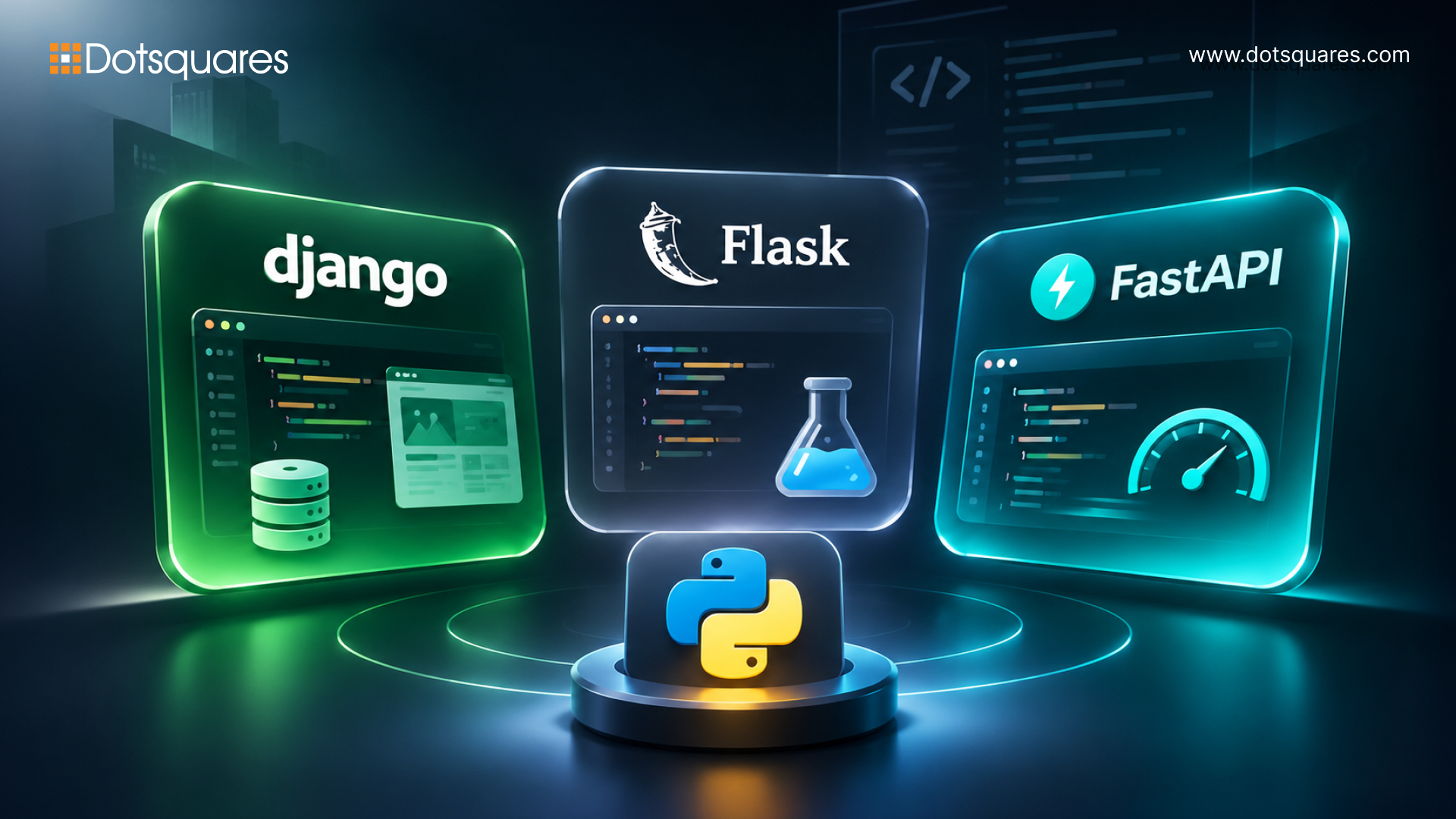
If you're building something in Python and the question of which framework to use has sent you down a rabbit hole, you're not alone. Django, Flask, and FastAPI each have their fans, each have their strengths, and each will tell you a very different story depending on what you're actually trying to build.
The frustrating answer to "which one is best?" is that it depends. But what it depends on is actually quite specific, and once you understand the trade-offs, the right choice usually becomes obvious pretty quickly. So let's actually work through it.
At the most basic level, these three frameworks solve different problems, and that's the starting point for the whole comparison.
Django is a "full stack" framework – it includes all that you may need for developing the web application within one package. It provides an ORM, admin interface, authentication, form processing capabilities, templating engine, and everything else necessary for creating the full-fledged app without using dozens of external packages. However, this approach involves certain restrictions and requirements from the developer – Django is opinionated, and has a specific approach to the project architecture. If you are trying to go against this architecture, you will waste too much time fighting the framework itself.
Flask is the opposite approach. It's a microframework; it gives you routing and request handling and not much else. Everything else (database integration, authentication, validation) is your choice. That freedom is exactly why developers love it for small services, internal tools, and prototypes. But it also means that as your project grows, you end up making a lot of decisions yourself that Django would have already made for you.
FastAPI is the newest of the three, and it was built specifically for building APIs fast. It's async-first, uses Python's type hints for automatic data validation through Pydantic, and generates interactive API documentation automatically. In terms of raw performance, it's in a different league from the other two, benchmarks consistently put FastAPI at 15,000–20,000 requests per second versus Django at around 4,000–6,000 and Flask at 2,000–3,000 under equivalent load conditions.
To make this concrete:
|
Factor |
Django |
Flask |
FastAPI |
|
Type |
Full-stack framework |
Microframework |
API framework |
|
Learning curve |
Moderate–steep |
Low |
Low–moderate |
|
Performance |
Moderate |
Lower |
High (async-native) |
|
Built-in features |
ORM, admin, auth, forms |
Routing only |
Validation, auto-docs |
|
Async support |
Partial (growing) |
Bolted on |
Native |
|
Best for |
Full web apps |
Small services, prototypes |
APIs, microservices, AI |
Django should be your go-to choice for projects that involve a true full-stack stack, user accounts, permissions, admin interface, relationships in database models, and plenty of basic CRUD operations. Just the Django admin interface will save you weeks of coding effort when your project requires an internal dashboard or a content management system.
Django should also be your choice if your team is expected to expand or change over time. As Django forces a certain project structure, a newly added developer six months into the project won't require any explanation to work with the code base.
The LTS release cycle of Django 5.2 (April 2025) goes through April 2028. This is important for companies who value predictable long-term support cycles.
Flask becomes appropriate where you need a simple, fast, and controllable solution. In cases where you are packaging a machine learning algorithm into an API endpoint, implementing a quick internal tool, or building a quick prototype to validate your idea, Flask is faster to implement than the other two options.
Flask also makes more sense where you are adding functionalities to an already implemented Flask system that is performing well. There are very few cases where there is a compelling reason to rewrite an already functional service using Django or FastAPI.
That said, Flask's async story is weaker than FastAPI's, and its performance ceiling is lower. For anything that's going to handle serious production traffic as an API, Flask is increasingly the answer that gets revisited once the load grows.
If you're building an API, and especially if that API needs to be fast, well-documented, or integrated with an AI/ML pipeline, FastAPI is hard to argue against in 2026. The JetBrains Python Developers Survey 2025 puts FastAPI adoption at 38% of Python developers (up from 29% the year before), and among ML engineers specifically, 42% are using FastAPI as their primary serving framework.
Automatic OpenAPI documentation is really a productivity boost, since the documentation is generated automatically using your type annotations, meaning that the documentation for your API will always be correct and interactive, with no additional effort required for its maintenance on the part of the teams utilizing your API.
In terms of custom API development, FastAPI fits nicely into today's microservices architecture, where multiple services need to interact with each other quickly and effectively. In this regard, the benchmarked performance of FastAPI starts making sense when you need to handle thousands of concurrent requests.
Here's the decision the way most real projects should frame it:
In the case of organizations making such a decision while building software as part of an overall larger build, framework selection is usually not the most critical factor. What is more relevant is the knowledge that the organization building it has of the pros and cons to determine which framework is better suited to the particular application. In case you are evaluating this decision for a commercial venture, you should speak to the organization that can build on all three instead of one that uses a certain stack by default. It all starts with the right technical decisions in custom software development.
A few questions worth working through before you commit:
If you're at the stage of scoping a Python-based project and want a team who can work across all three frameworks depending on what the project actually needs, Dotsquares has Python specialists with production experience in Django, Flask, and FastAPI. You can hire Python developers for a standalone project or as an extension of an in-house team.
The question of Django vs Flask vs FastAPI which is better does not have an answer. They are designed to solve different problems. Django will be great for a web app with an admin panel and user models. FastAPI is the solution of choice when creating high-performing APIs, microservices, and machine learning pipelines. Flask can be used for lightweight services, fast prototyping, or when minimum framework interference is needed.
Django is the most all-encompassing solution for a full-stack web application. It includes everything one would need from the start and forces a certain architecture which works well in a growing team. Flask and FastAPI are more suitable solutions for the API-first approach or microservices in general and not for web apps.
For most API use cases in 2026, yes. FastAPI is async-native, significantly faster under load (benchmarks consistently show 5–6x Flask's throughput for I/O-bound workloads), and generates interactive OpenAPI documentation automatically. Flask is still a fine choice for very small or simple APIs where performance isn't a priority, but for anything handling meaningful production traffic, FastAPI is the stronger option.
Django scales well for large web applications, Instagram ran on Django at hundreds of millions of users, and the framework's structure actually becomes an advantage at scale because it keeps large codebases navigable. That said, Django's performance as an API layer starts to show limits at very high request volumes. For large-scale applications with a heavy API component, a common pattern is to use Django for the web application layer and FastAPI for the high-throughput API services.
Indeed, and it happens more often than one might expect. One such scenario is where Django powers the web application, the user interface, and the admin interface while FastAPI takes care of the API layer serving the mobile application or some other integration. In another service within the same setup, Flask could be used to power the ML inference endpoint. The use of multiple frameworks in a microservices architecture is a perfectly valid design decision.



 November 05, 2026
Explore how Dotsquares built an end-to-end data engineering solution using Microsoft Fabric and Power BI to automate data pipelines and improve booking analytics.
Keep Reading November 05, 2026Compare Django, Flask and FastAPI to understand their features, use cases and differences, and choose the right Python framework for your project.
Keep Reading November 04, 2026
Explore smart contract automation for businesses, including its key use cases, benefits, cost savings, security advantages and challenges across different industries.
Keep Reading