
Is Your Business AI-Ready?

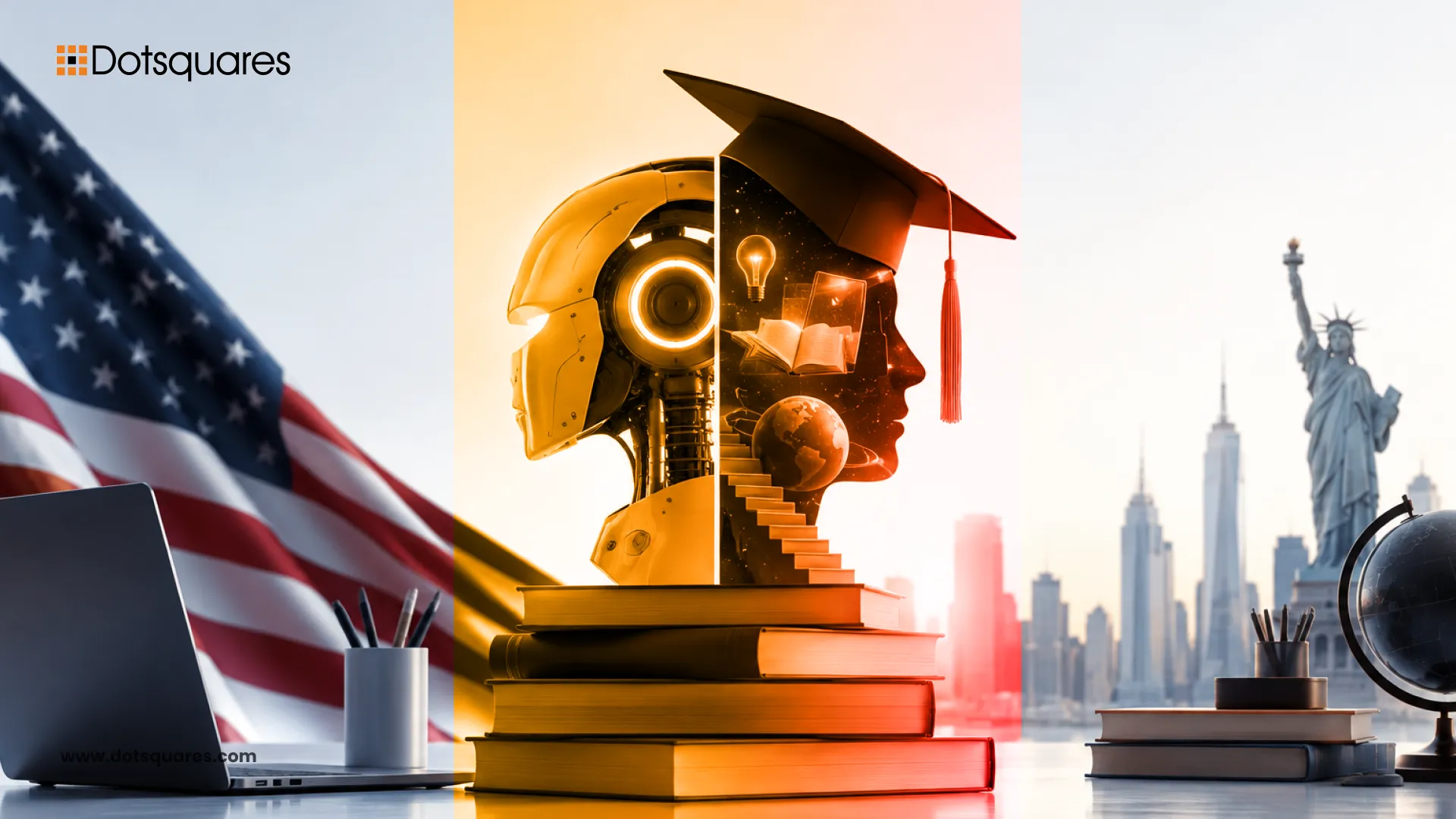
Ask any American teacher what their Sunday night looks like. A few years back the honest answer was a stack of quizzes and a half-written lesson plan. Now a lot of them will tell you the first draft came out of a chatbot in about four minutes and they watched a film instead. Small things. But it says plenty about how AI is reshaping the future of education in the US, and about how little of this was actually planned by anyone.
Gallup put the question to 2,232 public school teachers. Six in ten said yes, they use AI for work. The ones using it weekly reckoned it saved them 5.9 hours a week, which works out at roughly six weeks handed back over a school year.
Students didn't wait for permission either. Around 86% of higher-education students globally now say AI is part of how they study.
Strip the jargon out and it's software that finds patterns in data, then does something about them.
That's a maths app noticing a kid keeps tripping on the same type of question. It's a grader marking short answers. It's the chatbot answering an admissions query at 11pm on a Saturday, which nobody in the office was going to answer anyway. And it's the dashboard quietly flagging the student whose attendance has slipped three weeks running.
One teacher can't track 150 students question by question. That's really the whole pitch.
Honestly, it's three things, and they all showed up around the same time.
The first one is workload. More than half of K-12 teachers say they're burned out, and if you actually ask them why, it's rarely the teaching part. It's the grading, the emails, the forms. Nobody trains to be a teacher because they love paperwork.
Then there's what a normal classroom looks like now. One lesson, one pace, and thirty kids starting from thirty different places. A few are bored out of their minds, a few are completely lost, and the teacher is somehow supposed to serve both at once.
The third reason is money, and people tend to forget this one. Executive Order 14277 stood up a White House Task Force on AI Education. Then, come April 2026, the Department of Education rewrote its grant rules so AI-related projects get extra points in the scoring. Add in FutureEd's count of 77 AI bills working their way through 27 state legislatures right now, and you can see where this is headed. Wherever the funding goes, the Education Industry tends to follow. It always has.
Software adjusts to what a student can actually do, instead of what the grade level says they ought to be able to do by now.
An AI tutor will explain fractions a fifth time without sighing. For kids whose parents can't pay $80 an hour for a human, that matters more than any efficiency argument.
Attendance. Scheduling. Enrollment emails. Report card comments. Permission slips. Dull work, and there's a mountain of it.
Feedback three days later lands on a student who's forgotten the question. Feedback in ninety seconds doesn't.
Nudges and early warnings catch someone drifting before it turns into a withdrawal form.
Quizzes, reading passages pitched at three levels, revision sets. Made fast, then fixed by someone who knows the class.
Assistant, not replacement. The machine drafts, the teacher decides.
Generative AI is what dragged all this into the mainstream, largely because students found it first and institutions wrote policy afterwards.It also broke assessment, and there's no polite way around that. Detection tools catch under 40% of machine-written text in testing, and more than 60 universities across five countries have switched theirs off entirely. The institutions handling it well mostly gave up trying to catch cheats and redesigned the assessment instead. More writing done in the room, oral defence, drafts submitted along the way.
In K-12 it's early warning systems, reading fluency tools, IEP drafting, parent messages going out in six languages.
Higher ed leans on admissions triage, advising chatbots, retention modelling and research support.
Corporate and vocational training use it for skill-gap mapping and simulation practice, which is less glamorous and probably the fastest-growing slice.
And for anyone building EdTech products, recommendation engines and automated content tagging stopped being differentiators a while ago. They're table stakes. Most of it comes down to pointing artificial intelligence for education at data the institution was already sitting on.
This part isn't tidy.
Training is the worst gap by some distance. Only 18% of teachers get written guidance on how AI should be used, and roughly a third get nothing whatsoever. They're guessing. Stack FERPA and COPPA obligations on top, plus models trained on populations that look nothing like the classroom, plus the plain difference between a funded suburban district and a rural one two counties over.
Around 95% of college faculty worry students are outsourcing their thinking. That isn't technophobia. It's a reasonable thing to worry about.
None of it gets fixed by buying better software.
The market sits near $10 billion and forecasts put it past $32 billion by 2030, growing at something like 31% a year, with North America holding the biggest share.
Three bets look safe. AI literacy becomes a graduation requirement in more states. Assessment keeps shifting toward process and oral work. And procurement gets a lot less forgiving, because districts have started asking vendors for audit trails and straight answers on data.
The schools that come out ahead won't be the ones with the shiniest tools. They'll be the ones that wrote rules and trained their people.
If you're building for this market, a few things separate a product that sells from a demo that gets applause.
Go after workload first. Grading, reporting, parent communication. That's where the pain is, and pain is what gets the budget approved.
Build for compliance from day one, because student-data law is a gatekeeper here, not paperwork you sort out later.
Keep a human on anything touching grades or placement, with a real route to appeal.
Integrate with the LMS and the SIS, or watch your tool get quietly abandoned by November.
Then be ready to prove outcomes. Districts want evidence now, not testimonials from a launch partner.
That's broadly the work we do at Dotsquares with education clients, from adaptive learning platforms to tools layered onto systems a college has run for fifteen years. If you want the longer view, we wrote about it in Shaping Modern Education with the help of AI.
AI in education stopped being a pilot project in somebody's innovation budget. It's in lesson planning, grading, advising and admissions across the country, and it got there mainly because it hands overloaded people their evenings back.
What's still unsettled is governance, training and fairness. Not whether the technology works.
For schools, that means writing the policy and paying for the training. For businesses, it means building AI education solutions that protect student data, leave teachers in charge, and show results you can point at. Get that part right and the rest tends to sort itself out.



 October 15, 2026
Learn how low-code integration connects business apps and APIs, its key benefits, common use cases, limitations, and when to choose custom integration.
Keep Reading October 15, 2026
Learn about SAP BW to cloud migration, including benefits, challenges, AWS options, cost factors and planning steps for a successful migration.
Keep Reading October 12, 2026
Learn how React Native works, where it saves time and cost, which industries use it, and whether it's still a good choice in 2026.
Keep Reading 7 min read