
Is Your Business AI-Ready?

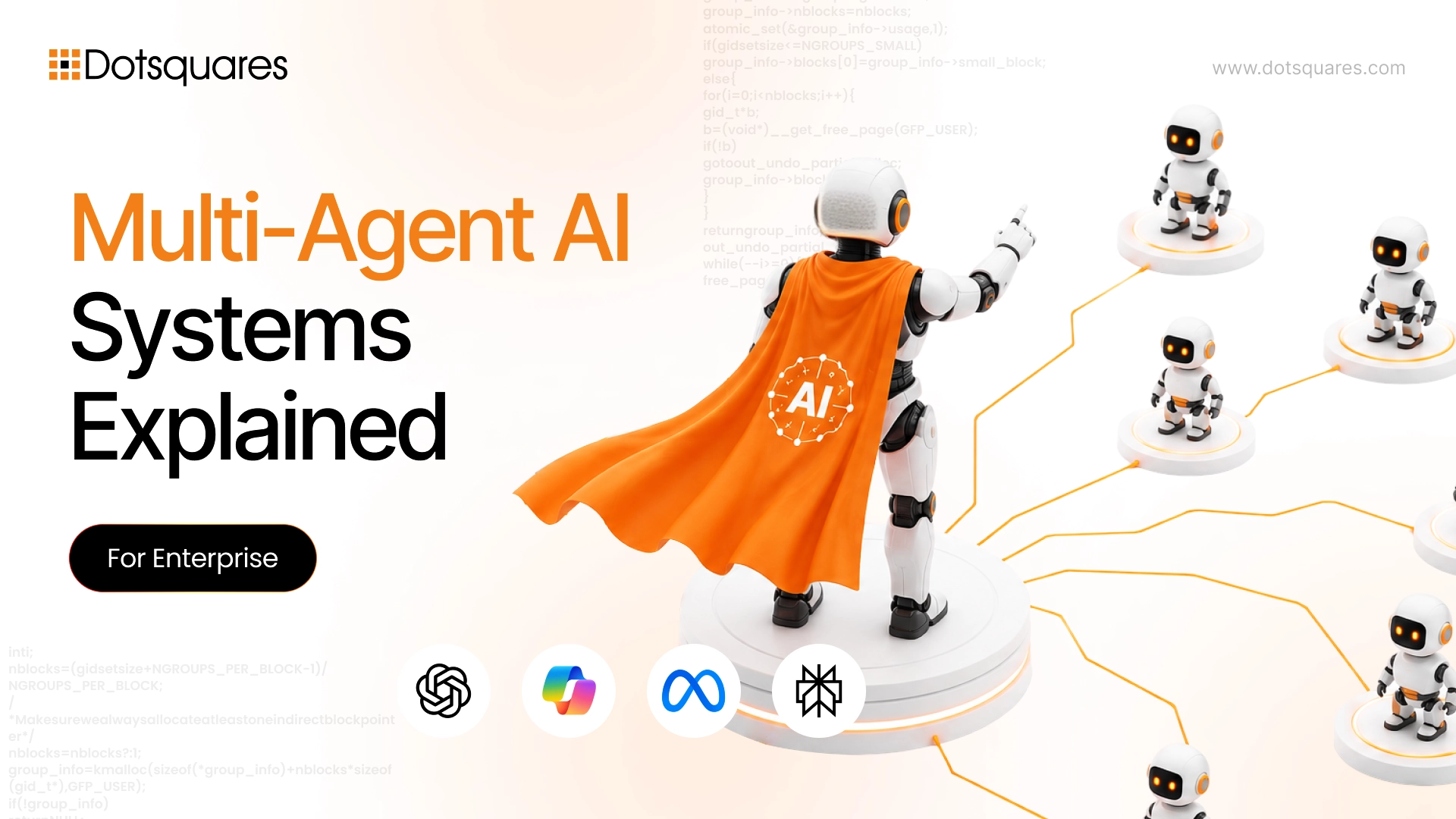
Artificial intelligence is soaring at jet-dynamic speed and moving beyond the use of chatbots and virtual assistants. Today, enterprises are using Multi-Agent AI Systems (MAS) to automate difficult tasks, improve decision-making, and increase operational efficiency. These agents are different from conventional AI, which was capable of performing one task at a time. A multi-agent system consists of multiple intelligent AI agents that can perform multiple tasks by establishing proper coordination with each other to accomplish a common task. This approach is helping organisations to solve business problems more efficiently while maintaining scalability, flexibility, and accuracy.
A multi-agent AI system is a network of autonomous AI agents that communicate, coordinate, and collaborate with each other to perform difficult tasks requiring extra skills and expertise. An interesting feature of this system is that each agent has expertise in performing a particular task effectively, such as data analysis, customer support, compliance verification, scheduling, or decision-making. Under this system, the whole task is divided among multiple agents with expertise in a specific task; here, the enterprises don’t have to depend on a single AI system to manage all tasks alone.
This can be understood by an example: in an enterprise customer support system, one agent may classify customer queries, another retrieve information from the knowledge base, a third validate policy compliance, and a fourth generate the final response. Together, these agents deliver faster and more accurate results than a standalone AI assistant.
A typical enterprise multi-agent architecture consists of several key components:
This can also be considered a task creator. The main responsibilities of this agent are to assign work to other agents, coordinate with them and check the execution of tasks assigned to each agent.
As the name suggests, these agents have expertise in performing specific tasks such as research, planning, analytics, coding, or customer interaction.
This agent stores contextual information so agents remain synchronised.
Enable agents to interact with CRMs, ERP systems, databases, cloud platforms, and third-party applications.
Allows employees to review, approve, or modify AI-generated actions whenever necessary.
This modular architecture allows enterprises to expand capabilities simply by adding new agents instead of redesigning the entire AI solution.
Multi-agent AI systems provide several advantages over traditional AI applications.Improved Scalability: All agents work together by collaborating with each other, there is a decline in the time consumed to accomplish difficult tasks.
As each agent is assigned a specific task based on its expertise, this not only minimises the chances of errors but also improves the quality of work.
Based on their operational needs, businesses can modify or replace individual agents without making any changes to the whole system.
Under a multi-agent AI system, all agents coordinate with each other in real time to exchange information; this makes it easier for all AI agents designated in each department, like finance, HR, procurement, and customer service, to access the same information at the same time.
As all complicated tasks are performed by multi-AI agents, this not only reduces the time consumption of time but also manual efforts, resulting in improved operational efficiency.
By deploying agentic AI in their operations, enterprises are changing their working patterns; today, many tasks in enterprises are performed automatically. Some common tasks performed by multi-agents in almost all enterprises are the following:• Automation of customer support services• Management of inventory and supply chain• Financial fraud detection• Healthcare diagnosis assistance• Software development and testing• Legal document review• HR recruitment and employee onboarding• Cybersecurity monitoring and threat response
For example, in banking, separate AI agents can verify customer identity, detect fraudulent transactions, assess financial risks, and generate compliance reports simultaneously, reducing processing times while improving accuracy.
Despite a vast range of benefits offered by multi-agent systems, enterprises have to face several changes. Among various challenges, one of the most common challenges faced is maintaining secure communication between agents, stopping unauthorised access to data, ensuring regulatory compliance, ensuring the relevance of AI decisions, monitoring AI decisions, and managing orchestration, some tasks that aren't as easy as they sound to perform. Apart from this, enterprises also require strong governance, observability, and human oversight to ensure AI systems remain reliable and accountable in production environments. Before diving into multi-agent adoption, it's worth evaluating where your organisation currently stands, you can check out this AI readiness assessment for businesses to get a clearer picture of your preparedness.
To enjoy the full benefits of initiating a multi-AI agent system, enterprises should start with clearly defined business problems rather than automating all the operations immediately. Creating multi-AI agents, integrating them with existing enterprise software, making effective policies to manage their operations, continuously monitoring performance, and maintaining human approval for critical decisions are some highly required attributes for long-term success.
Multi-agent AI systems are considered the second generation of automating business tasks. By combining multiple specialised AI agents into a coordinated platform, organisations can automate difficult tasks, improve decision-making, and enhance customer experiences through governance and scalability. As businesses continue adopting agentic AI, the use of multi-AI agents is expected to become a necessity for shifting towards a digital ecosystem.


 October 15, 2026
Learn how low-code integration connects business apps and APIs, its key benefits, common use cases, limitations, and when to choose custom integration.
Keep Reading October 15, 2026
Learn about SAP BW to cloud migration, including benefits, challenges, AWS options, cost factors and planning steps for a successful migration.
Keep Reading October 12, 2026
Learn how React Native works, where it saves time and cost, which industries use it, and whether it's still a good choice in 2026.
Keep Reading 4 min read