
Is Your Business AI-Ready?

Tech
 9 min read
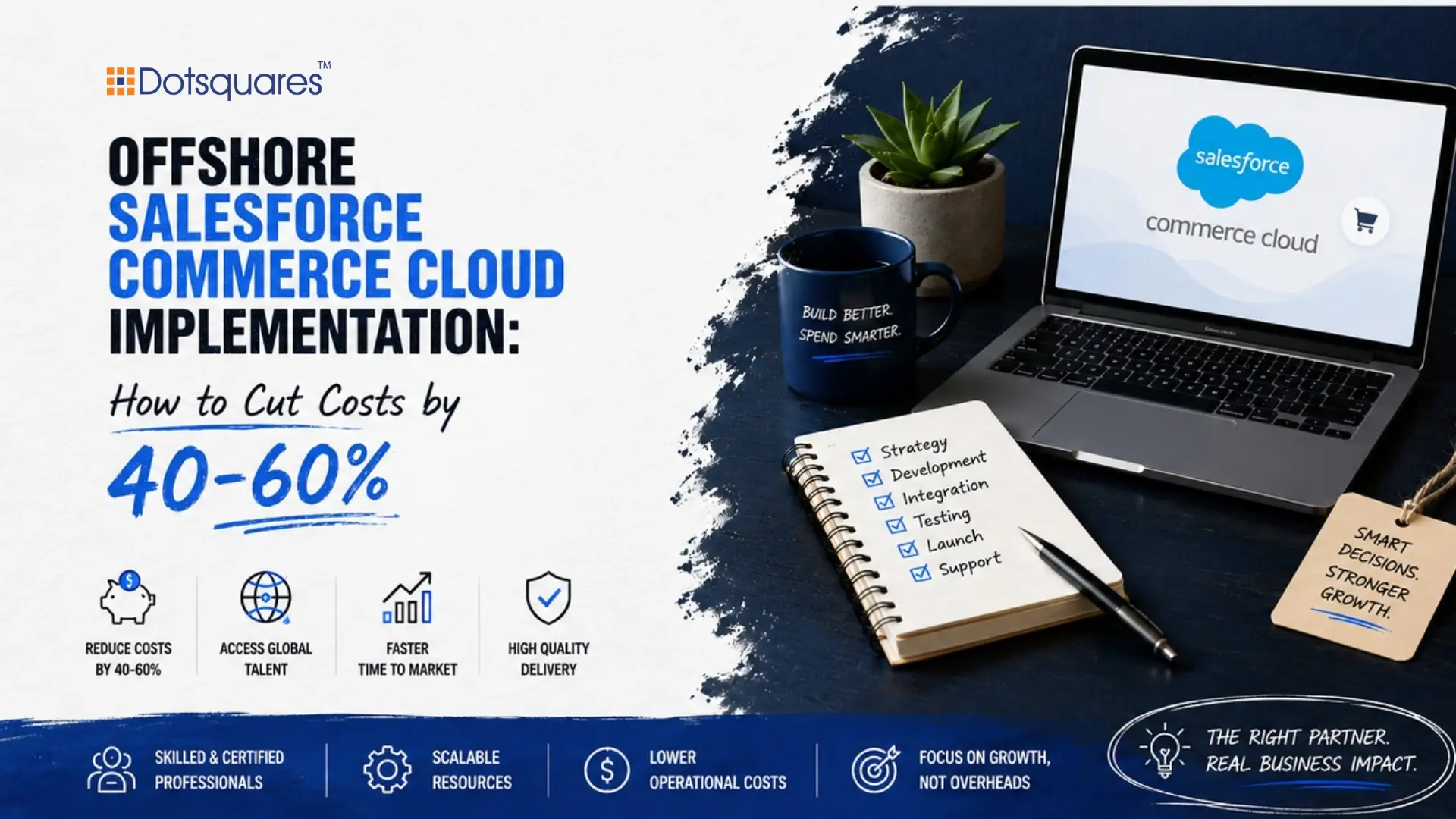
You’ve done your research. Salesforce Commerce Cloud seems like the right choice.
Then the implementation quote lands in your inbox, and it is somewhere between $150,000 and $300,000.
That number stops a lot of projects before they start. And here is what most vendors do not tell you upfront: the platform license is just one part of what you will pay. The bigger variable, and the one you actually have control over, is who implements it and where they are based.
Businesses that go offshore for their Salesforce development services are consistently saving 40–60% on total implementation costs without meaningful trade-offs in quality. This is not a workaround. In 2026, it is simply how smart commerce teams build.
Here is everything you need to understand the real cost of SFCC implementation, and how to structure your project to spend less.
Before you can cut costs, you need to know where money actually goes. Most businesses budget for the license and underestimate everything else.
The Salesforce Commerce Cloud system uses a GMV-based pricing system which charges customers based on the gross merchandise value that their store handles. The typical starting cost for this service begins at 1% of gross merchandise value which needs to be paid annually together with additional charges. The cost for a business that generates 5 million dollars in online sales each year amounts to approximately 50000 dollars each year before any custom code development begins.
B2C and B2B Commerce Cloud are priced separately, and combining them with Order Management adds further cost. In many cases, the total investment rises significantly due to Salesforce Commerce Cloud implementation, customisation, and integrations required to meet business needs. SFCC pricing can reach by $600,000 in some cases for large enterprise deployments; most of that is not the license itself, but the layer of implementation, customisation, and integrations that sit on top of it.
This is where the real spend happens. For mid-sized businesses, standard implementation costs usually fall between $30,000-$60,000. Complex implementations involving multi-cloud setups or compliance-heavy industries can easily exceed $150,000.
The implementation cost breaks down roughly like this:
The total cost of ownership for a mid-market B2C project reaches $200000 when all costs are combined before including ongoing managed services.
US-based and UK-based Salesforce consulting rates reflect the local labour market. Onshore (USA) rates typically range from $150 to $350+ per hour. Senior architects and technical leads command $200-$300 hourly rates for complex implementations.
That is not a markup; it is the genuine Cost of Hiring a Salesforce Consultant in those markets. A certified Salesforce Commerce Cloud architect in London or New York earns a market rate that an implementation firm has to cover before billing you a single hour.
The question is not whether those consultants are worth it. Many of them are excellent. The question is whether you need onshore billing rates for every hour on your project, or just for some of them.
The core argument for offshore salesforce development is straightforward: the same Salesforce certifications exist globally, but the cost of certified talent varies enormously by geography.
Offshore Salesforce development experts can reduce their labor expenses up to 62 percent when compared to using onshore staffing in the United States. India, Poland, Mexico, and Portugal currently produce highly trained Salesforce developers and consultants who hold certifications and possess 5-10 years of experience with Commerce Cloud at salary levels that match local living expenses instead of US or UK market standards.
Here is what the rate differential looks like in practice:
|
Region |
Typical Hourly Rate (2026) |
|
USA (onshore) |
$150–$350/hr |
|
UK (onshore) |
$125–$280/hr |
|
Eastern Europe (nearshore) |
$45–$85/hr |
|
India (offshore) |
$25–$60/hr |
|
Latin America (nearshore) |
$40–$75/hr |
Real savings example:
A mid-market B2C SFCC implementation scoped at 1,000 hours of development time:
That difference funds product development, marketing campaigns, or a second phase of the build.
Here is a nuance worth understanding before you move the entire project offshore: strategy and execution are different problems.
Using U.S.-based architects for strategy and offshore or nearshore development teams is now common, even for SMBs. This delivery model optimises budget without compromising quality.
The hybrid model typically works like this:
You pay US or UK rates for the hours that genuinely require local presence and senior strategic input. You pay offshore rates for the execution hours, which make up the majority of the project. Hybrid models combining onshore management with offshore development often provide the optimal cost-quality balance for complex implementations.
For a $200,000 onshore project, a well-structured hybrid delivery typically lands at $90,000–$120,000. Same outcome. Significantly different invoice.
Every project is different, but these ranges give you a working framework for budgeting.
By business size:
|
Business Size |
Onshore Estimate |
Offshore Estimate |
Hybrid Estimate |
|
Small (single-site B2C, light customisation) |
$40,000–$80,000 |
$15,000–$35,000 |
$25,000–$50,000 |
|
Mid-Market (multi-site, integrations, custom UX) |
$100,000–$200,000 |
$40,000–$90,000 |
$70,000–$120,000 |
|
Enterprise (multi-cloud, complex integrations, global) |
$200,000–$500,000+ |
$80,000–$200,000 |
$130,000–$280,000 |
The 5 factors that move the needle most on your final quote:
Not all offshore partners are equal, and the wrong choice costs more than going onshore. Here is a practical checklist for evaluating any offshore Salesforce commerce cloud implementation partner:
India's position in the offshore Salesforce market is not coincidental. The country produces the largest volume of Salesforce-certified professionals outside the United States, across all clouds, including Commerce Cloud. Indian offshore partners maintain ongoing competitiveness for price and quality because they established delivery centres and developed mature Agile and Scrum processes while acquiring extensive knowledge of US and UK client expectations. For custom CRM development and SFCC implementation specifically, India-based partners have accumulated over a decade of project experience at scale.
Not every project is a fit for offshore delivery. Here is a quick decision framework:
Offshore likely makes sense if:
Reconsider if:
If offshore makes sense for your business, the next step is a cost estimate scoped to your actual requirements, not a generic range from a blog post. A good offshore Salesforce development consulting partner will offer a free scoping call and a project-level cost estimate before you commit to anything.
How much does offshore SFCC implementation cost?
A mid-market B2C build typically ranges from $40,000-$90,000 offshore, versus $100,000-$200,000 onshore, a saving of 40-60% depending on scope, partner location, and customisation depth.
Is offshore Salesforce development reliable?
Yes, when the partner holds SFCC-specific certifications, a verifiable portfolio, and a structured project governance model. Offshore delivery risk is a process problem, not a geography problem.
What is the difference between onshore and offshore Salesforce consulting?
Onshore consultants charge $150-$350/hr, reflecting local market rates; offshore Salesforce development services deliver equivalent expertise from India, Eastern Europe, or Latin America at $25-$85/hr.
How do I calculate my Salesforce implementation cost?
Multiply estimated project hours by your team's blended hourly rate, add a 15-20% contingency, then add licence costs separately, SFCC starts around 1% of GMV annually.



 October 12, 2026
Learn how React Native works, where it saves time and cost, which industries use it, and whether it's still a good choice in 2026.
Keep Reading October 12, 2026
Learn why real-time data matters for AI agents, how streaming data supports faster decisions and automation, and the key challenges businesses should consider.
Keep Reading October 09, 2026
Compare ERC-20, ERC-721 and ERC-1155 token standards, their key differences, use cases, benefits and how to choose the right standard for your blockchain project
Keep Reading