Tech
How Retrieval-Augmented Generation (RAG) Improves Enterprise AI
 3 min read
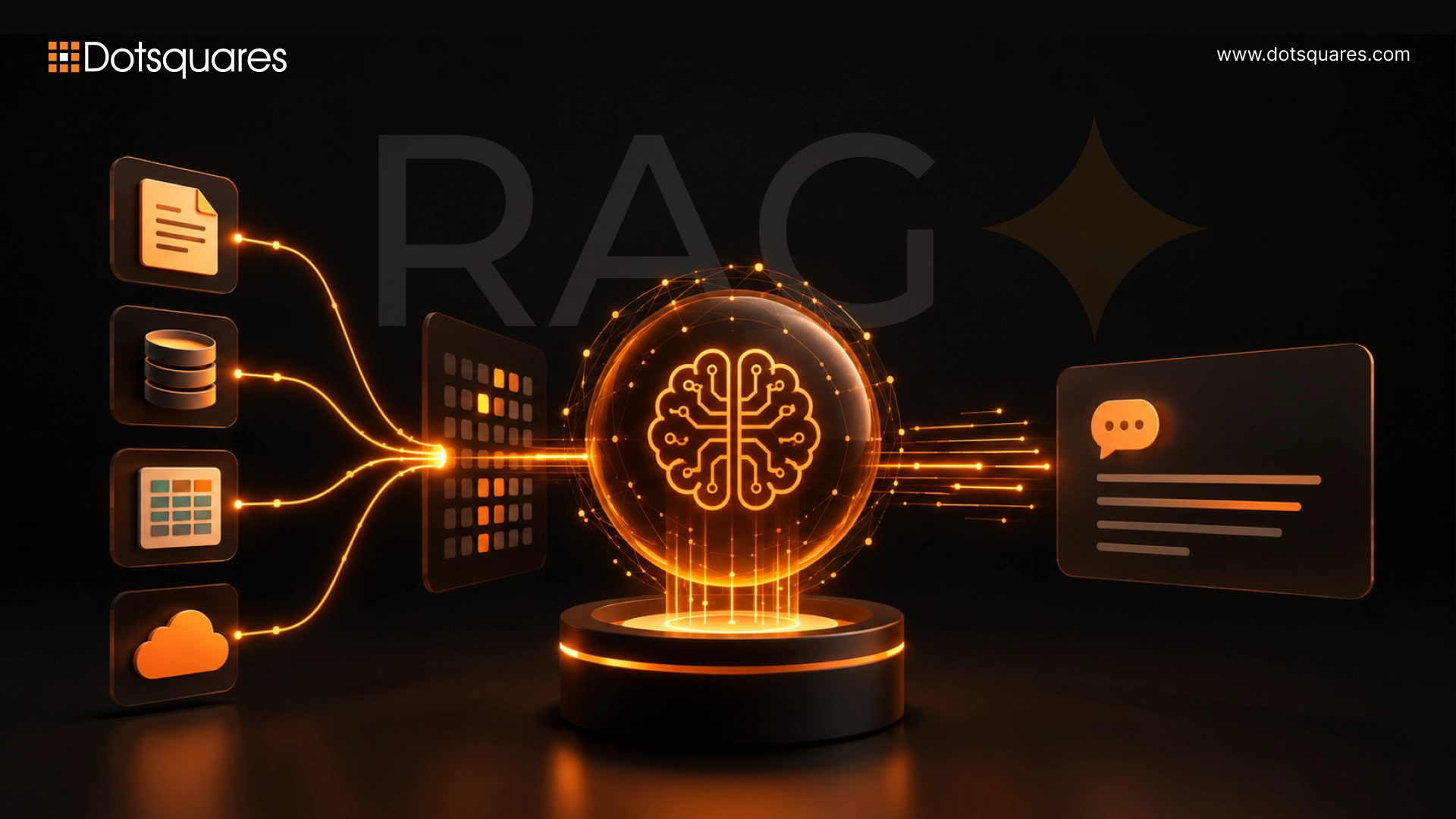
Generative AI is changing the way businesses provide customer services, manage their data sets, and do daily tasks. However, sometimes, there are several shortcomings with LLMs; they might be trained using old data, lack access to internal company data, and provide inaccurate or unsupported responses. The Retrieval-Augmented Generation is aimed at solving the challenges associated with LLMs by ensuring that the AI models connect to the appropriate data and help companies create responses based on the latest and business-related information.
What Is Retrieval-Augmented Generation?
Retrieval-Augmented Generation is an architecture in AI that connects generative AI with information retrieval. Rather than requiring an LLM to generate a response to a particular query based on the data it was trained to use, RAG will first search the connected data sources for information, and then that information will be provided to the model to generate a response.
The data sources can vary for enterprises, including internal documents, product catalogues, customer databases, knowledge bases, policy documentation, technical documentation, databases, and others.
How Does RAG Work?
A traditional RAG pipeline includes three steps:
- Information Retrieval: After receiving a user request, the system queries the enterprise knowledge base and finds appropriate information. Today’s RAG systems may perform semantic, vector, or keyword searches, or a combination thereof.
- Context Augmentation: The most appropriate information is appended to the user request to form the context. As a result, the LLM has access to information which was not in its initial training dataset.
- Information Generation: The LLM uses this context to generate the corresponding and well-grounded response. There is also an option to provide citations or references.
Key Benefits of RAG for Enterprise AI
1. Increases Accuracy
Accuracy is of great importance for enterprise applications. The use of RAG ensures that the responses given by AI models are always grounded in relevant business information. Although RAG does not solve the problem of hallucinations in models, it greatly improves their accuracy.
2. Ensures Availability of Fresh Information
The nature of business information is constantly changing. It may change due to various reasons, such as changes in information related to any product, company policies, regulations, pricing, and customer information. RAG allows the connected AI application to obtain fresh information without retraining the underlying LLM.
3. Allows for Utilisation of Internal Enterprise Information
General LLMs are not aware of the processes occurring within organisations or their private data. With the help of RAG, enterprises can connect their AI applications to internal information sources. In this way, the employees of an enterprise will get information specific to it.
4. Decreases Fine-Tuning Need
Retraining or fine-tuning of an AI model in order to update its knowledge can take considerable effort. RAG offers another solution to this problem by keeping business information separate from the model in connected external data sources. For businesses looking to understand the technical aspects of fine-tuning, LLM fine-tuning strategies can be beneficial for specific use cases.
5. Supports Enterprise Use Cases
Applications of RAG include but are not limited to AI-driven customer support, employee knowledge assistant, document search for documents, technical support, compliance research, product information on products, and developer assistant. Using RAG makes the enterprise knowledge accessible and usable through the combination of retrieval and generative AI.
RAG and the Future of Enterprise AI
With the increased adoption of generative AI, the deployment of the language model alone is insufficient. Enterprises require systems that will be able to utilise the organisation-specific, current, and reliable data. For this purpose, RAG offers a good approach to connect LLMs with the appropriate knowledge sources while increasing relevance, transparency, and flexibility.
Still, implementing this technology requires not only choosing a vector database and LLM but also having a good dataset, retrieval mechanism, access control, monitoring, evaluation, and governance.
Ultimately, Retrieval-Augmented Generation may become a solution that would enable enterprises to close the gap between general-purpose generative AI and enterprise-specific intelligence.


Related Post
 October 15, 2026
Low-Code Integration: What It Is, How It Works and When Businesses Should Use It
Learn how low-code integration connects business apps and APIs, its key benefits, common use cases, limitations, and when to choose custom integration.
Keep Reading October 15, 2026
SAP BW to Cloud Migration: Benefits, Challenges and Planning Steps
Learn about SAP BW to cloud migration, including benefits, challenges, AWS options, cost factors and planning steps for a successful migration.
Keep Reading October 12, 2026
Mobile App Development with React Native and What You Need to Know
Learn how React Native works, where it saves time and cost, which industries use it, and whether it's still a good choice in 2026.
Keep Reading