
Is Your Business AI-Ready?

Tech
 8 min read
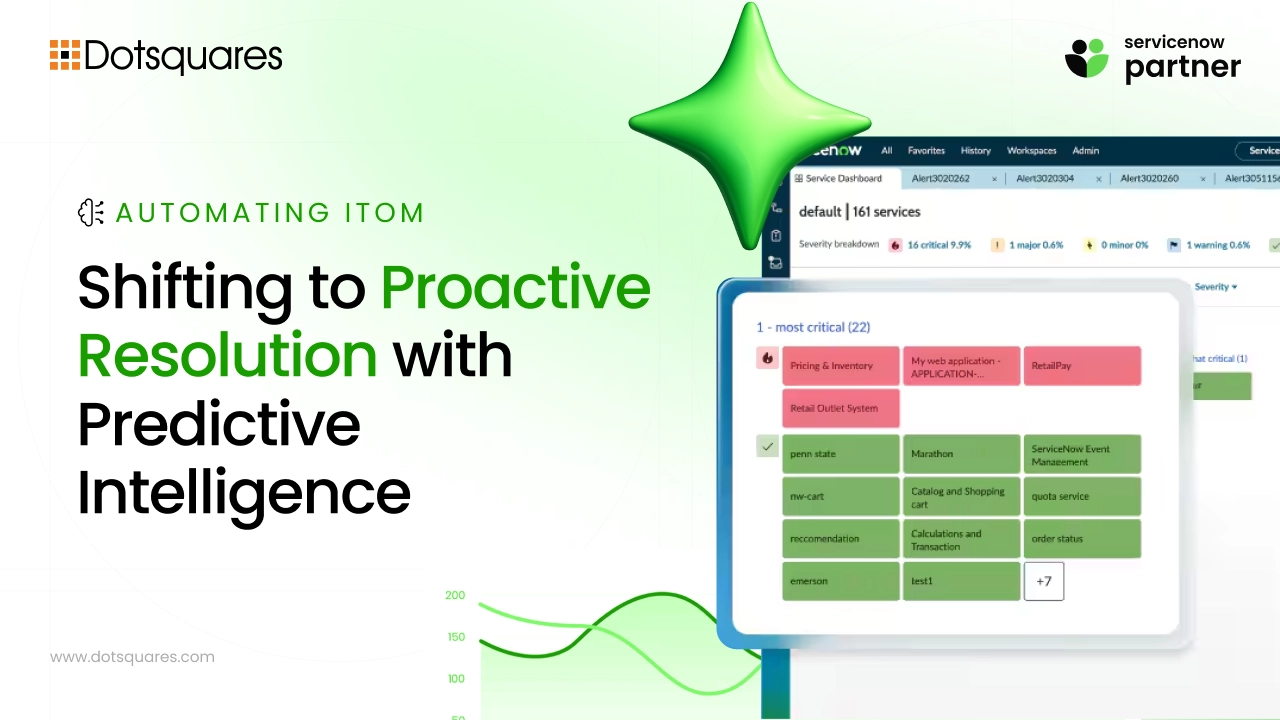
Here's a scenario most IT operations teams will recognise. An alert fires. Someone opens a ticket. Another person starts troubleshooting. A third escalates because the first two couldn't find the root cause fast enough. By the time the issue is resolved, there's been an hour of downtime, a trail of confused users, and a post-incident review where everyone agrees this should have been caught earlier.
The frustrating part? In many cases, the signals were there. Metric anomalies, log patterns, configuration changes, all visible in the monitoring data, just never connected in time to act on them.
This is the problem ServiceNow ITOM with Predictive Intelligence is built to solve. Not by giving IT teams more alerts, they already have too many. But by reducing the noise, correlating the signals that matter, and enabling automated or guided resolution before the outage happens.
Before getting into how the tooling works, it's worth being honest about the problem.
Most IT operations teams in 2026 are still fundamentally reactive. They monitor infrastructure, they receive alerts, and they respond to incidents. The monitoring tooling is sophisticated. The alert volumes are high. And paradoxically, the higher the alert volume, the harder it is to actually catch the incidents that matter before they escalate.
Alert fatigue is a real and documented problem in enterprise IT. When every monitoring tool generates its own alerts in its own format, and none of them are correlated against each other, operations teams spend most of their time triaging noise rather than preventing impact. A study cited in ServiceNow's AIOps research shows that organisations using traditional event management spend a significant proportion of their time on false positives and duplicate events that never needed human attention.
The operational cost of staying reactive also compounds. Every P1 incident that could have been prevented is not just downtime, it's the accumulated cost of engineer time, escalation, stakeholder communication, root cause analysis, and remediation. For enterprises running business-critical services on ServiceNow, the gap between reactive and proactive operations has a measurable financial impact.
Many organisations attempt to bridge this gap through custom AI development services, building anomaly detection and correlation models outside the platform, but these often struggle with integration complexity and limited operational context compared to native platform capabilities.
ServiceNow ITOM combines Event Management, Metric Intelligence, and Health Log Analytics into a unified operational intelligence layer. The shift this represents is architectural, not cosmetic.
Traditional monitoring tools react to known issues with threshold-based alerts: if CPU exceeds 90%, send an alert. Predictive AIOps does something fundamentally different. It identifies unknown patterns, predicts issues before they occur, correlates events across systems, and learns continuously from historical incident data, reducing noise through intelligent grouping and enabling automated remediation.
The three components that do the work:
ServiceNow customers using this combination have prevented 25–35% of critical P1 outages through predictive insights, according to data cited in the platform's AIOps research aligned with Gartner's Event Intelligence Solutions market guide. Behind many of these capabilities sits ServiceNow development, which enables organisations to extend, customise, and operationalise predictive intelligence models directly within the platform rather than relying on external tooling. That's not a marginal improvement, it's a material reduction in the incidents that cost organisations the most.
This is an area where a lot of ServiceNow teams have genuine uncertainty, and it's worth getting clear because all three are often discussed in the same breath and serve different purposes.
Predictive Intelligence is the ML layer built into the platform for pattern-based decisions using historical data. It does classification, similarity, clustering, and regression, and can be applied across ITSM, ITOM, HR, CSM, SecOps, and GRC. In ITOM specifically, it's powering the anomaly detection, event correlation, and routing predictions that make proactive operations possible. It requires structured data and is most effective when trained on real historical incident data from your environment.
Task Intelligence is the more accessible, use-case-specific evolution of the older Predictive Intelligence Workbench (which was deprecated in Yokohama). It's designed for non-data-science users, pre-trained models for classification, sentiment detection, and field prediction that activate with a click rather than requiring algorithm configuration. For ITSM incident classification and assignment, Task Intelligence is often the right starting point.
Now Assist is the generative AI layer, powered by LLMs including ServiceNow's own Now LLM v2.0 and integrations with Azure OpenAI GPT-4o, Google Gemini, Anthropic Claude, and AWS Bedrock as of mid-2026. It handles unstructured tasks: summarising ticket histories, generating knowledge articles, drafting responses, providing contextual recommendations. Where Predictive Intelligence operates on structured patterns in historical data, Now Assist generates new content and provides contextual intelligence for unstructured situations.
The honest framing from ServiceNow's own community: neither replaces the other. Predictive Intelligence provides pattern-based automation for structured decisions. Now Assist delivers intelligence augmentation for unstructured tasks. In ITOM specifically, Predictive Intelligence is doing the heavy lifting on anomaly detection, event correlation, and proactive issue identification, Now Assist enters when engineers need context, summaries, and guidance on what to do next.
Here's what the shift from reactive to proactive looks like in a ServiceNow ITOM environment that's been properly configured.
An application service starts showing a subtle performance metric anomaly, not enough to trigger a threshold alert, but enough for Metric Intelligence to flag it as trending toward a historical failure pattern. Health Log Analytics simultaneously picks up unusual patterns in the application logs that correlate with the same type of failure. Event Management correlates both signals into a single meaningful event rather than two separate alerts.
ServiceNow ITOM assigns this event to the affected business service, maps the CI relationships, and determines the potential blast radius. Operational Intelligence generates a recommended remediation workflow. If the issue fits a defined automated response, a playbook executes without human intervention. If it requires engineer involvement, an incident is created with full context already attached, what triggered it, what services are affected, what historical remediation worked in similar situations.
This is the contrast with reactive operations: by the time a threshold-based alert would have fired, proactive operations has already correlated the signals, assessed the impact, and either resolved the issue or handed a complete picture to the engineer who needs to act. This kind of automated incident workflow connects directly to ServiceNow Playbooks for guided remediation, the structured automation that ensures resolution follows a consistent, validated path rather than depending on individual engineer knowledge.
ITOM's proactive intelligence doesn't operate in isolation from security and risk. In regulated environments, financial services, healthcare, government, the same anomaly detection that predicts infrastructure failures is also relevant to security operations.
Unusual traffic patterns, access anomalies, configuration drift, these are ITOM signals that have security implications. When ITOM's operational intelligence connects to ServiceNow SecOps for automated security operations, the same signal that might indicate an infrastructure problem can simultaneously trigger a security assessment. That's the value of operating on a single platform: IT operations, security, and risk share the same data model and the same workflow engine.
For organisations managing compliance alongside operations, the ServiceNow GRC automated compliance management layer adds a third dimension, ensuring that operational changes and incidents are automatically assessed against compliance controls, rather than requiring manual audit work after the fact.
A few common implementation mistakes worth naming directly.
Expecting predictions without historical data. Predictive Intelligence learns from your incident history. An organisation that hasn't maintained clean, well-categorised historical incident data gets proportionally weaker predictions. Data quality upfront is not optional, it's the input that determines output quality.
Treating event management configuration as a one-time activity. The monitoring landscape changes. New services come online. Infrastructure evolves. Alert rules set up eighteen months ago don't reflect the current environment. ITOM operational intelligence needs ongoing maintenance of its rules, thresholds, and correlation logic to remain effective.
Activating Predictive Intelligence without connecting it to remediation. Detection without response isn't proactive operations, it's better-informed reactive operations. The value compounds when anomaly detection connects to automated remediation playbooks that can act on what's been detected, not just surface it to a dashboard.
Skipping CMDB health. ITOM's service impact analysis depends on the CMDB accurately reflecting which CIs map to which business services. An incomplete or inaccurate CMDB produces impact assessments that don't reflect reality, which erodes trust in the tooling faster than almost anything else.
Dotsquares provides ServiceNow consulting services across ITOM, Predictive Intelligence configuration, and the AIOps capabilities that connect detection to resolution. That includes CMDB health assessments, event management rule design, Metric Intelligence configuration, and the integration work that connects ITOM signals to SecOps, GRC, and automated remediation workflows.
If your organisation is still managing IT operations reactively and the cost of that is becoming hard to justify, the first step is usually an honest assessment of what's already in place and what would need to change to make proactive operations viable. That's a conversation the Dotsquares ServiceNow team is set up to have.
Talk to the Dotsquares ServiceNow team


 October 15, 2026
Learn how low-code integration connects business apps and APIs, its key benefits, common use cases, limitations, and when to choose custom integration.
Keep Reading October 15, 2026
Learn about SAP BW to cloud migration, including benefits, challenges, AWS options, cost factors and planning steps for a successful migration.
Keep Reading October 12, 2026
Learn how React Native works, where it saves time and cost, which industries use it, and whether it's still a good choice in 2026.
Keep Reading