
Is Your Business AI-Ready?

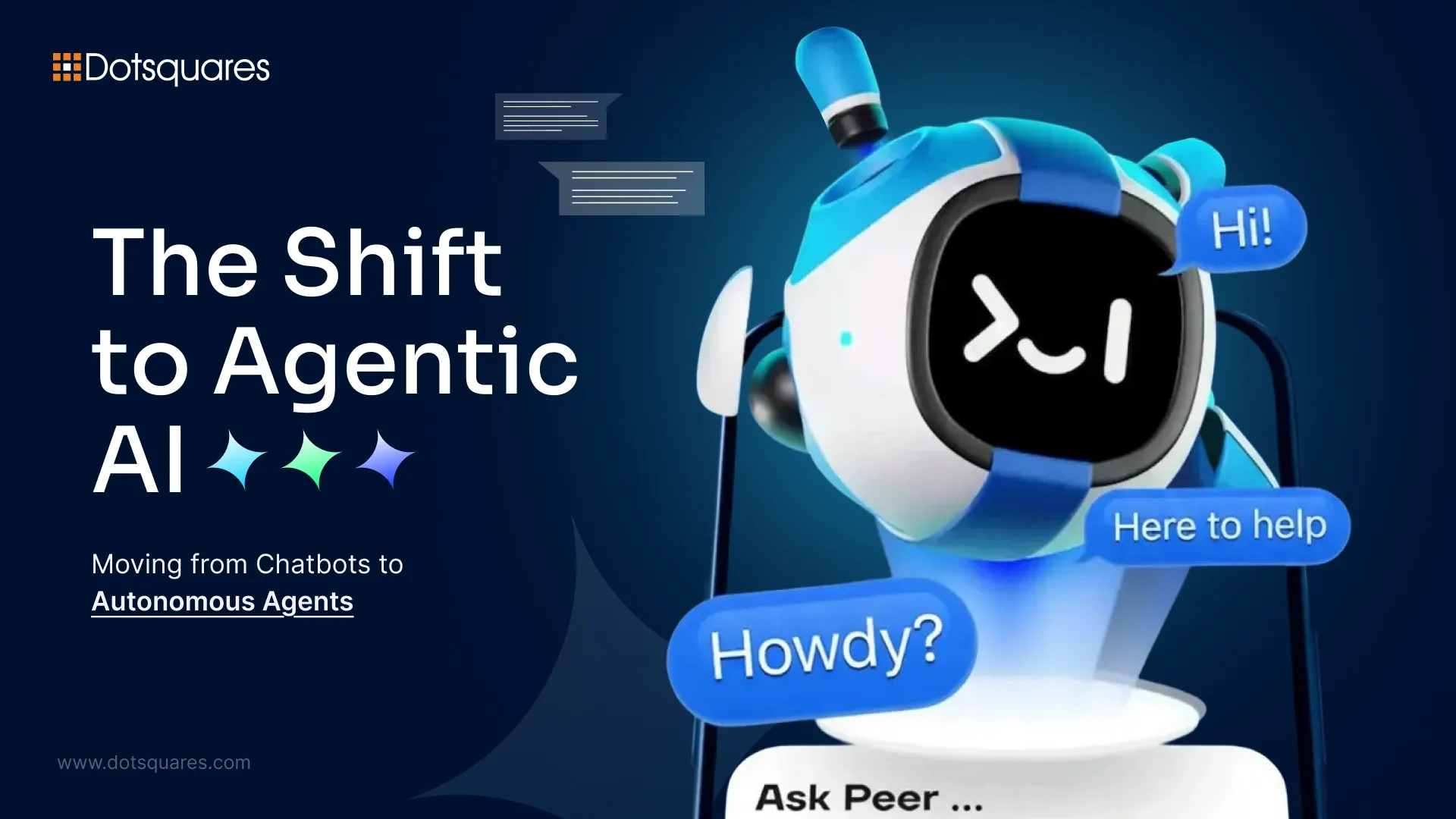
Over the past ten years, artificial intelligence (AI) has advanced quickly, and the most significant change in AI today goes beyond simply having more intelligent responses or larger language models. It has to do with independence. Reactive AI-Powered Chatbots that respond to commands are no longer our only option. Rather, AI is evolving into agentic systems, self-governing entities that can act, think, and produce outcomes with little assistance from humans.
Business processes, customer interaction, knowledge work, and digital transformation itself are all expected to change as a result of this shift. Let’s look at what this shift really means for businesses today and where it’s heading next.
At its core, Agentic AI refers to systems that don’t just respond, they act. Unlike traditional chatbots that generate text based on a user’s input, agentic AI can:
This is AI that transitions from being suggestive to being executive. In simple terms: where a chatbot tells you what to do, an agentic AI does it for you , which is why many developers are now exploring creating own AI agent for real business automation.
To understand the shift, it’s useful to look at the stages of AI interaction:
|
AI Type |
Capabilities |
Example |
|
Chatbots |
Respond to simple queries |
FAQ bot |
|
Conversational AI |
Natural language + context |
Customer support assistant |
|
Generative AI |
Produces content |
Drafts emails or code |
|
Agentic AI |
Plans, executes, adapts |
Autonomous task completion |
Traditional chatbots are reactive, they wait for prompts. By contrast, agentic AI is proactive: it understands goals and decides on the best course of action, using tools and integrations to achieve results without constant user direction.
Here’s a direct comparison to highlight the shift:
|
Feature |
Traditional Chatbots |
Agentic AI |
|
Interaction |
User-initiated |
Goal-driven |
|
Task Complexity |
Simple, one step |
Multi-step, cross-system |
|
Autonomy |
Low |
High |
|
Context Handling |
Short memory |
Persistent memory |
|
Action Scope |
Provides suggestions |
Executes tasks end-to-end |
This defines a fundamental change, from suggestion engines to autonomous executors.
Conversations become workflows thanks to agentic AI. While an agentic AI can handle all aspects of ticket resolution, including raising tickets, updating systems, and sending confirmations, a typical chatbot might write a support response. For years, AI Chatbots Revolutionising Customer Support helped businesses automate FAQs and basic ticket handling. But today, agentic AI takes this further by resolving issues end-to-end without human intervention.
Chatbots are unable to coordinate actions across environments, but agentic AI can do so by integrating deeply with tools like CRM, billing systems, scheduling platforms, and databases.
Because agentic systems function with greater cross-system execution and less human oversight, early adopters report notable reductions in manual overhead.
According to current trends, businesses are moving from pilots to fully functional deployments, which include multi-agent orchestration, CRM updates, autonomous scheduling, and customer care workflows.
Solution: To guarantee secure and open agent operations, Dotsquares uses role-based permissions, approval workflows, audit trails, and human-in-the-loop controls.
Solution: To minimise errors and guarantee precise, business-approved outputs, we employ validation layers, retrieval-based knowledge systems (RAG), and tool-driven execution.
Solution: To enable seamless automation without interfering with ongoing business operations, we create tailored APIs, secure connectors, and middleware to integrate agentic AI with your current systems.
Every organisation operates differently. Off-the-shelf automation tools rarely address complex workflows, compliance needs, and cross-system integrations. That’s why many companies are investing in Custom AI Solutions designed specifically around their internal processes.
Through specialised Custom AI Development Services, businesses can build secure, scalable, and fully integrated agentic systems that align with operational goals while maintaining governance and control.
The agentic AI landscape is rapidly becoming one of the most exciting frontiers in technology:
The shift from chatbots to agentic AI represents a fundamental leap in how AI systems contribute to business and society. From simply responding to queries, AI is now capable of planning, executing, and learning, effectively becoming autonomous digital workers.
For companies looking to stay ahead, embracing agentic AI means rethinking workflows, governance, and how humans and machines collaborate, not just how they converse.


 April 03, 2026
Create a scalable LMS using SharePoint Online, Power Apps, and Power Automate. Manage training, automate workflows, and keep data secure within Microsoft 365.
Keep Reading March 31, 2026
Compare Power BI and Tableau on cost, features, ease of use, and performance. Find the right BI tool for your business data and decision-making needs.
Keep Reading March 31, 2026
Discover 7 key benefits of Sitefinity CMS, including flexibility, integrations, security, and personalization to drive real business growth and digital success.
Keep Reading