PC Game Development: Cost, Timeline & Tech Stack
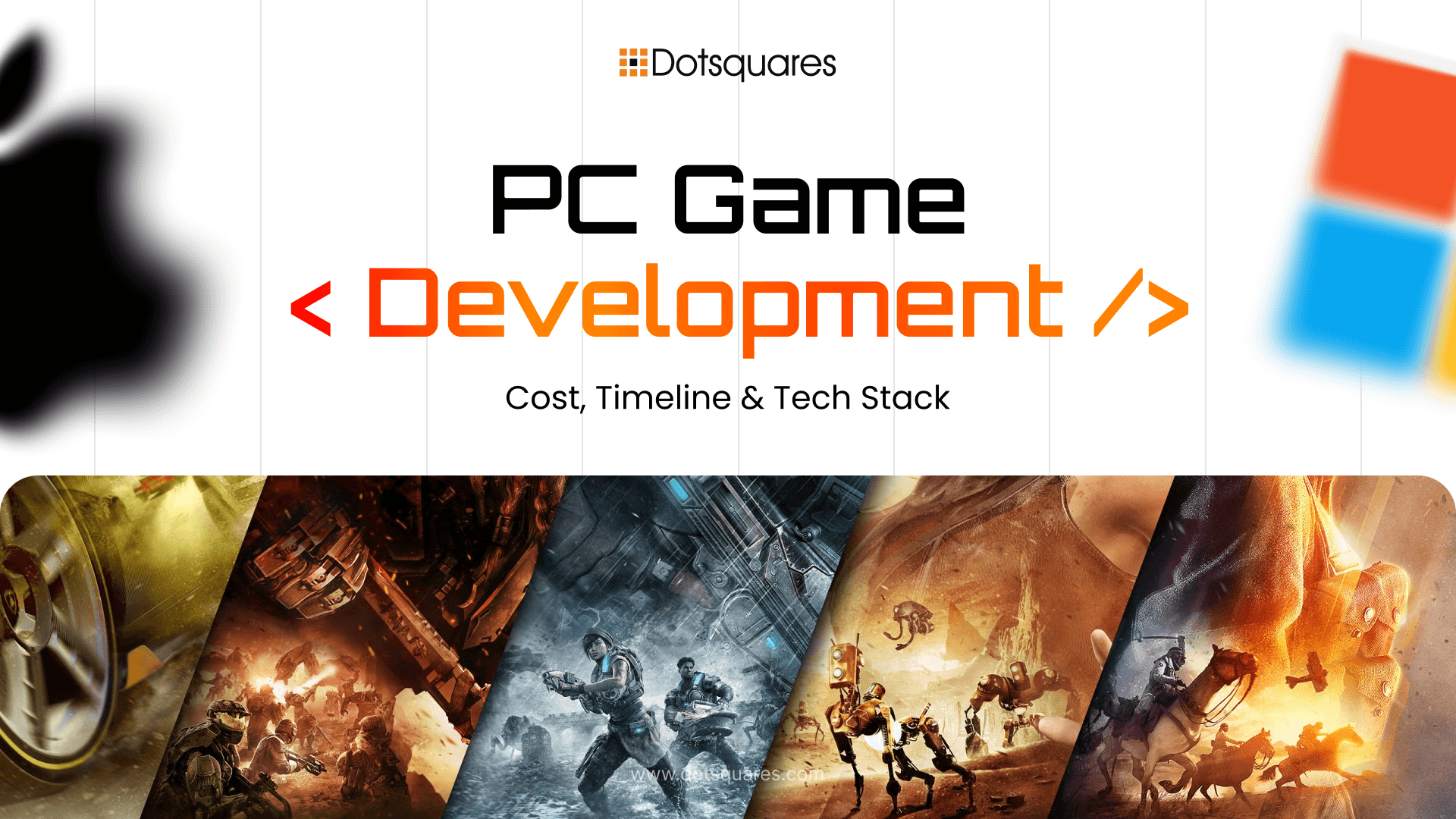
When we talk about building for the PC, we are talking about a market that has no "ceiling." Unlike mobile development, where you are constantly fighting against battery life and screen size, the PC platform is where you go to see what a game can actually become when hardware isn't the primary bottleneck.
But with that power comes a much higher level of scrutiny. PC players are notoriously vocal about the "feel" of a game. If the movement isn't precise or the camera logic is clunky, the most beautiful graphics in the world won't save your Steam reviews. To navigate this, a professional game developer has to look past the surface level and focus on the fundamental pillars of the experience.
The Foundation: The 3 C's of Game Dev
In simpler terms, before you even think about your story or your art style, you have to nail what we call the 3 C's of game dev: Character, Camera, and Controls.
- Character: This isn't just about how the protagonist looks, but how they inhabit the world. Does the weight of their jump feel realistic? Does their animation blend smoothly when they transition from a sprint to a stop?
- Camera: On a PC, the camera is the player's eyes. If it hitches on a wall or moves too slowly during a high-speed chase, the immersion is instantly broken.
- Controls: PC gamers use everything from mechanical keyboards to high-end flight sticks. The input lag has to be virtually zero.
Now you’ve understood this, it’s easy to see why the initial "prototyping" phase for a PC game is so intense. If these three elements don't harmonise, the project is fundamentally flawed from day one. This is usually the first area where a high-quality desktop game development service provider will focus their resources.
Keeping the Momentum: The 40-Second Rule in Gaming
One of the biggest challenges in PC development is the scale of the environments. When you have a massive map, how do you keep the player from getting bored while moving from point A to point B?
This is where we apply the 40-second rule in gaming. It’s a psychological benchmark that suggests a player should be rewarded with something interesting, a new visual landmark, a lootable item, or a minor environmental story, every 40 seconds.
If your game fails this rule, the world feels like a "walking simulator." Implementing this rule effectively is what drives the timeline and the cost of the project up. It requires thousands of hours of manual "cluttering" and environmental storytelling that AI simply hasn't mastered yet. It’s the difference between a world that feels "generated" and one that feels "lived in."
Cost and Tech Stack: The Hidden Hurdles
When you look for PC game development services, the quote you receive is largely dictated by the "fidelity" of the tech stack. On PC, you aren't just optimising for one device; you are optimising for a spectrum of hardware.
- The Tech Stack: Most high-end PC titles are built on either Unity or the latest Unreal Engine, but the "stack" includes much more. It involves specialised middleware for physics (like PhysX), sound (like FMOD), and complex backend databases for games that require persistent online worlds.
- The Timeline: A standard PC game can take anywhere from 18 months for a small indie title to 5 years for a "Triple-A" experience. The middle ground, where most commercial projects live, usually sits around the 24-month mark.
- The Budget: The biggest cost isn't the software; it's the specialised labor. The project requires technical artists who possess knowledge about 4K texture rendering and 60 frames per second operation without causing GPU crashes to execute their tasks.
Our previous discussion about developing video games in 10 basic steps serves as our main framework to present the complete project timeline. However, for PC gaming the complete process requires multiple times more work than shown in those three steps.
Integration of New Frontiers: AR/VR and Immersion
We are also seeing a massive pivot toward AR/VR Games and Apps Development within the PC space. Because PC hardware can handle the heavy processing required for VR headsets, many developers are now building "hybrid" titles. This adds another layer to the 3 C's of game dev, as "Controls" and "Camera" have to be completely reinvented for a 360-degree immersive space.
Finding the Right Partner
The PC market presents harsh challenges but brings its highest rewards. The development process for competitive tactical shooters and deep narrative RPGs shares one common goal. The development process for competitive tactical shooters and deep narrative RPGs needs to create a virtual environment that respects both player time and their computer system requirements.
Selecting a desktop game developer isn't just about finding someone who can use an engine; it's about finding a team that understands the psychological triggers that make a game successful. At Dotsquares, we’ve spent two decades navigating these technical shifts, helping founders move from a basic concept to a polished, market-ready PC title.


Related Post
 March 31, 2026
Power BI or Tableau: Which BI Tool Is Good for Your Business?
Compare Power BI and Tableau on cost, features, ease of use, and performance. Find the right BI tool for your business data and decision-making needs.
Keep Reading March 31, 2026
7 Key Benefits of Sitefinity That Drive Real Business Value
Discover 7 key benefits of Sitefinity CMS, including flexibility, integrations, security, and personalization to drive real business growth and digital success.
Keep Reading March 27, 2026
Fractional Real Estate Tokenisation: Benefits, Process & Future Trends
Discover how fractional real estate tokenisation works, including benefits, step-by-step process, and how it makes property investment more accessible & liquid.
Keep Reading