
Is Your Business AI-Ready?

Tech
 5 min read
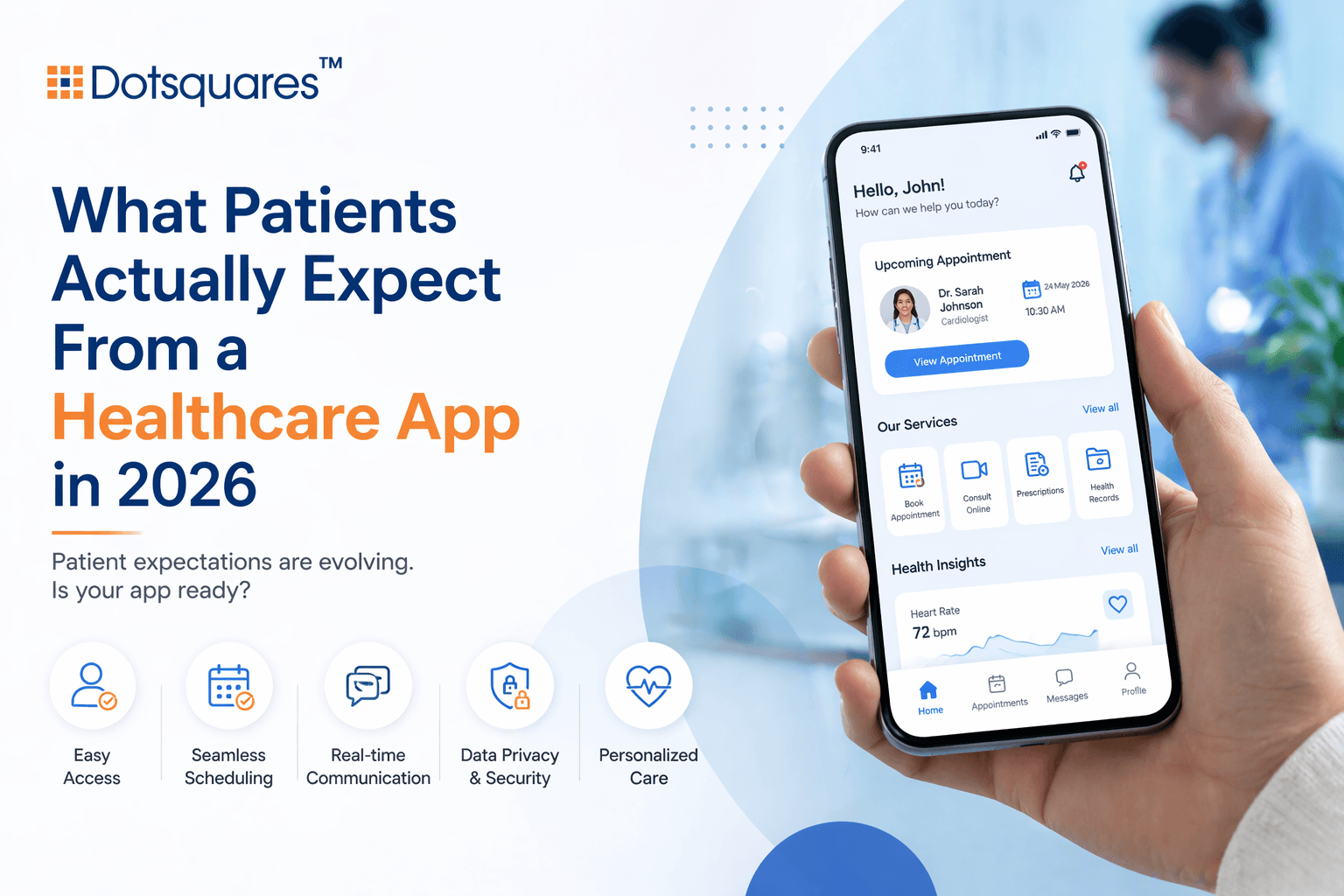
A patient pulls up your app to book an appointment. It takes four taps to find the right screen, the available slots don’t match what reception told them, and the confirmation never arrives. They close the app and call the front desk anyway.
That’s not a minor inconvenience. That’s a broken first impression, and in healthcare, first impressions decide whether someone comes back.
Healthcare apps are now the front door for most providers. What’s behind that door matters more than most teams realise when they start building.
The most-used feature in any patient-facing app. Also, the most commonly underdeveloped one.
Patients need to see real availability, pick a time and get a confirmation in seconds. No form submissions that disappear into a void. No confirmation emails that land 20 minutes later. Just a booking that works.
For the practice, the same system has to handle:
When scheduling is built right, reception calls drop. Admin pressure drops. Patient satisfaction goes up. When it is patched together, it causes problems on both sides of the counter.
Here’s a question worth asking early in any healthcare app project:
If the answer is no, the design is incomplete.
Healthcare users span every age group and every level of digital confidence. Healthcare IT solutions that works only for tech-comfortable users is design that’s already excluding a significant portion of the patient population. The standard to build to includes:
Accessibility in healthcare apps isn’t a bonus feature, but the baseline.
Most portals are built with good intentions and end up being barely touched. The reason is usually the same: they show patients just enough information to feel like a feature, without giving them anything genuinely useful.
A portal worth having lets patients:
This level of accessibility aligns with how AI in healthcare knowledge management improves the way patient data is organised, accessed and delivered across modern healthcare systems.Every access point needs permission controls and a full audit log. Sensitive health data requires knowing exactly who accessed what, and when. That’s a technical requirement, not an optional extra.
HIPAA, GDPR, and PIPEDA, which regulations apply depends on your location and the type of data your platform processes, and in many cases, more than one framework applies simultaneously.
A custom medical website design company builds the technical foundation that makes compliance achievable from day one: encrypted data storage and transmission, role-based access controls, secure session handling, and audit-ready logging. Formal compliance support is provided when it’s explicitly required, with the scope defined clearly at the start based on your specific operational and regulatory context.
Nothing is rushed in later under pressure. Nothing slips through because the scope was vague or incomplete upfront.
A video link dropped into a confirmation email is not a telemedicine feature. It is a workaround wearing a feature’s clothes.
Proper virtual consultation means the entire flow lives inside the app. Patients join from the same place they booked. Providers see the queue, manage sessions, and add notes that feed directly back into the patient record.
For patients who are already anxious about a remote appointment, a seamless experience is the difference between completing the consultation and abandoning it halfway.
Missed appointments cost money. A reminder sent 24 hours before a visit, and again an hour out, recovers a meaningful percentage of them without anyone on the team having to do anything.
The same infrastructure handles:
Set it up once and it runs. The admin team handles fewer calls. Patients feel looked after between visits.
An app that doesn’t connect to the existing electronic health record system creates a new problem for every problem it solves. Clinicians end up switching between screens. Data gets updated in one place and not the other. Errors become harder to trace.
HL7 and FHIR standards exist to handle structured two-way data exchange between systems. A medical website design agency that knows how to implement this properly keeps records in sync without manual intervention. One that works around it creates fragile infrastructure that becomes harder to manage over time.
A platform built for today's patient volume needs to still work when that volume doubles. Healthcare organisations grow, merge, and add service lines quickly. The technology underneath needs to scale without emergency rework.
Cloud-native architecture and modular system design make that possible. This is where reliable application development services play a key role in building scalable systems that grow with patient demand.
Patients book on their phones. Clinicians work on tablets and laptops. Admin staff use desktops. The app needs to perform at the same standard across all of them, not just render at the right screen size.
Testing across real devices, real browsers and real connection speeds catches the issues that don’t show up in a controlled demo.
A well-specified healthcare app built by a team that doesn’t understand clinical environments will still fall short. Healthcare development sits at the intersection of technical skill and sector knowledge. Gaps in either show up once the product goes live.
At Dotsquares, we build healthcare apps, patient portals and integrated clinical platforms for organisations that need both done well. Our medical website design services are built around real workflows and real patient journeys, not generic starting templates.
Planning a healthcare app and want to get it right from day one?
Talk to our team for a free quote.



 October 15, 2026
Learn how low-code integration connects business apps and APIs, its key benefits, common use cases, limitations, and when to choose custom integration.
Keep Reading October 15, 2026
Learn about SAP BW to cloud migration, including benefits, challenges, AWS options, cost factors and planning steps for a successful migration.
Keep Reading October 12, 2026
Learn how React Native works, where it saves time and cost, which industries use it, and whether it's still a good choice in 2026.
Keep Reading