Tech
ServiceNow ITOM in 2026: From Discovery & Monitoring to AI-Driven Operations
 8 min read
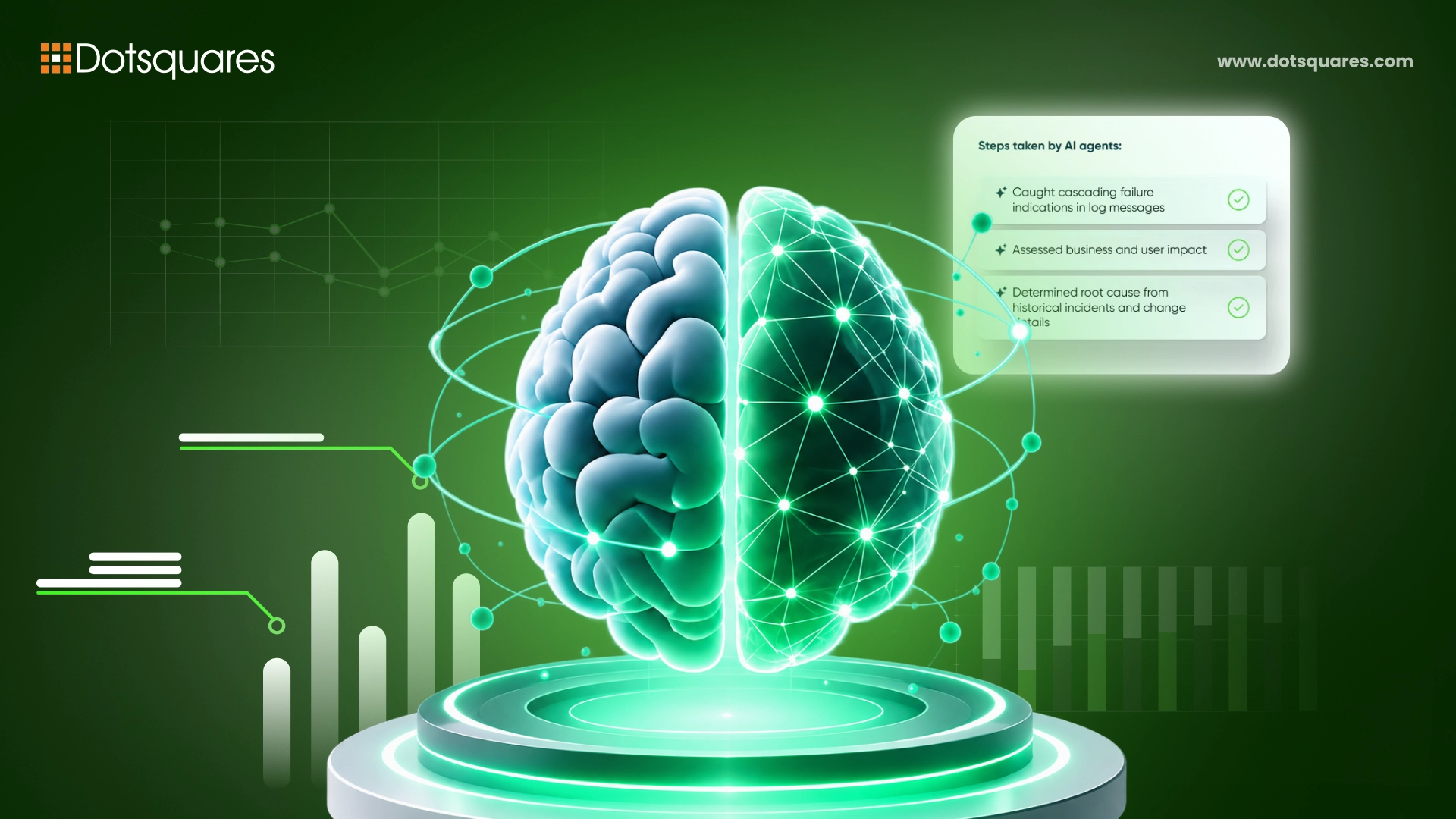
An IT operations team used to measure a good day by how few alerts fired. In 2026, that measure has flipped entirely: a good day is one where the alerts that did fire were the ones that actually mattered. That shift, from drowning in monitoring noise to acting on genuinely useful signal, is the real story behind where ServiceNow ITOM has landed this year, and it's why so many IT leaders are revisiting their ITOM setup right now rather than treating it as a "set it and forget it" platform investment.
If your team is still spending most of its day triaging alerts instead of preventing outages, this is worth a proper look.
What Is ServiceNow ITOM and What Has Changed by 2026?
ServiceNow IT Operations Management (ITOM) is the suite of tools that discovers, maps, monitors, and manages the technology infrastructure a business actually runs on, servers, applications, cloud services, network devices, and everything connecting them. What's changed by 2026 isn't the core purpose; it's how much of the operational decision-making has shifted from human judgment to AI-assisted or fully automated response.
Traditional ITOM told you something had gone wrong. Modern ITOM, layered with predictive AIOps and generative AI assistance, is increasingly telling you something is likely to go wrong before it actually does, and in a growing number of cases, fixing it without a human needing to step in at all.
ServiceNow ITOM Modules: What Each One Actually Does
ITOM isn't one tool, it's a set of connected modules, and understanding what each one actually does matters before planning any implementation or expansion. Discovery builds and maintains an accurate map of every asset and connection in your environment. Service Mapping takes that raw infrastructure data and connects it to the actual business services it supports. Event Management ingests alerts from across your monitoring stack and correlates them into something genuinely actionable. Predictive AIOps applies machine learning to spot patterns and anomalies before they escalate. And Now Assist layers generative AI on top of all of it, summarising incidents, drafting responses, and giving engineers fast context without them having to dig through ticket history manually.
For a deeper breakdown of how these modules fit together, our guide on ServiceNow modules covers the full platform picture beyond ITOM specifically.
ServiceNow Discovery: Building a Reliable View of Your Infrastructure
Everything downstream in ITOM depends on Discovery being accurate. If your Configuration Management Database (CMDB) doesn't reflect what's actually running in your environment, servers that were decommissioned months ago still showing as active, cloud instances spun up last week nowhere to be found, every automation and alert built on top of that data inherits the same inaccuracy. Discovery scans your environment continuously, identifying hardware, software, and the relationships between them, so the rest of ITOM is working from a picture of reality, not a stale snapshot from whenever the last manual audit happened.
Service Mapping: From Infrastructure to Business Services
Knowing a server went down is one thing. Knowing that server going down means your customer-facing checkout page is now broken is what actually matters to the business. Service Mapping is what bridges that gap, connecting individual configuration items back to the actual business services they support, so when something breaks, the team responding understands the real business impact immediately instead of working that out after the fact through separate conversations with three different departments.
How ServiceNow ITOM Monitoring and Event Management Reduce Alert Noise
Here's the question every IT operations leader eventually asks, how do we stop teams from spending their day investigating alerts that don't actually matter? Alert fatigue is a real, well-documented problem, when every monitoring tool fires its own alerts in its own format with no correlation between them, teams end up triaging noise instead of preventing genuine impact.
Event Management addresses this directly by ingesting alerts from across your monitoring stack, SolarWinds, Dynatrace, Datadog, and others, and correlating related alerts into a single, actionable event rather than a dozen disconnected notifications about the same underlying issue. Organisations that properly integrate their monitoring tools into ServiceNow Event Management have reported noise reduction of up to 85%, turning what used to be a flood of low-value alerts into a manageable stream of genuinely actionable ones. A reliable crm software development company can also help businesses build connected systems that support better visibility across customer and operational data.
Where Predictive Intelligence Changes ServiceNow ITOM
This is genuinely the most important shift in ITOM heading through the rest of 2026. Traditional monitoring tells you something is wrong. Predictive Intelligence helps you anticipate what may go wrong, and that difference changes the entire operating rhythm of an IT team.
Anomaly detection flags deviations from normal system behavior before they cross a threshold that would trigger a traditional alert, catching the early signs of a problem while it's still small.
Pattern recognition learns what "normal" actually looks like across your specific environment, rather than relying on static, manually configured thresholds that rarely reflect how a system genuinely behaves under real load.
Incident prediction uses historical data, past incidents, configuration changes, performance trends, to flag a growing likelihood that a specific service is heading toward an outage, often well before any conventional alert would fire.
Root-cause analysis correlates event data, configuration changes, and performance metrics together, cutting down the manual investigation time that used to eat hours after every significant incident.
Proactive remediation goes a step further, triggering automated playbooks, restarting a service, clearing disk space, rolling back a change, without waiting for a human to manually diagnose and act.
Predictive Intelligence handles the structured, pattern-based side of this work, while Now Assist, ServiceNow's generative AI layer built on Now LLM v2.0 alongside integrations with models like Azure OpenAI's GPT-4o, Google Gemini, Anthropic's Claude, and AWS Bedrock, handles the unstructured side, summarising ticket histories, drafting knowledge articles, and giving engineers fast, contextual answers. Neither replaces the other; they work as complementary layers on the same platform. Our detailed guide on ServiceNow ITOM predictive intelligence goes considerably deeper into how these two AI layers actually work together in practice.
What AI-Driven IT Operations Actually Look Like in 2026
This isn't a hypothetical future state anymore; it's already running in production at real enterprises. Huntington National Bank, presenting at ServiceNow's Knowledge 2026 conference, described reimagining their monitoring as a predictive, data-driven ecosystem, integrating AIOps with intelligent metrics, anomaly detection, and adaptive thresholds to turn what used to be fragmented monitoring into genuine, proactive insight.
In practice, AI-driven operations in 2026 mean a connection pool exhaustion issue doesn't just trigger an alert to a technician anymore; it triggers an AI agent that investigates the pattern, correlates it against recent changes, and in a growing number of cases, resolves it directly through an automated playbook. Leading ITOM implementations are now targeting benchmarks that would have sounded ambitious even a couple of years ago: autonomous remediation rates above 50% of incidents resolved without human intervention, mean time to detection under 5 minutes, and change success rates above 95% through service maps accurate enough to predict the impact of a change before it's even made.
ServiceNow ITOM Implementation: What Businesses Should Plan First
A successful ServiceNow ITOM implementation doesn't start with AI, it starts with getting Discovery and your CMDB genuinely accurate, since every predictive model and automated playbook built afterward depends entirely on that foundation being solid. From there, the sequence generally runs: integrate your existing monitoring stack and configure intelligent noise reduction, validate Service Mapping for your most business-critical services, and only then move into predictive AIOps and automated remediation for your highest-frequency, best-understood incident types. Trying to jump straight to AI-driven automation on top of an inaccurate CMDB or unmapped services tends to produce automation that's confidently wrong, which is considerably worse than no automation at all.
How Much Business Value Can ServiceNow ITOM Deliver?
Done properly, ITOM delivers value on two fronts at once: dramatically less time spent on manual alert triage and investigation, and measurably fewer and shorter outages thanks to earlier detection and faster, more accurate remediation. Organisations that align ITOM with IT Asset Management on top of this also get a genuine single source of truth spanning both operational health and asset lifecycle, which matters directly for licence optimisation and cost accountability, not just uptime.
When Do You Need ServiceNow Consulting Services for ITOM?
Bringing in ServiceNow consulting services makes the most sense at a few specific points, when your CMDB has drifted from reality and needs a genuine cleanup rather than a patch, when you're integrating a genuinely complex, multi-vendor monitoring stack into Event Management, when you're ready to move from basic alerting into predictive AIOps and need the modeling done properly, or when your existing implementation has grown organically over years and needs a structured health check before adding more automation on top of it. Getting expert ServiceNow software development support at these specific points tends to save considerably more time than it costs, since a poorly configured foundation is far more expensive to unwind later than to get right from the start.
Ready to Get More Out of Your ServiceNow ITOM Investment?
Whether you're just getting Discovery and Service Mapping properly configured, or you're ready to move into predictive AIOps and automated remediation, getting this right depends on the same thing it always has: an accurate, well-maintained foundation underneath the AI. Our team of ServiceNow experts can help assess where your current implementation stands and what's genuinely worth prioritising next. Get in touch with Dotsquares to talk through what your ITOM setup actually needs.


Related Post

 October 16, 2026
E-commerce Security: Protect Your Store From Cyber Threats
Learn how E-commerce security protects your online store from fraud, data breaches, and bots. Explore threats, PCI DSS, and best practices.
Keep Reading October 15, 2026
Low-Code Integration: What It Is, How It Works and When Businesses Should Use It
Learn how low-code integration connects business apps and APIs, its key benefits, common use cases, limitations, and when to choose custom integration.
Keep Reading October 15, 2026
SAP BW to Cloud Migration: Benefits, Challenges and Planning Steps
Learn about SAP BW to cloud migration, including benefits, challenges, AWS options, cost factors and planning steps for a successful migration.
Keep Reading