
Is Your Business AI-Ready?

Tech
 6 min read
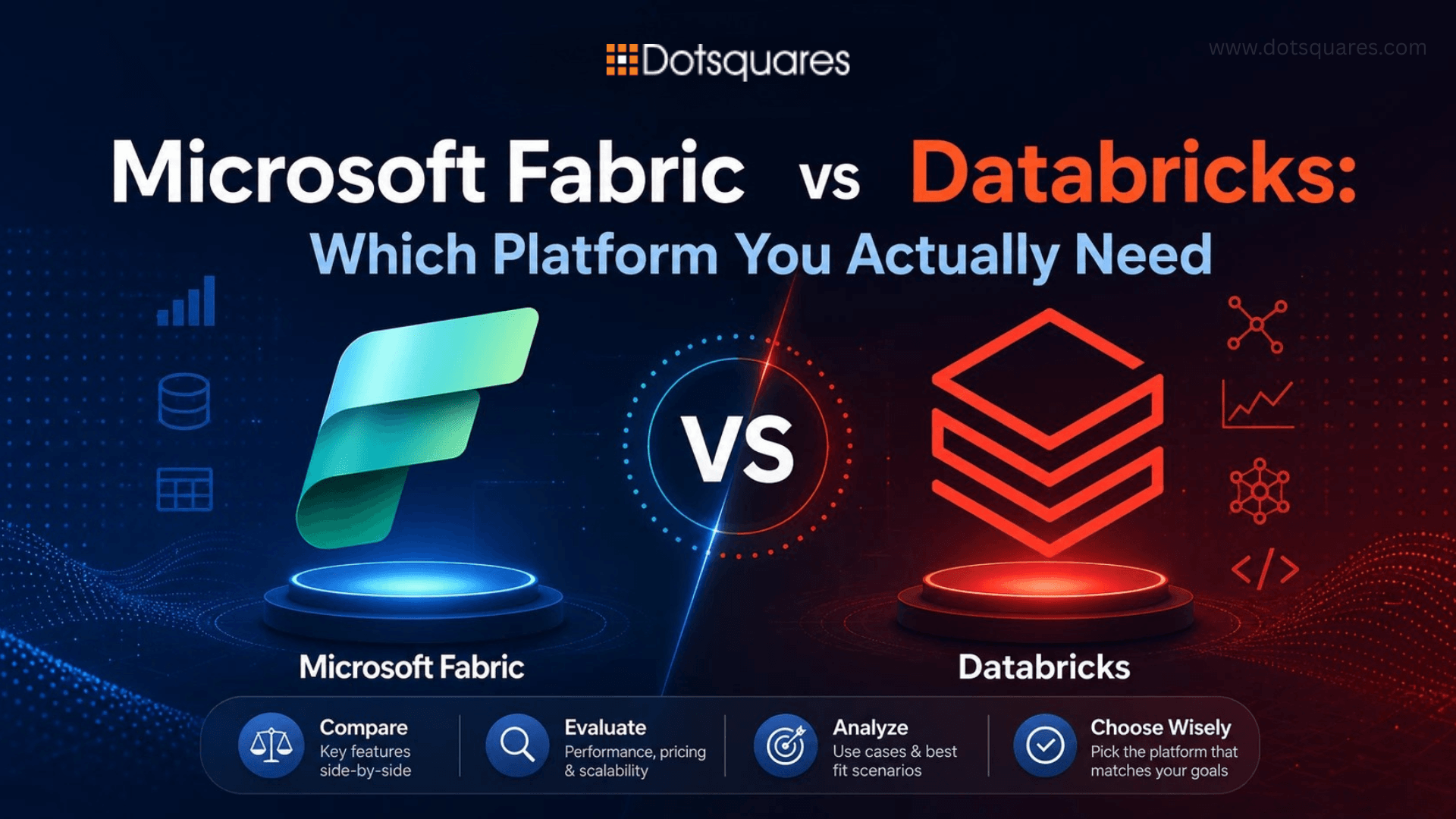
In today’s business scenario, data plays a crucial role in making strategic decisions. Whether it is the collection of customers’ information or internal reporting or predictive analytics, or machine learning, businesses always look for platforms that can manage data efficiently in a profitable way for them.
This is where Microsoft Fabric and Databricks come into the picture.
Both platforms provide the best solutions for data engineering, analytics, business intelligence, and AI. However, both of them are developed for different types of users and business goals. Microsoft Fabric development is based on simplicity, its smooth integration with other Microsoft products and faster adoption by businesses make it suitable for businesses looking for a quick adoption and easy-to-use option. Databricks, on the other hand, is built for advanced engineering, machine learning, and technical flexibility.
Now the question arises, which platform is better for your business?
Both Microsoft Fabric and Databricks are suitable for
However, they differ in their operations.
Microsoft Fabric is an all-in-one SaaS analytics platform that is empowered with the powers of data engineering, data science, Power BI, and real-time analytics in one environment. This platform aims to reduce complexity and help organisations work quickly within the Microsoft platform.
Databricks is a lakehouse platform which is mainly built for large-scale data engineering, machine learning, and AI. This platform helps in performing complex technical tasks with more flexibility, deeper control and stronger support. In simple terms:
Microsoft Fabric = Simplicity + Business Integration
Databricks = Flexibility + Engineering Power
Microsoft Fabric is Microsoft’s unified analytics platform that brings all major data services into one place. It includes:
The most notable benefit of using Microsoft Fabric is its seamless integration. Instead of using different tools separately, teams can work inside one environment with shared governance and better collaboration. As this platform is mainly considered as SaaS, businesses don’t have to worry about managing their infrastructure and spend more time on analysing data for decision-making. The platform is best for organisations using Microsoft products like
When Your Business Is Already Using Microsoft Products: If your teams are already working on Azure, Power BI, and Microsoft 365, then using MS Fabric reduces the problems in its integration with your existing platforms.
Databricks is a unified data and AI platform developed using lakehouse architecture. It is mainly developed for tasks that require extra technical knowledge. It carries the flexibility of data lakes and the power of data warehouses, and is mainly used for
Its biggest strength is control: Databricks makes it easier for technical teams to work smoothly on data architecture, compute optimisation, and advanced AI workflows.
Choosing the right platform should not be based only on features; there are some factors that need to be prioritised. These include
Some businesses choose Databricks consulting service because it looks more powerful, but this can soon become useless if your teams are not able to work smoothly by using it. Similarly, choosing Fabric just because it is simple and easy to use may deprive your teams of enjoying the benefits if your business objective is to scale and expand extensively into advanced AI and ML.
Today, many businesses are adopting platforms together: Databricks for engineering and AI and Fabric for reporting and executive dashboards. Additional factors that businesses should consider are:
Databricks is enriched with both ML and AI capabilities
It offers:
Fabric also supports machine learning, mainly through Azure Machine Learning integration and AI-assisted analytics. However, it mainly aims at simplified adoption instead of deep model engineering.
If the main objective of your business is to deploy AI in your operations, then Databricks is the best option.
Microsoft Fabric uses a capacity-based pricing model.
Advantages:
Issues:
Databricks uses DBU (Databricks Unit) consumption pricing.
Advantages:
Challenges:
An answer to this question is not possible in a single word. If you are looking for simplicity, smooth Power BI integration, predictable pricing and quick adoption, then MS Fabric is the best option.
On the other side, if your objective is advanced machine learning, multi-cloud architecture, open standards and deep engineering flexibility, then it is better to go for Databricks.
There is, however, one more option, which is using both these platforms. Databricks for heavy engineering and AI, and MS Fabric for business intelligence and quick adoption. This option is best for many businesses.
Whether you are looking to introduce advanced AI workflows, or looking to manage large-scale data engineering, or choose the right data platform strategy, hiring the services of an data engineering experts can save you both time and money in building an expandable and efficient analytics ecosystem.


 October 15, 2026
Learn how low-code integration connects business apps and APIs, its key benefits, common use cases, limitations, and when to choose custom integration.
Keep Reading October 15, 2026
Learn about SAP BW to cloud migration, including benefits, challenges, AWS options, cost factors and planning steps for a successful migration.
Keep Reading October 12, 2026
Learn how React Native works, where it saves time and cost, which industries use it, and whether it's still a good choice in 2026.
Keep Reading